

 English
 Français
 Español
 Português
 عربى
عربى






Product Definition:The High-Value Consumables House is not a traditional storage cabinet, but a digital management hub that integrates smart access, precise traceability, and security monitoring. It i...
See DetailsHigh-Value Consumables House: A Digital Management Hub for Safer Medical Supply Control
Content
- 1 The Management Challenge Behind High-Value Consumables
- 2 Product Definition: More Than a Storage Cabinet
- 3 Core Functions That Create Closed-Loop Traceability
- 4 Advantages Over Conventional Cabinets and Competing Solutions
- 5 Clinical Scenario: Urgent Cardiac Stent Retrieval
- 6 Product Capabilities and Operational Benefits
- 7 Manufacturing Strength Behind the Solution
- 8 Advanced Production Processes and Quality Control
- 9 Why Telecommunications Expertise Matters in Medical Digital Infrastructure
- 10 Deployment Flexibility for Different Hospital Environments
- 11 Economic Impact: Cost Reduction Through Better Control
- 12 Medical Safety and Risk Management
- 13 Customization and OEM/ODM Capability
- 14 Global Service Perspective and Long-Term Partnership Value
- 15 Implementation Recommendations for Hospitals
- 16 Future Development of Intelligent Consumables Management
- 17 Q&A: Key Questions About the High-Value Consumables House
- 17.1 What is the High-Value Consumables House?
- 17.2 Which hospital items are most suitable for this product?
- 17.3 How does it improve clinical efficiency?
- 17.4 How does it improve safety?
- 17.5 What advantages does it have over traditional cabinets?
- 17.6 Can it be customized for different hospital departments?
- 17.7 Why is manufacturing experience important for this product?
- 17.8 How does the product help reduce costs?
- 17.9 Where can the unit be placed?
- 17.10 Is the product part of broader hospital digital transformation?
- 18 Conclusion
- 19 References
- 20 Product: High-Value Consumables House
In modern hospitals, high-value medical consumables are no longer simple inventory items. They are critical clinical assets that directly influence surgical safety, treatment quality, financial control, regulatory compliance, and patient outcomes. Implantable devices, cardiac stents, orthopedic implants, specialized catheters, intervention consumables, and expensive diagnostic reagents often carry high unit costs, strict batch requirements, short usage windows, and serious traceability responsibilities. Managing them with manual ledgers, basic shelves, or ordinary cabinets creates delays, data gaps, and avoidable risk. The High-Value Consumables House is designed to solve this challenge by transforming storage into an intelligent, secure, and traceable management environment.
Unlike a traditional storage cabinet, the High-Value Consumables House functions as a digital management hub. It combines smart access control, user identity verification, precise item traceability, intelligent alerts, flexible capacity planning, and security monitoring in one integrated solution. Its purpose is not merely to store supplies, but to control the complete lifecycle of high-value consumables from receipt and storage to retrieval, use, return, review, and replenishment. For hospitals seeking safer operating room supply workflows and more reliable consumables governance, this product represents a significant step toward precision medical management.
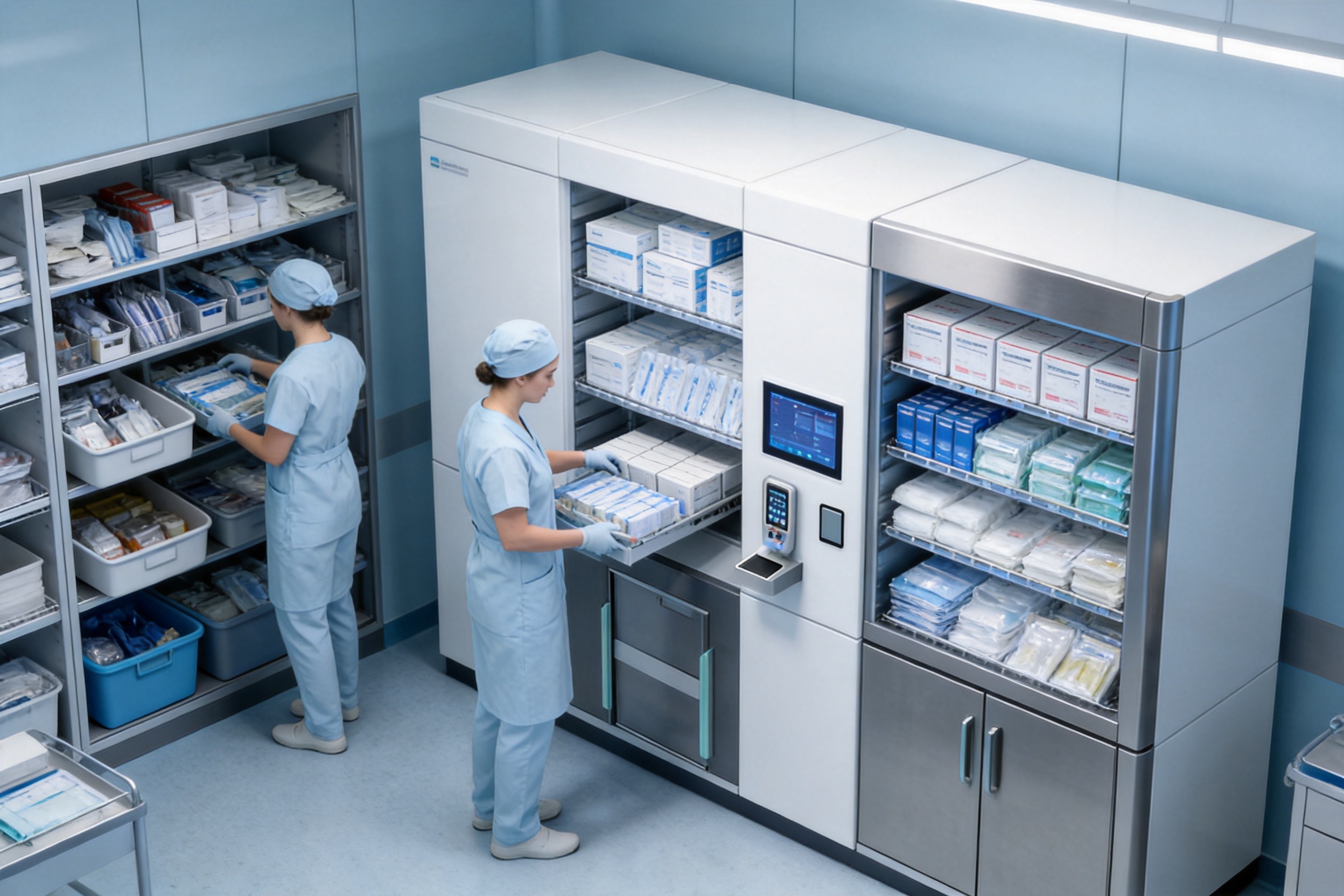
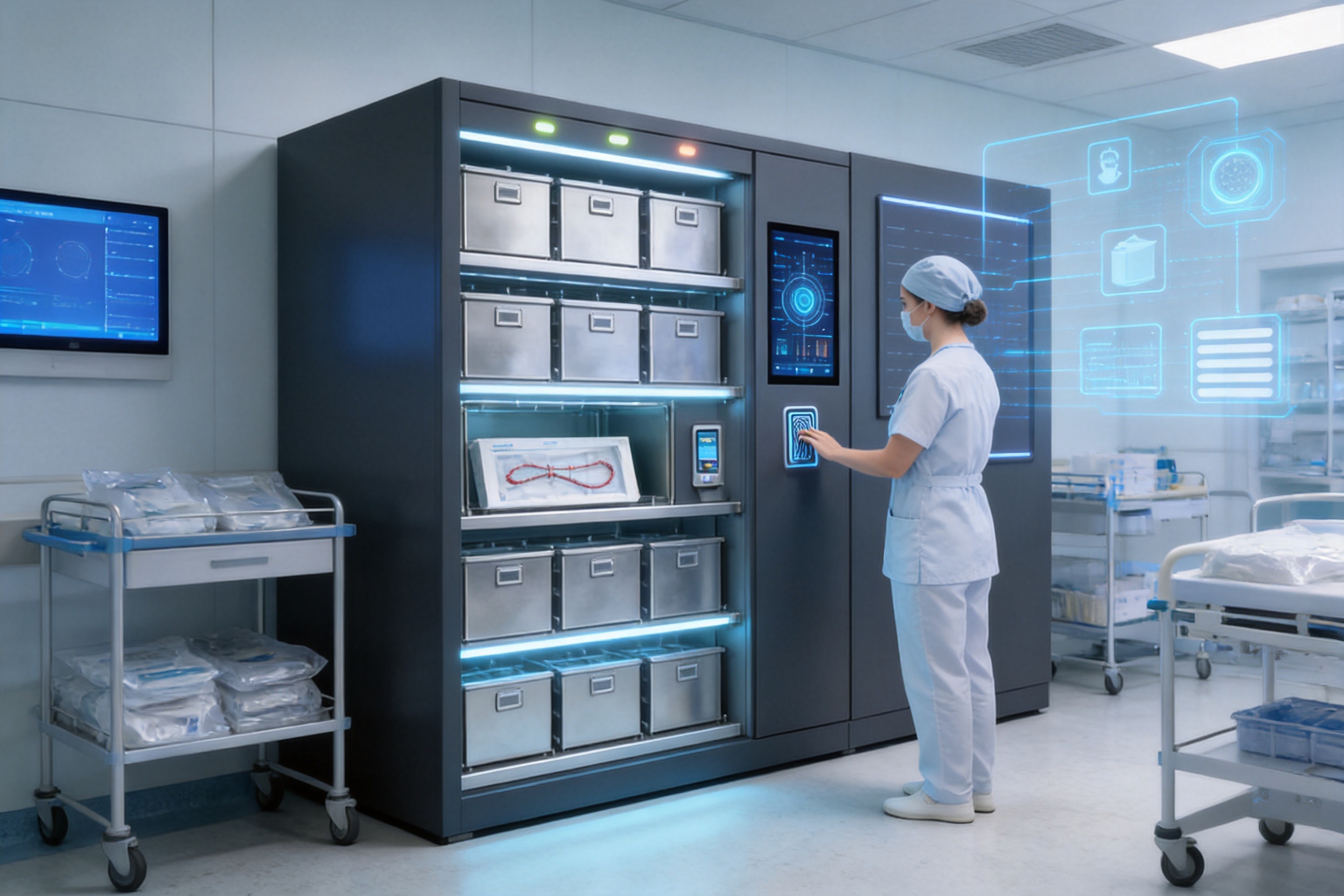
The product is especially suitable for departments where urgent access and accurate accountability must coexist. Operating rooms, interventional centers, catheterization labs, implant storage areas, central supply departments, pharmacy-related high-value reagent zones, and specialized clinical units all need fast retrieval without sacrificing control. In these environments, a nurse or authorized staff member can complete identity verification by fingerprint or card, retrieve the required item within seconds, and allow the system to automatically record the user, time, item information, batch number, and other critical data. This reduces manual workload while strengthening the hospital’s ability to verify who accessed what, when, and for which clinical purpose.
The value of the High-Value Consumables House is therefore twofold. First, it improves efficiency by reducing search time, paperwork, repeated counting, and administrative friction. Second, it improves medical safety by creating a closed-loop traceability chain for critical consumables. When every item is monitored, every access event is recorded, and every abnormal situation can trigger a prompt alert, hospitals gain stronger protection against misallocation, omission, expiration, unauthorized access, and loss. In an era where healthcare institutions must balance clinical performance, cost control, and compliance pressure, intelligent consumables management is becoming a strategic necessity rather than an optional upgrade.
The Management Challenge Behind High-Value Consumables
High-value consumables create a unique management challenge because they sit at the intersection of clinical urgency, financial significance, and regulatory sensitivity. A low-cost general supply may tolerate occasional manual inefficiency, but a high-value implant or specialized device cannot. The wrong item, an expired batch, missing documentation, or delayed retrieval can lead to treatment delays, billing disputes, inventory loss, or patient safety concerns. Hospitals must ensure that these items are immediately available when needed, but also tightly controlled to prevent unauthorized use or inaccurate records.
Traditional management methods often depend heavily on manual registration. Staff members open cabinets, search for the item, write down product details, update spreadsheets, or complete paper forms after the clinical event. During busy surgical schedules, emergency procedures, or staff shift changes, this process is vulnerable to omissions. Even when employees are careful, handwritten records can be incomplete, illegible, delayed, or inconsistent. Later reconciliation then becomes time-consuming, and discrepancies may be difficult to resolve.
Another common problem is decentralized storage without standardized control. High-value consumables may be stored in different rooms, on open shelves, in locked cabinets, or in department-specific boxes. This can create hidden inventory, repeated purchasing, uneven stock distribution, and uncertainty about availability. In urgent surgery, staff may spend valuable minutes searching for the correct specification. In procurement planning, managers may order additional stock because they cannot see accurate real-time inventory. In financial management, delayed consumption records can complicate charge capture and cost accounting.
Expiration and batch traceability are also critical concerns. Many high-value medical supplies have strict validity periods, and some must be traced by lot number, serial number, or product code. If items are not used according to first-expire-first-out principles, hospitals may face avoidable waste. If a recall occurs, locating affected products quickly becomes essential. A manual system may require extensive searching across paper records and physical storage locations. The High-Value Consumables House addresses these concerns by making item identity, access activity, and inventory status digitally visible.
Security is another major issue. High-value consumables are expensive, compact, and clinically sensitive. Unauthorized access, accidental removal, misplaced items, and unrecorded emergency use can all cause financial and operational losses. A simple mechanical lock cannot distinguish between different users, enforce tiered permissions, or automatically record access events. Intelligent access control enables hospitals to define who can open the unit, which items can be accessed, and how usage information is captured. This changes security from passive locking to active management.
Product Definition: More Than a Storage Cabinet
The High-Value Consumables House is best understood as an intelligent management solution rather than a piece of furniture. Its physical structure provides secure and spacious storage, but its core value lies in the digital layer built into the product. This digital layer supports identity recognition, permission control, automatic record generation, alert management, and lifecycle traceability. The system is engineered for critical, high-risk, and high-value supplies within hospitals, with a special emphasis on items that require strict accountability.
The concept of a “house” is important because it implies a managed environment. A normal cabinet simply contains products. A High-Value Consumables House governs them. It organizes access, monitors movement, supports departmental workflows, and produces data that can be used by clinical, logistics, finance, and administrative teams. By turning consumable storage into a controlled digital node, the product helps hospitals move from fragmented manual practices to standardized intelligent management.
In a typical use scenario, an authorized nurse approaches the unit before or during a procedure. The nurse authenticates through fingerprint or card verification. The system recognizes the staff member and checks permission level. After access is granted, the nurse retrieves the required item. The system records the retrieval event, including identity, time, item details, and batch information. Depending on hospital workflow configuration, the record can support later linkage to patient use, department cost allocation, billing review, or replenishment planning. This type of automatic data capture reduces reliance on after-the-fact manual entry.
The product is designed to support both urgent access and strict control. In many hospitals, these goals appear to conflict: if access is too restricted, clinical work slows down; if access is too loose, accountability suffers. The High-Value Consumables House balances the two by allowing authorized retrieval in seconds while keeping a complete digital footprint. This is particularly valuable in operating rooms and interventional departments where time is critical and every consumable must be documented accurately.
Its modular design also allows the system to accommodate different consumable sizes and departmental layouts. High-value medical supplies are not uniform. Some items are small packages, while others are larger kits or specialized components. A flexible internal structure and larger storage space help hospitals arrange items according to clinical use frequency, category, specification, or department preference. The unit can be placed near an operating room for immediate procedural support or in a central management area for controlled distribution. This flexible placement gives hospitals more options than rigid, one-size-fits-all storage systems.
Core Functions That Create Closed-Loop Traceability
Closed-loop traceability means that the hospital can follow a consumable across every critical stage: receiving, storage, access, transfer, clinical use, review, and replenishment. For high-value consumables, this capability is essential. The High-Value Consumables House contributes to this closed loop by ensuring that access is verified, data is recorded, and item status is visible. The result is a management process in which fewer events depend on memory, handwritten notes, or delayed reporting.
Smart access control is the first pillar. By using fingerprint or card-based verification, the system associates each access event with a specific authorized user. This provides accountability and discourages unauthorized handling. Tiered permission settings can be used to distinguish roles. For example, a department nurse, operating room manager, materials administrator, and biomedical supervisor may require different rights. Some users may retrieve items; others may replenish stock; managers may review records; administrators may configure inventory categories and alerts. Such permission layering helps prevent misallocation and improper use.
Precise item recording is the second pillar. High-value consumables often require batch, model, specification, and quantity data. When these details are digitally captured, the hospital gains a more reliable audit trail. If a product recall occurs, management can rapidly identify affected inventory and investigate usage records. If a dispute arises about whether a specific item was used, retrieved, or returned, the access history provides evidence. This data is also useful for consumption analysis, procurement forecasting, and department-level cost management.
Intelligent alerts are the third pillar. Alerts can support inventory thresholds, abnormal access, potential expiration, and replenishment needs. Instead of discovering shortages only during surgery preparation, staff can receive earlier warnings. Instead of finding expired products during periodic manual checks, managers can act before waste occurs. Instead of relying on a single person to notice irregular movement, the system can help expose exceptions. This proactive management style is a key advantage over ordinary cabinets and manual ledgers.
Security monitoring is the fourth pillar. High-value consumables need physical security as well as data security. A secure structure, controlled access, and monitoring capabilities reduce the risk of theft, accidental removal, or unrecorded usage. More importantly, the system creates deterrence because every authorized access event is associated with user identity and time. In a hospital environment, this improves discipline without creating unnecessary friction for legitimate clinical work.
Workflow integration is the fifth pillar. The product is not intended to stand apart from hospital operations; it is designed to become a practical part of daily clinical logistics. Its placement near operating rooms, central consumable zones, or specialized departments allows hospitals to redesign workflows around real-time visibility and authorized retrieval. When paired with internal hospital management practices, the High-Value Consumables House can support standardized receiving, storage, retrieval, return, inventory check, and replenishment procedures.
Advantages Over Conventional Cabinets and Competing Solutions
The most immediate advantage of the High-Value Consumables House is that it changes the management mode. Conventional cabinets primarily solve the problem of physical placement. They offer compartments, locks, and shelves, but they do not create complete digital accountability. Even when locked, a traditional cabinet cannot automatically verify who accessed it, what was removed, which batch was involved, or whether replenishment is needed. By contrast, the High-Value Consumables House treats every access event as a data point in a traceable process.
Compared with manual storage rooms, the product offers stronger operational efficiency. In a manual environment, staff members may spend time searching across shelves, checking product codes, recording details, and later reconciling inventory. The High-Value Consumables House reduces these steps by creating a more structured and digitally supported retrieval process. This is especially important during urgent procedures. When a cardiac stent or implantable device is needed quickly, every minute matters. A nurse who can verify identity and retrieve the item in seconds can support faster clinical response.
Compared with ordinary smart cabinets, the High-Value Consumables House emphasizes larger storage space and flexible placement. Some intelligent cabinets are designed for smaller items or limited departmental use. High-value hospital consumables, however, vary widely in size, packaging, and usage patterns. A larger and modular structure allows hospitals to store more categories and specifications in one controlled environment. This reduces the need for scattered storage and improves inventory visibility.
Another advantage is the product’s focus on high-risk and high-value medical scenarios. Some competitors offer generic inventory cabinets that can be used in many industries, but medical consumables require specialized thinking. Hospital workflows involve emergency retrieval, sterile package handling, batch traceability, expiration management, department cost allocation, and clinical accountability. The High-Value Consumables House is positioned specifically for these needs, making it more suitable for healthcare environments than generic electronic lockers or simple warehouse automation tools.
Tiered permissions provide a competitive advantage because they align with hospital management structures. Different roles require different levels of access. Without tiered permissions, a storage system may become either too open or too restrictive. Too much openness increases risk; excessive restriction slows clinical work. The High-Value Consumables House enables a balanced model in which authorized staff can act quickly while managers maintain oversight. This supports both clinical speed and administrative control.
Intelligent alerts also distinguish the solution. A traditional storage system only tells staff what is present when someone physically checks it. An intelligent alert mechanism allows the hospital to move toward exception-based management. Managers do not need to manually inspect every item every day to discover shortages, expiration risk, or abnormal usage. Instead, the system can help direct attention to the items that require action. This saves labor and reduces the chance that critical issues remain hidden until they affect patient care.
The product also supports cost reduction. High-value consumables represent a significant portion of hospital material expenditure. Poor visibility can lead to overstocking, emergency purchasing, expired inventory, missed billing, and untraceable loss. By improving accuracy and accountability, the High-Value Consumables House helps hospitals control these costs. It does not reduce cost by limiting clinical care; it reduces cost by improving process quality. Better inventory data enables more precise procurement, fewer redundant purchases, and improved stock rotation.
From a safety perspective, closed-loop traceability is a major differentiator. In the event of a recall, adverse event investigation, or internal audit, hospitals need reliable records. If the system can show access history and item details, staff can respond more quickly and confidently. Competitors that only provide locked storage cannot support this level of traceability. Even systems with partial digital functions may fall short if they do not connect user identity, time, item information, and management alerts into a coherent process.
Clinical Scenario: Urgent Cardiac Stent Retrieval
Consider an operating room or catheterization lab where an urgent procedure requires a cardiac stent. In a traditional storage environment, a nurse may need to locate the correct cabinet, unlock it, search among similar packages, confirm specifications, write down the batch number, and notify materials staff afterward. If the procedure is time-sensitive, documentation may be delayed until after the patient is stabilized. This is understandable in clinical reality, but it creates a gap between actual use and recorded data.
With the High-Value Consumables House, the workflow becomes more controlled and efficient. The nurse authenticates by fingerprint or card. Because the system recognizes the user, access is linked to staff identity. The nurse retrieves the required item from an organized, secure, and monitored storage environment. The system records the access time and relevant product information. Manual logging is reduced, and the clinical team can focus on the patient rather than paperwork.
This scenario illustrates why the product is not simply a convenience tool. It contributes to patient safety by ensuring that the right item can be retrieved quickly and that critical information is captured accurately. If the consumable later needs to be linked to patient records, billing, department consumption, or recall tracking, the access data creates a foundation for that process. The hospital gains speed at the point of care and traceability after the event.
The same logic applies to orthopedic implants, vascular intervention consumables, high-cost surgical kits, and expensive reagents. Any item that is costly, clinically important, or traceability-sensitive can benefit from a storage environment that combines rapid access with digital accountability. The product’s modular structure allows the hospital to adapt the interior arrangement to these different supply types rather than forcing all items into a fixed cabinet format.
Product Capabilities and Operational Benefits
| Capability | Operational Meaning | Hospital Benefit |
|---|---|---|
| Fingerprint or card verification | Access is linked to an authorized user identity | Improves accountability and reduces unauthorized handling |
| Tiered permission control | Different staff roles can receive different access rights | Balances fast clinical access with management oversight |
| Automatic access recording | User, time, item, and batch information can be captured | Reduces manual logging and supports audit traceability |
| Intelligent alerts | Exceptions such as low stock or abnormal access can be highlighted | Helps prevent shortages, omissions, and inventory loss |
| Larger modular storage | Different consumable sizes and categories can be accommodated | Supports flexible departmental deployment and cleaner organization |
| Security monitoring | Physical storage is combined with digital access supervision | Strengthens protection for expensive and sensitive medical supplies |
| Flexible placement | The unit can be positioned near clinical or central management areas | Adapts to hospital workflow and space planning needs |
Manufacturing Strength Behind the Solution
A high-value medical consumables management system must be reliable not only in software logic but also in physical construction. Hospitals operate continuously, and storage equipment may be accessed many times per day. Doors, locks, sensors, electronic modules, structural frames, wiring, and control components must work consistently under demanding conditions. The manufacturing strength behind the High-Value Consumables House is therefore a critical part of its value.
Wanma Technology Co., Ltd. was established in 1997 and has long specialized in communication cabinets, communication electronic equipment, and passive optical components. This background is highly relevant to the development of intelligent medical storage equipment. Telecommunications infrastructure products require stable cabinets, precise assembly, dependable electronic integration, environmental durability, cable management, standardized production, and long-term operating reliability. These capabilities translate well into the design and production of digital medical consumables management equipment.
The company’s experience in communication cabinets supports strong structural design. Cabinet manufacturing demands precision in metal processing, frame stability, surface treatment, component fit, door alignment, ventilation planning, and installation convenience. For a High-Value Consumables House, similar strengths are needed to ensure secure storage, large capacity, modular arrangement, and durable daily use. A unit that handles expensive medical supplies must feel robust, open smoothly, support organized internal placement, and maintain consistent performance over time.
Electronic equipment manufacturing experience is equally important. Smart access systems require reliable circuits, identity verification modules, control boards, power supply design, data interfaces, and internal wiring. The equipment must integrate mechanical security with digital logic. Manufacturing teams with a background in telecom electronic products understand the importance of stable signal transmission, component compatibility, assembly consistency, testing procedures, and fault reduction. This contributes to the reliability of the finished medical management product.
Passive optical component expertise also reflects precision manufacturing culture. Optical communication networks require careful component handling, accuracy, and quality control. While a medical consumables house is a different product category, the discipline of producing network infrastructure components supports a mindset of precision, repeatability, and quality assurance. Hospitals benefit when a manufacturer applies telecommunications-grade attention to stability and detail to medical storage systems.
The company’s products are widely used in Ethernet networks, optical communication networks, central equipment rooms, national high-speed railways, and urban rail transit systems. These application environments require long service life, stable performance, and dependable supply. Experience serving such infrastructure sectors indicates an ability to manufacture equipment that must operate under serious reliability expectations. When applied to hospital intelligent management solutions, this background helps create confidence that the product is built for professional use rather than light-duty storage.
Advanced Production Processes and Quality Control
The manufacturing of an intelligent consumables management unit involves multiple coordinated processes. Structural fabrication, surface finishing, electronic integration, software configuration support, assembly, inspection, functional testing, packaging, and delivery all influence final quality. A manufacturer with mature production experience can control these processes more effectively, reducing variation and improving reliability.
Structural production begins with design translation. The product must accommodate larger storage space while maintaining a stable footprint and secure enclosure. Materials must be processed accurately so that compartments, frames, doors, access modules, and internal fixtures align correctly. Precision cutting, forming, joining, and finishing help ensure that the cabinet structure is strong and consistent. Good structural quality also affects the user experience: doors close properly, access points remain aligned, and modules can be arranged cleanly.
Surface treatment is important in hospital environments. Equipment used near clinical departments should present a clean, professional appearance and support routine maintenance. A well-managed finishing process can improve corrosion resistance, durability, and visual quality. Consistent coating and finishing also reflect the manufacturer’s process discipline. While the High-Value Consumables House is a digital system, the physical surface is what hospital staff interact with every day, so it must be both practical and professional.
Electronic integration requires careful assembly. Access verification modules, control units, displays or indicators, locks, sensors, and wiring must be installed in a manner that supports stable operation. Poor wiring or inconsistent assembly can lead to faults that disrupt clinical workflows. Telecommunications manufacturing experience helps in this area because communication equipment often involves dense electronic integration and strict attention to signal and power stability. Applying similar methods to medical storage systems helps improve dependability.
Functional testing is another essential process. Before delivery, the unit should be checked for access control operation, authentication response, locking performance, alert functions, data recording behavior, and general mechanical reliability. Testing reduces the chance that installation teams or hospital users discover problems after deployment. For hospitals, reliable commissioning is important because storage systems are often introduced into active clinical environments where downtime is difficult to tolerate.
Quality control also includes consistency across customized orders. Hospitals may require different internal layouts, sizes, permission settings, storage categories, or deployment locations. The company’s experience in providing integrated solutions for customized products supports this flexibility. Customization is not merely changing dimensions; it requires understanding how the product will be used, how departments manage supplies, and how physical and digital features should match workflow. A mature OEM and ODM capability allows the manufacturer to adapt the solution while maintaining controlled production standards.
Timely delivery is part of manufacturing strength. Hospitals planning supply chain upgrades need predictable project timelines. Delays can affect department renovation, system implementation, and staff training. A company with an established production base, long industry history, and sales network across more than 20 countries and regions is better positioned to manage production coordination and delivery commitments. This matters for large hospital projects or multi-site deployments.
Why Telecommunications Expertise Matters in Medical Digital Infrastructure
At first glance, telecommunications products and medical consumables management may appear unrelated. However, both fields depend on infrastructure reliability. Telecommunications cabinets and network equipment protect critical connectivity assets. Medical consumables management systems protect critical clinical assets. Both require secure enclosures, organized internal layouts, stable electronic control, scalable deployment, and long-term operational dependability.
Telecommunications infrastructure also teaches manufacturers how to design for standardization and modularity. Network systems must be installed in different rooms, buildings, transportation environments, and central equipment areas. This experience supports the flexible placement concept of the High-Value Consumables House. Hospitals also have varied spaces: some units may be placed beside operating rooms, while others may be located in central consumables warehouses or specialized departments. A manufacturer familiar with infrastructure deployment can better understand these spatial and operational differences.
Another shared principle is traceable asset control. In telecom environments, equipment rooms contain valuable components that must be organized, documented, and maintained. In hospitals, high-value consumables require even more immediate clinical accountability. The transition from communication equipment management to intelligent medical consumables management is therefore a natural extension of digital infrastructure thinking. The High-Value Consumables House can be understood as a medical infrastructure node: it stores, protects, records, and supports the movement of critical supplies.
Telecommunications manufacturing also emphasizes durability because network equipment often remains in service for extended periods. Hospitals likewise need equipment that can endure frequent use. A smart cabinet that fails often creates more problems than it solves. By applying established production discipline from communication cabinets and electronic equipment, the manufacturer can deliver a medical product with stronger structural confidence and practical reliability.
Deployment Flexibility for Different Hospital Environments
The High-Value Consumables House is designed to be placed flexibly according to department needs. This is a major advantage because hospital layouts differ widely. Some hospitals prefer decentralized access near clinical areas to support rapid retrieval. Others prefer centralized management to strengthen control and reduce duplicated stock. Many hospitals need a hybrid approach, with central storage for reserve inventory and department-level units for immediate use. The product’s flexible placement supports all of these models.
In operating room areas, the unit can support fast access to surgical implants, intervention consumables, and urgent high-cost items. Its smart verification and automatic records reduce the administrative burden on nurses, especially during high-pressure cases. In interventional centers, the system can help manage catheters, stents, guidewires, balloons, and other specialized products that vary by specification. Accurate access recording is particularly useful because these items may be selected during a procedure based on real-time clinical judgment.
In central management areas, the High-Value Consumables House can support stronger stock governance. Central teams can organize items by category, batch, expiration date, department, or supplier. They can use access records and alerts to manage replenishment and reduce hidden inventory. A central deployment can also improve purchasing discipline by giving administrators better visibility into actual usage patterns.
In reagent or specialized diagnostic storage areas, the product can help manage expensive items that require careful tracking. While storage conditions must be matched to product requirements, digital access control and traceability can still provide value for items where accountability and cost control are important. The modular design makes it possible to adapt the internal organization to different package types and departmental routines.
Flexible placement also supports phased implementation. A hospital may begin with one department, evaluate workflow improvements, and then expand to additional areas. Because the product is a management hub rather than a single-purpose cabinet, it can become part of a broader hospital digital transformation strategy. Over time, the hospital can standardize high-value consumables management across multiple clinical zones.
Economic Impact: Cost Reduction Through Better Control
High-value consumables are expensive, and small management errors can create large financial consequences. A single missing implant, expired device, or unbilled item may represent substantial cost. Across a hospital, repeated small inefficiencies can accumulate into significant waste. The High-Value Consumables House supports cost reduction by improving visibility, accountability, and process discipline.
One source of savings is reduced inventory loss. When access is controlled and recorded, items are less likely to disappear without explanation. Staff members know that retrieval is associated with identity and time, which encourages proper procedure. Managers can investigate discrepancies more easily because they have a record trail. This does not only prevent intentional loss; it also reduces accidental misplacement and unrecorded emergency removal.
Another source of savings is better stock rotation. Intelligent alerts and digital records can support more disciplined use of inventory before expiration. High-value consumables that expire on shelves represent direct financial waste. By improving visibility into item status, hospitals can prioritize use, transfer stock between departments if appropriate, and adjust purchasing behavior. Better rotation is especially important for items with specialized specifications and unpredictable demand.
Procurement planning also improves when usage data becomes more accurate. Manual systems often produce distorted consumption patterns because records are delayed or incomplete. With automatic access recording, managers can better understand which items are used frequently, which are rarely used, and which departments consume specific categories. This helps reduce overstocking and emergency purchasing. It also supports supplier negotiation and budget planning.
Charge capture may also benefit. In many hospitals, high-value consumables need to be associated with patient treatment and billing processes. If usage records are incomplete, billing omissions or disputes may occur. While the High-Value Consumables House is not a billing system by itself, its traceable access data can strengthen the foundation for accurate charge management when aligned with hospital procedures.
Labor efficiency is another economic benefit. Nurses and materials staff spend substantial time searching, counting, documenting, and reconciling consumables. Reducing these manual tasks allows clinical staff to focus more on patient care and allows materials managers to focus on higher-value supply chain analysis. In busy departments, even small time savings per retrieval can become meaningful over hundreds or thousands of access events.
Medical Safety and Risk Management
The most important benefit of intelligent high-value consumables management is improved medical safety. Cost control matters, but hospitals ultimately adopt such systems to protect patients and strengthen clinical reliability. The High-Value Consumables House supports safety by making it easier to retrieve the correct item, verify product information, and trace usage history.
Wrong-item risk is reduced when storage is structured and access is controlled. High-value consumables may have similar packaging but different sizes, models, or specifications. A well-organized storage system helps staff locate the correct item more quickly and reduces confusion. Digital records further support accountability when items are selected and used.
Expiration risk is also reduced. Expired medical consumables can create serious safety issues and regulatory concerns. Manual checking is labor-intensive and prone to oversight, especially when departments hold large and varied inventories. Intelligent alerts and better inventory visibility help managers act before expiration becomes a clinical risk.
Recall response is strengthened through batch traceability. If a supplier or regulatory authority identifies a problem with a batch, the hospital must quickly determine whether affected items remain in stock or have been used. The High-Value Consumables House helps preserve the data needed for this investigation. Faster recall response protects patients and reduces administrative uncertainty.
Unauthorized access risk is reduced through identity verification and permissions. Not every staff member should be able to access every high-value item. A tiered system supports role-based governance without requiring constant manual supervision. This is especially useful during shift changes, night operations, and emergency situations where traditional oversight may be limited.
The product also supports a culture of responsibility. When hospital staff understand that access is traceable and procedures are standardized, compliance improves naturally. The system becomes a practical tool for reinforcing safe behavior. Instead of relying only on policy documents, hospitals can embed safety controls into daily workflow.

Customization and OEM/ODM Capability
Hospitals do not all manage consumables in the same way. A large tertiary hospital may need multiple units across operating rooms, interventional centers, and central warehouses. A specialized hospital may focus on a narrower range of implants or reagents. A newly built facility may want the system integrated into a broader digital logistics plan. An established hospital may need equipment that fits existing rooms and workflows. Customization is therefore essential.
Wanma Technology Co., Ltd. develops, manufactures, and markets its own branded products while also providing integrated solutions for customized products. This OEM and ODM capability is valuable for hospital projects because the High-Value Consumables House can be adapted to specific storage volumes, internal structures, access methods, departmental workflows, and deployment strategies. Customization helps ensure that the system fits the hospital rather than forcing the hospital to redesign itself around a rigid product.
Customization may include internal compartment planning for different consumable sizes, modular layouts for multiple categories, access permission configuration, exterior dimensions suited to room constraints, and workflow-specific record fields. It may also include project-level coordination for multi-department deployment. A manufacturer with experience in customized digital infrastructure solutions can communicate with hospital stakeholders, understand technical requirements, and translate them into manufacturable solutions.
Strong customization capability also gives the product an advantage over competitors that offer only standardized cabinets. A standardized cabinet may work for simple storage, but high-value consumables management often requires alignment with local practice. For example, one department may need rapid access to a small number of urgent items, while another may need controlled storage for a broad range of specifications. A flexible product platform can serve both scenarios.
From a manufacturing perspective, customization must be controlled. Uncontrolled customization can lead to inconsistent quality, long delivery times, and difficult maintenance. The company’s long experience in communication cabinets and electronic equipment provides a foundation for modular customization: adapting structure and configuration while maintaining disciplined production processes. This balance is important for hospitals that need both tailored functionality and dependable quality.
Global Service Perspective and Long-Term Partnership Value
Wanma Technology has a sales network covering more than 20 countries and regions, including the United States, Australia, the United Kingdom, Italy, South Africa, and Ghana. This international experience indicates an ability to respond to different market requirements, project expectations, and delivery environments. For medical institutions and distributors considering intelligent consumables management solutions, global service perspective is important because digital infrastructure products often require long-term cooperation rather than one-time purchase.
A High-Value Consumables House is not a disposable item. It becomes part of hospital operations. Therefore, buyers should consider not only the product features but also the manufacturer’s ability to support customization, production continuity, quality consistency, and delivery reliability. A company with decades of manufacturing history and experience serving infrastructure industries can offer stronger partnership value than a supplier focused only on low-cost cabinet assembly.
Long-term partnership is also important as hospital needs evolve. A hospital may begin with high-value implant management, then expand to more departments, add new consumable categories, or refine permission policies. A capable manufacturer can support this evolution with additional units, design improvements, and customized configurations. The value of the product grows when it becomes part of a scalable management ecosystem.
The company’s mission emphasizes creating satisfaction for customers, fulfillment for employees, and value for society. In the context of medical consumables management, this mission aligns with practical outcomes: helping hospitals reduce waste, improve safety, and support better patient care. Intelligent infrastructure becomes meaningful when it improves real work for nurses, managers, clinicians, and patients.
Implementation Recommendations for Hospitals
Hospitals considering the High-Value Consumables House should begin with a clear inventory assessment. Managers should identify which items are high-value, high-risk, frequently used, expiration-sensitive, or recall-sensitive. This may include implants, stents, intervention consumables, specialized surgical items, and expensive reagents. Categorizing items before deployment helps determine the appropriate storage layout, capacity, and permission structure.
The next step is workflow mapping. Hospitals should document how items are received, stored, requested, retrieved, used, returned, charged, and replenished. This reveals where manual delays and data gaps occur. The High-Value Consumables House should then be configured to reduce those gaps. For example, if urgent retrieval is the main problem, placement near clinical areas may be preferred. If inventory loss is the main problem, central controlled storage may be more important.
Permission planning is essential. Hospitals should define user roles clearly. Nurses, department heads, materials managers, procurement staff, and administrators may require different access rights. Tiered permissions should match real responsibilities. Excessive restrictions may frustrate clinical users, while excessive openness may weaken control. The best approach is to create practical rules that support daily work while preserving accountability.
Staff training should focus on both operation and purpose. Users need to know how to authenticate, retrieve items, respond to alerts, and follow procedures. They should also understand why the system matters: faster access, safer traceability, reduced waste, and better patient protection. When staff see the system as a tool that helps them rather than a monitoring burden, adoption improves.
Hospitals should also establish review routines. Managers can periodically analyze access records, inventory levels, alert history, and discrepancy reports. These reviews can identify usage trends, abnormal patterns, overstocked items, and training needs. The High-Value Consumables House provides data, but management action turns data into improvement.
Future Development of Intelligent Consumables Management
The High-Value Consumables House reflects a broader trend in healthcare: the transformation of physical assets into digital management nodes. Hospitals are increasingly expected to know where critical supplies are, who accessed them, how they were used, and whether inventory is adequate. Manual systems cannot easily meet these expectations at scale. Intelligent storage solutions will become more important as hospitals pursue precision medicine, refined cost management, and stronger compliance.
Future development may include deeper integration with hospital information systems, procurement platforms, patient billing processes, and clinical documentation workflows. The more connected the storage environment becomes, the more complete the consumables lifecycle can be. However, successful digital transformation begins with reliable physical and access-control foundations. The High-Value Consumables House provides that foundation by securing items, verifying users, recording activity, and supporting alerts.
Artificial intelligence and data analytics may eventually enhance demand forecasting, abnormal usage detection, and inventory optimization. For example, historical usage patterns could support smarter replenishment suggestions. Department-level consumption data could help identify variation in clinical practice or purchasing needs. Expiration analysis could reduce waste. These future possibilities depend on accurate data capture at the point of storage and access, which is exactly what intelligent consumables management equipment enables.
As healthcare systems become more accountable, traceability will continue to gain importance. High-value consumables often have direct patient impact, and hospitals must be able to demonstrate responsible management. Intelligent access records, batch traceability, and security controls help institutions meet this expectation. The High-Value Consumables House is therefore not only a current operational improvement but also a platform for future digital healthcare logistics.
Q&A: Key Questions About the High-Value Consumables House
What is the High-Value Consumables House?
It is an intelligent management solution for critical, high-risk, and high-value medical consumables. Instead of functioning as a traditional storage cabinet, it serves as a digital management hub that combines smart access, traceability, security monitoring, modular storage, and intelligent alerts.
Which hospital items are most suitable for this product?
It is suitable for implantable devices, cardiac stents, orthopedic implants, interventional consumables, expensive reagents, specialized surgical supplies, and other items that require strict accountability, high security, and accurate batch tracking.
How does it improve clinical efficiency?
Authorized staff can verify identity by fingerprint or card and retrieve needed items quickly. The system reduces manual searching and logging, allowing nurses and clinical teams to focus more on patient care, especially during urgent procedures.
How does it improve safety?
The product supports closed-loop traceability by recording access identity, time, item information, and batch details. It helps reduce wrong-item risk, expiration risk, unauthorized access, and incomplete documentation. It also supports faster recall response and audit review.
What advantages does it have over traditional cabinets?
Traditional cabinets mainly provide physical storage and basic locking. The High-Value Consumables House adds digital identity verification, tiered permissions, automatic records, intelligent alerts, larger modular storage, and security monitoring. This creates a more complete management system rather than simple storage.
Can it be customized for different hospital departments?
Yes. The product can be adapted to different storage capacities, internal layouts, placement needs, and access management models. This is useful because operating rooms, interventional centers, central warehouses, and reagent areas often have different workflows.
Why is manufacturing experience important for this product?
The product combines structural storage, electronic control, access verification, and daily operational reliability. A manufacturer with experience in communication cabinets, electronic equipment, and digital infrastructure can provide stronger structural design, stable electronic integration, disciplined quality control, and dependable customization.
How does the product help reduce costs?
It reduces costs by improving inventory visibility, lowering loss risk, supporting better stock rotation, reducing expired inventory, improving procurement planning, and decreasing manual reconciliation work. It helps hospitals control high-value consumables through process accuracy rather than simple restriction.
Where can the unit be placed?
It can be placed near operating rooms, in interventional departments, in central consumables management areas, or in specialized storage zones depending on hospital workflow. Its flexible placement is one of its important practical advantages.
Is the product part of broader hospital digital transformation?
Yes. It turns physical consumables storage into a digital management node. By capturing accurate access and inventory data, it supports future integration, analytics, refined cost control, and more advanced hospital logistics management.
Conclusion
The High-Value Consumables House addresses one of the most important challenges in modern hospital operations: how to make critical medical supplies immediately available while ensuring strict traceability, security, and cost control. It goes beyond traditional storage by combining smart access, identity verification, automatic records, tiered permissions, intelligent alerts, modular capacity, and flexible placement. For operating rooms, interventional centers, central management areas, and specialized departments, it offers a practical path toward safer and more efficient consumables management.
Its competitive strength lies in its ability to create a new management mode. Hospitals no longer need to depend solely on manual ledgers, scattered cabinets, and after-the-fact reconciliation. Instead, they can use a digital hub that records access, supports accountability, and helps managers act before problems become clinical or financial risks. This makes the product valuable not only for efficiency but also for patient safety and administrative confidence.
The manufacturing foundation behind the solution further strengthens its value. With decades of experience in communication cabinets, communication electronic equipment, passive optical components, and customized digital infrastructure solutions, Wanma Technology Co., Ltd. brings structural reliability, electronic integration capability, quality discipline, and customization strength to the medical consumables management field. This combination of product intelligence and manufacturing depth helps differentiate the High-Value Consumables House from ordinary cabinets and generic inventory systems.
As hospitals continue to pursue precision medicine, refined supply chain management, and safer clinical workflows, intelligent high-value consumables management will become increasingly essential. The High-Value Consumables House offers a forward-looking solution that protects valuable supplies, supports clinical speed, improves traceability, and empowers hospitals to manage every critical item with greater confidence.
References
Association for Healthcare Resource and Materials Management. Healthcare Supply Chain Best Practices and Inventory Control Principles.
World Health Organization. Medical Device Regulations: Global Overview and Guiding Principles.
International Organization for Standardization. Quality Management Systems and Risk-Based Process Control Guidelines.
Healthcare Financial Management Association. Cost Management Strategies for Hospital Supply Chains.
U.S. Food and Drug Administration. Medical Device Tracking and Recall Management Guidance.
Journal of Healthcare Operations Management. Studies on Automated Inventory Systems and Clinical Workflow Efficiency.
Product: High-Value Consumables House
PREV:Electronic Fence for Intelligent Clean-Area Access and Uniform Management
NEXT:Rack-Type Data Center for Modular, High-Density Digital Infrastructure
NEXT:Rack-Type Data Center for Modular, High-Density Digital Infrastructure
Interested in cooperation or have questions?
Related products
-
-
Product DefinitionThe Wanma Intelligent Access Control System is an integrated security management terminal combining high-definition display, biometric recognition, and smart monitoring functions. Fe...
See Details -
Product Definition This product is a high-capacity intelligent consumables management cabinet designed for hospitals, laboratories, and medical institutions, integrating RFID technology, smart access ...
See Details -
Product Overview: The ZW□-12/T630-25 outdoor high-voltage AC vacuum circuit breaker is a key device designed for 12 kV overhead distribution lines. By deeply integrating the primary switching unit wi...
See Details
Ready to Get started ? Contact Us Now !

Product.
Contact Details.
-
 +86 13958188250
-
 +86 13958188250
-
 [email protected]
- Wanma Industrial Park Taihu Yuan Town Lin'an District Hangzhou City China.
QR Code

Copyright © Wanma Technology Co., Ltd. All Rights Reserved.
Custom Ethernet Optical Network Railway Transit Equipments Suppliers
