

 English
 Français
 Español
 Português
 عربى






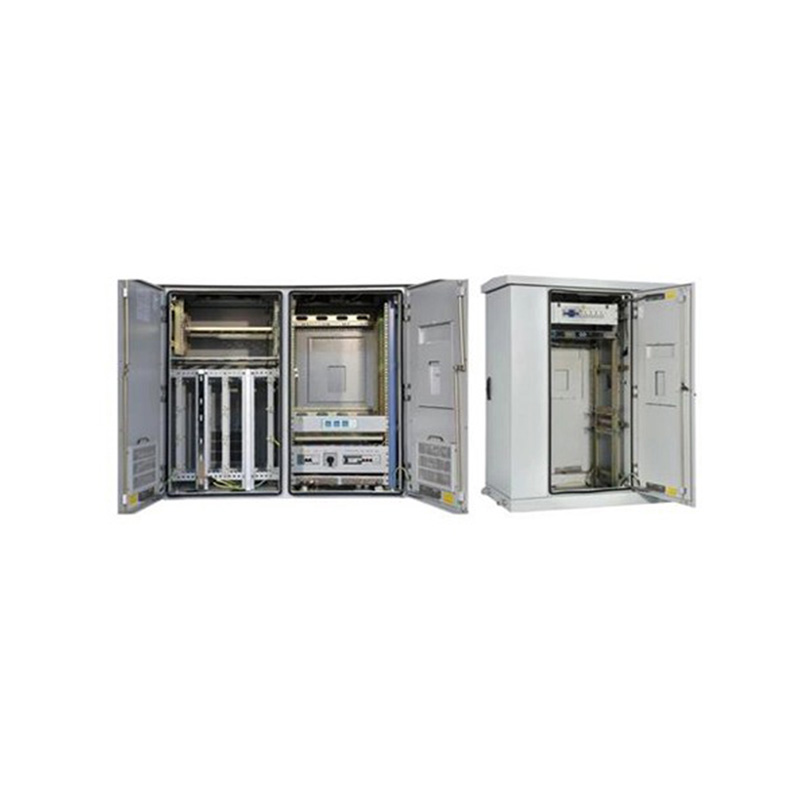
Application:It is used for the fixed network and broadband access, providing physical working environment and security system for the workstation in wired network. Features:•The cabinet is composed of...
See DetailsQuick Connectors for Bow-Type Fiber Cables: Reliable Field Termination for Modern Optical Networks
Content
- 1 1. The Role of Quick Connectors in Fiber Network Deployment
- 2 2. Product Overview and Main Application Areas
- 3 3. Optical Performance Designed for Stable Transmission
- 4 4. Repeatable Installation and Field Productivity
- 5 5. Hot-Melt Quick Connector Technology
- 6 6. Advantages Over Conventional Field Termination Methods
- 7 7. Manufacturing Strength and Process Control
- 8 8. Use in Telecommunications and FTTH Modernization
- 9 9. Use in Railway and Urban Transit Communication Systems
- 10 10. Installation Guidance for Reliable Results
- 11 11. Maintenance, Reinstallation, and Lifecycle Value
- 12 12. Customization and Integrated Network Solutions
- 13 13. Supply Reliability and International Service Capability
- 14 14. Selection Considerations for Project Engineers
- 15 15. Frequently Asked Questions
- 15.1 Q1: What type of cable is this quick connector designed for?
- 15.2 Q2: Where can the connector be used?
- 15.3 Q3: What is the typical insertion loss?
- 15.4 Q4: What return-loss performance is provided?
- 15.5 Q5: Can the connector be installed more than once?
- 15.6 Q6: What tools are needed for the standard installation?
- 15.7 Q7: What is the hot-melt type quick connector?
- 15.8 Q8: Why is hot-melt equipment stability important?
- 15.9 Q9: Does a quick connector eliminate the need for testing?
- 15.10 Q10: Is the connector suitable for FTTH modernization?
- 15.11 Q11: Can it be used in railway and urban transit projects?
- 15.12 Q12: What makes factory-ground fiber ends advantageous?
- 15.13 Q13: How does the product compare with factory-made patch cords?
- 15.14 Q14: How does the product compare with fusion splicing?
- 15.15 Q15: What company capabilities support this product?
- 15.16 Q16: Can customized solutions be requested?
- 16 16. Conclusion
- 17 References
- 18 Product: Fiber Solution-Quick Connector
Optical fiber networks continue to expand across telecommunications, enterprise connectivity, residential broadband, railway systems, urban transit, industrial facilities, and intelligent infrastructure. As network architectures become more distributed, installers need termination components that can be deployed quickly without sacrificing optical performance, mechanical reliability, or long-term serviceability. The Fiber Solution-Quick Connector is designed to meet this requirement by providing a practical connection method for Bow-type cables in a wide range of fiber termination and distribution environments.
Unlike conventional termination methods that may require extensive polishing, adhesive curing, and specialized workshop equipment, a quick connector can simplify installation at the point of use. This is particularly valuable when technicians need to complete a connection inside an optical fiber termination box, optical fiber distribution box, household intelligent box, optical fiber socket-box, or optical distribution frame. It is also suitable for setting patch cord lengths during the construction or renovation of a new optical distribution frame.
The product combines factory-controlled fiber-end-face grinding with a field-oriented installation process. Its typical insertion loss is approximately 0.3 dB, with a specified value below 0.5 dB, while the return loss is greater than 45 dB for UPC applications. These characteristics support stable optical transmission in access networks and other fiber communication systems where consistent connection quality is essential.
In addition to optical performance, the connector is designed for repeatable installation. It can be installed repeatedly more than three times while maintaining stable performance, helping technicians correct routing, replace damaged cable sections, or adapt the connection to changing cabinet layouts. The installation process requires relatively few tools, generally including a wire stripper and a cutting knife for the standard quick-connection procedure.
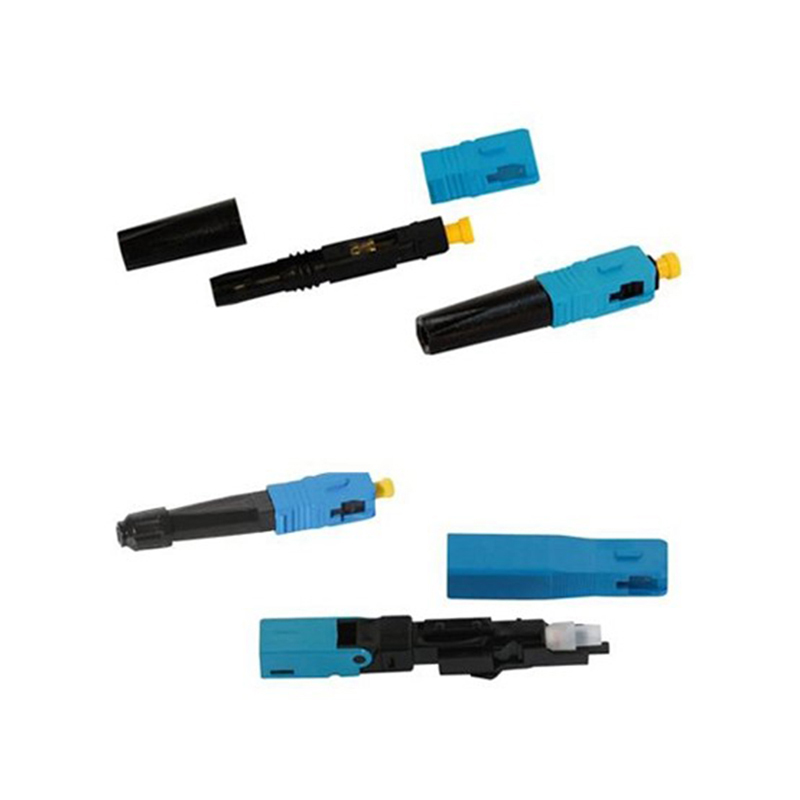
Fiber Solution-Quick Connector
1. The Role of Quick Connectors in Fiber Network Deployment
Fiber optic networks depend on numerous connection points. These points are found in central offices, equipment rooms, outdoor cabinets, distribution boxes, building entry points, residential communication boxes, and subscriber outlets. Every connection must maintain optical alignment and protect the fiber from excessive bending, tensile stress, contamination, and accidental movement.
Traditional fiber termination processes can be highly effective, but they often require trained personnel, polishing equipment, curing materials, inspection tools, and a controlled working environment. These requirements are manageable in a factory or professional laboratory, but they may become difficult in a crowded equipment room, a construction site, a railway facility, or a residential installation area.
A quick connector addresses this challenge by integrating key termination functions into a compact component that can be installed at the work location. The connector is intended to reduce preparation time and lower the dependence on complex tools. For network operators and installation contractors, this can improve productivity and reduce the risk of delays caused by missing equipment or unsuitable working conditions.
The Fiber Solution-Quick Connector is especially suitable for Bow-type cables. These cables are commonly used in access and indoor fiber installations because their structure supports compact routing and practical deployment in buildings and customer premises. The connector provides a termination solution that fits applications where installation speed, stable performance, and flexible cable management are important.
Quick connection does not mean that optical quality is treated as secondary. The connector’s fiber end face is ground in the factory before delivery. Factory grinding helps provide a more consistent surface condition than uncontrolled field polishing. By controlling this process during manufacturing, the product can help reduce variations caused by inconsistent technician technique, unsuitable consumables, or dust and vibration at the installation site.
2. Product Overview and Main Application Areas
The product is a Fiber Solution-Quick Connector intended for telecommunications applications. Its primary use is the connection of Bow-type cables in passive optical network infrastructure and related fiber distribution environments.
The connector can be used in optical fiber termination boxes, where incoming or outgoing fiber cables must be organized and connected in a protected enclosure. It is also suitable for optical fiber distribution boxes that serve as important transition points between feeder, distribution, and drop cables.
For building and residential deployments, the product can be installed in a household intelligent box or optical fiber socket-box. These locations often have limited space and may be accessed by technicians working under time pressure. A compact and repeatable termination method can make installation and maintenance more practical.
The connector is also appropriate for optical distribution frame renovation. During an upgrade, an installer may need to reorganize existing fiber routes, establish new patch cord lengths, or add connections without replacing an entire cabinet. The quick connector can support such work by providing a flexible termination option that can be completed close to the final installation point.
Another important application is the setting of patch cord lengths in a new optical distribution frame. Instead of preparing every connection in advance with fixed dimensions, installers can terminate selected cables during the frame assembly process. This can help accommodate actual routing conditions, cabinet spacing, and equipment positioning.
| Application Area | Typical Installation Requirement | Product Contribution |
|---|---|---|
| Optical fiber termination box | Compact and stable fiber termination | Supports organized connection of Bow-type cables |
| Optical fiber distribution box | Reliable distribution-side connection | Provides a practical field installation method |
| Household intelligent box | Limited space and simple tools | Helps simplify residential fiber installation |
| Optical fiber socket-box | Direct customer-side termination | Allows flexible connection close to the outlet |
| Optical distribution frame renovation | Reconfiguration and replacement work | Supports patching and adjustment without extensive equipment |
| New optical distribution frame | Patch cord length adjustment | Allows termination based on actual routing conditions |
3. Optical Performance Designed for Stable Transmission
Optical performance is the most important consideration when selecting a fiber connector. A connector that is easy to install but produces excessive loss or unstable reflection can affect network availability, transmission distance, and maintenance costs. The Fiber Solution-Quick Connector is designed to balance installation convenience with measurable optical performance.
The stated insertion loss is below 0.5 dB, with a typical value of approximately 0.3 dB. Insertion loss represents the reduction in optical power introduced by the connection. Lower insertion loss generally provides more available power margin for the network. In practical terms, a connection with controlled loss helps the optical link remain within its planned operating range.
The product also provides a return loss greater than 45 dB for UPC applications. Return loss describes the amount of light reflected toward the source. Higher return loss indicates lower reflection and is beneficial for maintaining signal integrity, particularly in systems that are sensitive to back reflection.
These specifications are supported by the factory-ground fiber end face. The end face is a critical optical interface. Small irregularities, contamination, scratches, or poor geometry can interfere with the alignment of the fiber cores. Factory processing provides a controlled basis for connector performance before the product reaches the installation site.
Consistent end-face preparation can also reduce the performance gap between different installers. With conventional field polishing, results may vary according to operator experience, polishing pressure, film condition, inspection habits, and environmental cleanliness. By completing the grinding process during manufacturing, the connector can reduce some of these variables and make the field installation more repeatable.
Of course, the final performance of any fiber connection also depends on correct cable preparation, cleanliness, alignment, routing, and inspection. The connector’s factory-controlled end face is an important advantage, but technicians must still follow appropriate installation practices. A clean connector interface and properly prepared cable are essential to achieving the expected result.
Insertion Loss and Link Budget
In an optical network, the total link budget includes the loss of fiber, connectors, splices, splitters, adapters, and other passive components. Every connection consumes a portion of the available optical margin. By keeping typical insertion loss near 0.3 dB and below the specified 0.5 dB limit, the quick connector can support link designs that require predictable passive losses.
This is particularly relevant in access networks, where optical signals may pass through several distribution points before reaching the subscriber. It is also important in renovation projects, where additional connectors may be installed in an existing route. Controlled connector loss helps network planners estimate the total optical budget more accurately.
Return Loss and Reflection Control
Reflection can be caused by small air gaps, imperfect end-face contact, angular misalignment, or contamination. Excessive reflection may affect certain optical transmitters and receivers, especially in systems that use sensitive modulation or high-speed transmission technologies. A return loss greater than 45 dB for UPC applications indicates that the connector is designed to control reflected light at a level appropriate for many telecommunications deployments.
Installers should ensure that the connector type matches the interface and polishing geometry used by the network. UPC and APC systems are not interchangeable for every application. The product information specifies UPC return-loss performance, so project engineers should confirm connector compatibility before ordering and deployment.
4. Repeatable Installation and Field Productivity
One of the principal advantages of a quick connector is the ability to complete a fiber termination without transporting the cable to a specialized workshop. This can significantly improve productivity in distributed construction environments. Technicians can prepare and connect the cable close to the termination box, outlet, or distribution frame where it will remain in service.
The product can be installed repeatedly more than three times while maintaining stable performance. This feature is valuable in situations where a technician needs to reposition the connector, correct an installation error, modify the cable route, or replace a housing component. Repeatability helps reduce waste and provides greater flexibility during commissioning.
Compared with one-time termination methods, a repeatable connector can lower the operational risk associated with small routing changes. Fiber installation often requires adjustment after the cabinet door is closed, after cable slack is organized, or after other equipment is mounted. A connector that tolerates repeated installation gives technicians more opportunities to achieve a neat and mechanically secure result.
Repeatable installation is also useful during maintenance. If a connection must be temporarily disconnected and re-established, a connector designed for multiple installation cycles can simplify the work. This does not eliminate the need for careful cleaning and inspection, but it can reduce the likelihood that a minor service operation will require a completely new termination.
Tools and Installation Efficiency
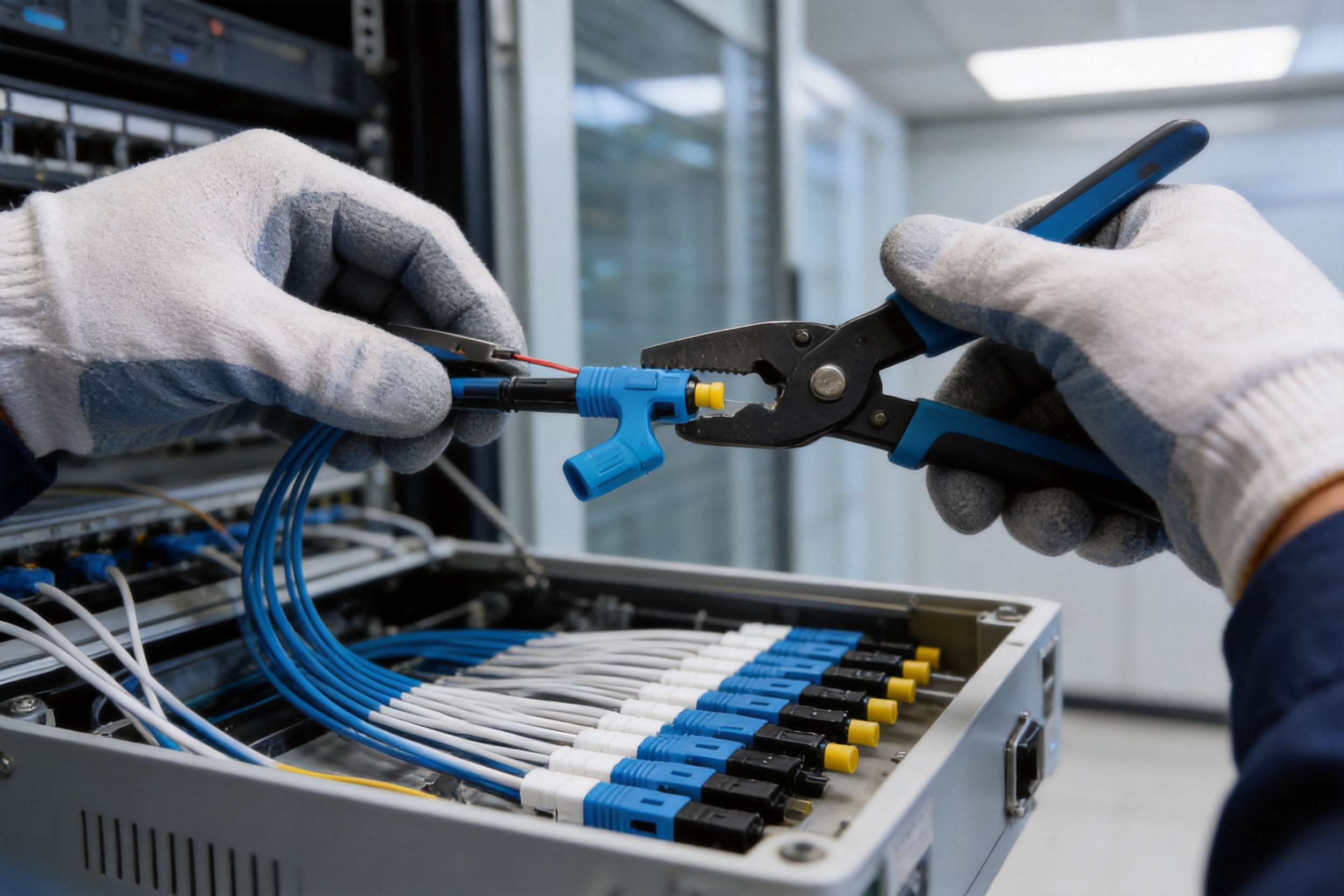
The standard installation process requires relatively few tools. The listed tools include wire strippers and a cutting knife. This limited tool requirement can be helpful for field teams that work across multiple sites and need to carry compact equipment kits.
Fewer tools can also reduce preparation time before a project begins. Large-scale fiber deployments may involve many technicians working in different locations. Standardizing the basic tool set makes it easier to train personnel, prepare work vehicles, and coordinate installation procedures.
However, the use of fewer tools does not mean that quality control should be reduced. Technicians should still prepare the cable carefully, avoid damaging the fiber, maintain cleanliness, and verify the completed connection where required. Simplified installation is most effective when supported by clear work instructions and appropriate inspection procedures.
5. Hot-Melt Quick Connector Technology
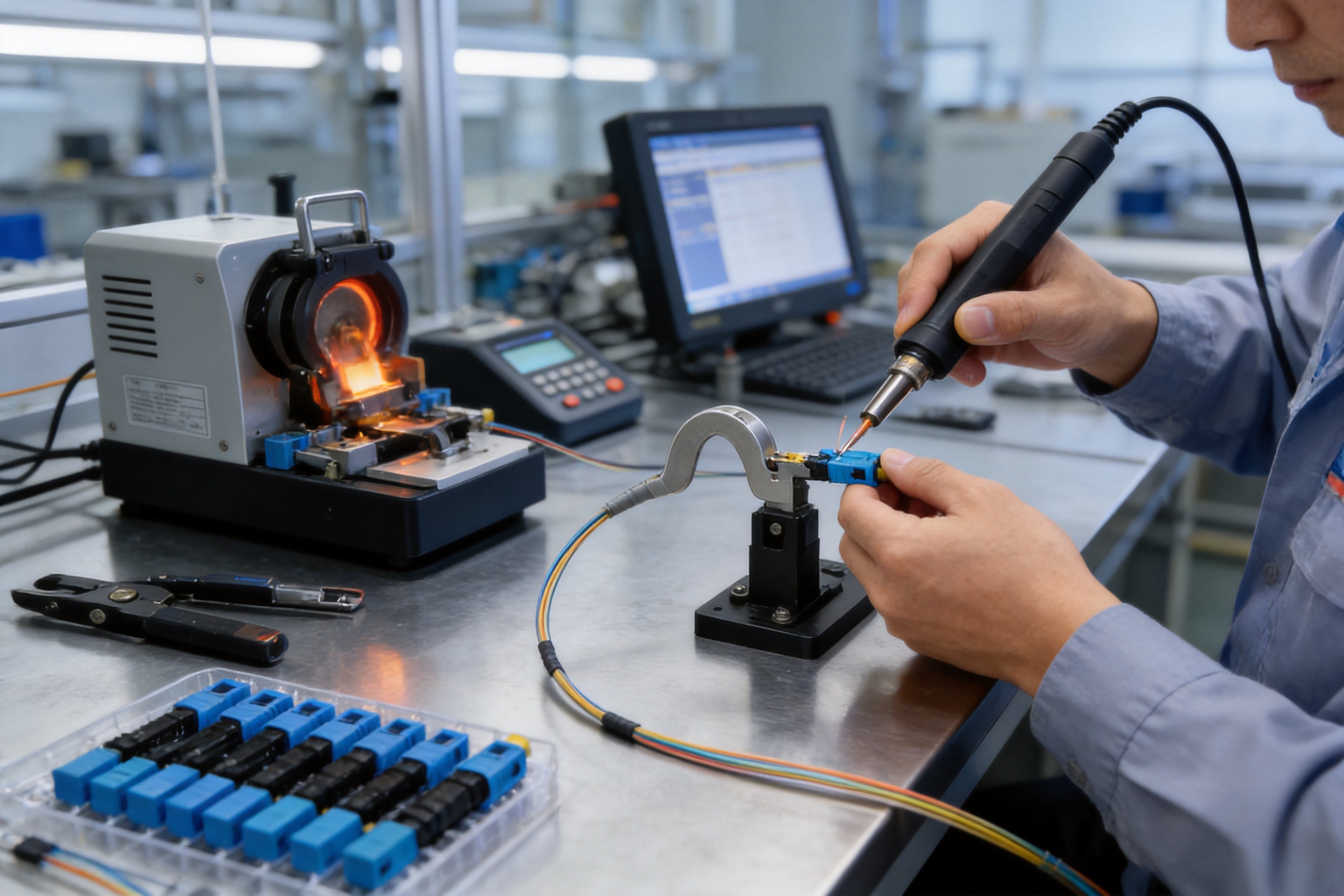
The hot-melt type quick connector provides an alternative installation method for applications that require a stable and reliable field connection. It is installed on-site by hot-melting, creating a termination process that combines field flexibility with controlled connector construction.
Hot-melt installation is particularly useful when the project requires a stronger focus on process consistency. The connector can be prepared at the actual installation location while relying on a defined heating and melting procedure. This helps bridge the gap between fully prefabricated patch cords and more traditional adhesive-based field termination.
The product information emphasizes that the hot-melt type quick connector offers stable performance and reliability. These characteristics are important in communication cabinets, fiber distribution frames, and other locations where the connection may remain in service for many years.
At the same time, hot-melt connector performance depends on the stability of the equipment used during installation. Heating conditions, temperature control, timing, and equipment maintenance can influence the quality of the finished connection. For this reason, the installation team should use suitable hot-melt equipment and maintain it according to the project’s operating procedures.
Equipment stability is important because it helps prevent avoidable losses caused by human or process errors. If heating is inconsistent, the connector may not achieve the intended bonding or alignment condition. If the equipment is poorly maintained, temperature deviations may become more likely. A controlled hot-melt process therefore requires both a suitable connector and dependable installation equipment.
Why Equipment Control Matters
A well-designed connector cannot completely compensate for uncontrolled installation conditions. Hot-melt installation should be treated as a repeatable manufacturing-style process performed in the field. This means that technicians should verify equipment readiness, use the correct operating parameters, maintain a clean work area, and inspect the result when the process is complete.
Training also plays a major role. Installers should understand how to prepare Bow-type cables, how to position the fiber, how to operate the heating equipment, and how to identify an abnormal result. Clear training can reduce unnecessary optical loss and improve consistency between different installation teams.
6. Advantages Over Conventional Field Termination Methods
The Fiber Solution-Quick Connector offers several advantages compared with more equipment-intensive termination approaches. The most apparent advantage is reduced installation complexity. Traditional termination may involve multiple preparation stages, adhesive curing, polishing, inspection, and specialized fixtures. A quick connector streamlines the process and can make field deployment more efficient.
A second advantage is factory-controlled fiber-end-face preparation. When the end face is ground at the factory, the product benefits from a standardized manufacturing environment. This can reduce variability that might otherwise result from differences in technician experience or site conditions.
A third advantage is repeatability. The ability to install the connector more than three times with stable performance gives the product an advantage in applications where network routing may change during construction or maintenance. It also supports more flexible inventory and service planning.
A fourth advantage is suitability for compact installation areas. Optical termination boxes, household intelligent boxes, and socket-boxes may not provide enough space for a full workshop-style termination process. A quick connector can be used closer to the final connection point with a smaller tool requirement.
A fifth advantage is adaptability for renovation projects. Existing optical distribution frames are often constrained by installed cables, cabinet dimensions, and limited downtime. A field-installable connector can help technicians complete targeted modifications without dismantling an entire system.
| Comparison Factor | Quick Connector Approach | More Conventional Field Termination |
|---|---|---|
| Required equipment | Limited basic tools; hot-melt versions require suitable heating equipment | May require polishing, curing, inspection, and specialized fixtures |
| Installation location | Can be completed near the final enclosure or outlet | Often benefits from a controlled workshop environment |
| Fiber-end-face preparation | Factory-ground end face | May depend more heavily on field polishing quality |
| Adjustment flexibility | Can be reinstalled more than three times with stable performance | Changes may require a new termination |
| Use in renovation | Practical for patching and reconfiguration | May require more time and additional consumables |
| Training emphasis | Cable preparation, correct assembly, cleanliness, and equipment control | More extensive polishing and adhesive-process training may be required |
The comparison does not mean that one termination method is ideal for every network. Fusion splicing, mechanical splicing, factory-terminated assemblies, and conventional connectorization all have important roles. The quick connector is advantageous when installation speed, field flexibility, compact tools, and repeatable termination are priorities.
7. Manufacturing Strength and Process Control
The connector’s advantages are closely linked to the manufacturer’s ability to control production. A company that develops and manufactures communication cabinets, electronic communication equipment, and passive optical components can apply experience across the complete network equipment chain. This broader product background supports an understanding of how connectors are used inside cabinets, distribution systems, equipment rooms, and transport communication networks.
The manufacturer has operated since 1997 and focuses on communication infrastructure products. Its experience includes communication cabinets, communication electronic equipment, and passive optical components. This product scope is relevant because the quick connector is not an isolated accessory; it forms part of the wider passive optical infrastructure that connects cables, distribution equipment, and customer-side outlets.
Manufacturing its own branded products allows the company to maintain closer control over product development, production planning, quality procedures, and customer feedback. It also supports the creation of customized solutions for projects with special dimensions, cable structures, installation conditions, or performance requirements.
Factory grinding of the fiber end face is one example of process control. Instead of leaving all end-face preparation to the installation site, the manufacturer performs a critical operation under controlled production conditions. This approach can help improve consistency and supports the product’s stated optical performance.
For hot-melt connector products, manufacturing strength also includes the ability to define compatible installation procedures and equipment requirements. A reliable product program should not focus only on the connector body; it should also consider cable preparation, heating conditions, assembly sequence, inspection, packaging, and field training.
Production experience in passive optical components can contribute to better compatibility with distribution boxes, termination boxes, optical frames, and household communication enclosures. It can also help the manufacturer understand the practical concerns of installers, including cable routing, bend control, space limitations, labeling, maintenance access, and replacement procedures.
Quality-Oriented Production
Quality in fiber products depends on both material selection and process discipline. The connector must maintain proper mechanical dimensions, stable optical alignment, suitable retention, and reliable protection of the fiber. Manufacturing controls should therefore address incoming materials, component forming, assembly, fiber preparation, optical testing, visual inspection, packaging, and traceability.
A company serving telecommunications and transport applications must also recognize that network components may be deployed in demanding environments. High-speed railways, urban rail transit systems, central equipment rooms, and outdoor distribution facilities can expose equipment to vibration, temperature changes, dust, repeated maintenance, and long service periods. The connector should be selected and installed according to the environmental requirements of the specific project.
The manufacturer’s experience serving more than 20 countries and regions provides exposure to different network standards, deployment practices, and customer expectations. International project experience can help strengthen documentation, packaging, communication, and support processes. It can also encourage the development of products that are adaptable to different construction methods and infrastructure layouts.
8. Use in Telecommunications and FTTH Modernization
Fiber-to-the-home networks require a large number of compact and serviceable connections. The final section of the network may pass through building risers, floor distribution boxes, household intelligent boxes, and optical socket-boxes before reaching the subscriber device. In such deployments, installers often need to work in confined locations with strict time limits.
The quick connector is suitable for this environment because it can support field termination of Bow-type cables without requiring a large installation station. The limited tool requirement can simplify work inside apartments, offices, commercial buildings, and multi-dwelling units.
During FTTH modernization, existing copper or older optical systems may be upgraded to higher-capacity fiber infrastructure. The physical route may already be crowded, and new cables may need to be adapted to existing boxes or cabinets. A connector that supports flexible patch cord length and repeated installation can make these upgrades more manageable.
Network modernization also benefits from predictable optical loss. As operators introduce higher-speed access technologies, the available optical margin becomes increasingly important. A connector with controlled insertion loss and low reflection can support the planning of more reliable access links, provided that the entire link is correctly engineered and maintained.
The product can also support staged construction. A contractor may install cables first and complete final connections after cabinets, outlets, or customer equipment are ready. The ability to terminate at the required stage helps reduce the need for excessive pre-assembled cable inventory and can accommodate actual site measurements.
9. Use in Railway and Urban Transit Communication Systems
Railway and urban transit networks rely on communication infrastructure for operations, passenger information, surveillance, signaling support, ticketing, maintenance coordination, and administrative systems. These networks may include central equipment rooms, station communication cabinets, platform facilities, trackside enclosures, and control centers.
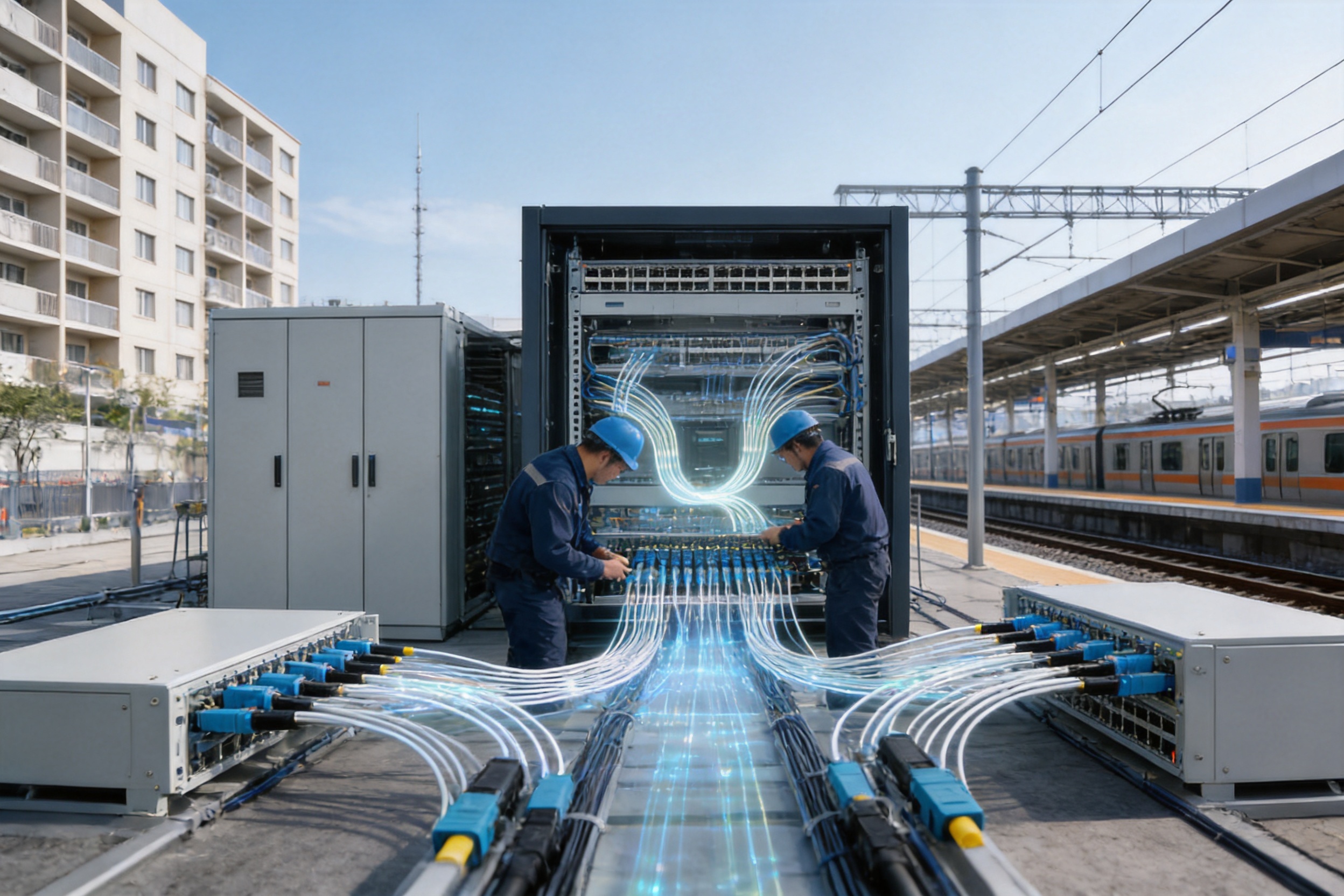
Optical fiber is widely used in these systems because it provides high bandwidth and immunity to electromagnetic interference. However, the network still depends on practical connection and distribution components. A quick connector can be useful during the installation of fiber termination boxes, equipment cabinets, and distribution frames, particularly when construction schedules require rapid completion.
Railway and transit projects may also involve renovation of existing communication systems. Work must often be coordinated with operating schedules, restricted access windows, and strict documentation requirements. A field-installable connector can help technicians complete targeted connection work in a limited maintenance period.
For these applications, project teams should consider the full environmental specification, including temperature, vibration, humidity, dust, mechanical protection, fire-safety requirements, and enclosure ratings. The connector should be deployed within the conditions for which the product and its installation method are suitable.
The manufacturer’s experience with national high-speed railway and urban rail transit systems reflects an understanding of the infrastructure context in which communication components are used. This experience can support the development of products and integrated solutions that fit the organization, installation, and maintenance requirements of transportation networks.
10. Installation Guidance for Reliable Results
Successful installation begins with cable identification and preparation. The technician should confirm that the cable is the correct Bow-type cable for the connector and that the cable length is sufficient for the intended routing. Excessive tension should be avoided because mechanical stress can affect long-term reliability.
The outer jacket and internal elements should be stripped carefully using suitable tools. The fiber should not be scratched, sharply bent, or contaminated during preparation. The cutting knife and wire stripper should be maintained in good condition so that the cable structure is not damaged.
After preparation, the fiber should be positioned according to the connector’s installation procedure. The connector must be assembled in the correct sequence, and the fiber should be fully seated. Incomplete insertion or incorrect alignment can increase optical loss and reduce mechanical stability.
For hot-melt versions, the heating equipment should reach and maintain the required operating condition before the process begins. Technicians should avoid using unstable, damaged, or unsuitable equipment. Heating time and temperature should follow the approved procedure rather than being estimated informally.
Cleanliness is essential at every stage. Dust, oil, moisture, and small particles can affect the optical interface. Connectors should be protected from unnecessary exposure, and the completed interface should be inspected or cleaned according to the project’s quality-control requirements.
After installation, the connection should be checked for proper seating, cable retention, bend radius, and routing. Where required, optical testing should be performed to verify insertion loss and identify abnormal reflection. The finished connection should be labeled so that future maintenance personnel can identify the cable path and service function.
Recommended Installation Checklist
Confirm the cable type and connector compatibility before stripping the cable.
Measure the required cable length and allow suitable routing slack.
Use clean, sharp, and appropriate stripping and cutting tools.
Prevent sharp bends, excessive pulling force, and twisting during assembly.
Keep the fiber end and connector interface free from contamination.
For hot-melt installation, verify that the heating equipment is stable and suitable.
Follow the approved assembly sequence and avoid improvising process parameters.
Check mechanical retention and cable routing after the connector is installed.
Perform optical testing where required by the project specification.
Record the installation location, cable identification, test result, and technician information.
11. Maintenance, Reinstallation, and Lifecycle Value
Fiber networks are long-term assets. Their value depends not only on initial installation speed but also on the ability to maintain, expand, and modify the system over time. The quick connector’s repeatable installation feature can contribute to lifecycle value by making certain maintenance operations less disruptive.
When a cabinet layout changes, technicians may need to adjust patch cord lengths or move a termination from one port to another. A connector that can be installed repeatedly more than three times with stable performance offers practical flexibility during such changes.
Maintenance teams should still treat every reinstallation as a quality-sensitive operation. The connector and fiber interface should be protected from dust, the cable should be inspected for damage, and the connection should be tested after reassembly when the service is important.
Inventory management can also benefit from a versatile quick connector. Contractors may reduce the number of pre-cut patch cord lengths that must be stored, since some connections can be completed according to actual field measurements. This can reduce the risk of having the wrong cable length at a project site.
For network operators, faster maintenance can reduce service interruption. A technician who can complete a replacement or adjustment using a compact toolkit may spend less time transporting equipment or waiting for workshop preparation. Over many service events, these operational improvements can contribute to lower maintenance effort.
12. Customization and Integrated Network Solutions
Different projects may require different connector configurations, cable lengths, packaging methods, labels, or installation instructions. A manufacturer that provides integrated solutions for customized products can work with customers to address these requirements more effectively than a supplier focused only on standard catalog items.
Customization may involve adapting the product to a particular termination box, matching a project’s cable structure, preparing special packaging for international delivery, or supplying documentation for a large installation program. The feasibility of each customization should be evaluated technically and commercially before production.
The manufacturer’s broader portfolio of communication cabinets, electronic communication equipment, and passive optical components also creates opportunities for system-level coordination. Customers may be able to source related products from one experienced supplier, simplifying technical communication and procurement management.
Integrated supply can be valuable in large network projects because connectors must fit the geometry, access, labeling, and cable-management features of the enclosure in which they are installed. Product coordination can reduce incompatibility risks and help create a more orderly installation.
13. Supply Reliability and International Service Capability
Network construction schedules are often influenced by delivery timing. Delayed connectors can prevent cabinet completion, postpone testing, and increase labor costs. A supplier with established manufacturing operations and experience serving international customers can provide a stronger foundation for predictable supply planning.
The manufacturer has a sales network covering more than 20 countries and regions, including the United States, Australia, the United Kingdom, Italy, South Africa, and Ghana. International experience may support export packaging, customer communication, order coordination, and adaptation to different project requirements.
Reliable delivery should be accompanied by consistent quality. Customers typically expect the same product characteristics across repeated orders, particularly when connectors are used in standardized network designs. Manufacturing process control and product documentation are therefore important parts of supplier performance.
Long-term partnerships are especially valuable in telecommunications. Operators and contractors may need replacement products, technical clarification, customized components, or additional quantities months or years after the original project. A supplier committed to customer satisfaction and strategic cooperation can help support the full product lifecycle.
14. Selection Considerations for Project Engineers
Before selecting a quick connector, project engineers should confirm the cable type, connector interface, polishing geometry, optical performance requirements, environmental conditions, and installation method. The product is intended for Bow-type cables, and compatibility should be verified before deployment.
Insertion loss and return loss should be considered within the complete link budget. The stated insertion loss below 0.5 dB and typical value of 0.3 dB provide useful reference points, but actual project performance also depends on cable condition, adjacent connectors, splitters, splices, and installation quality.
The project team should determine whether a standard quick-connection process or hot-melt installation is more suitable. Standard field installation may be preferred where speed and minimal tooling are the primary objectives. Hot-melt installation may be selected where a defined heating process and stable equipment are available.
Environmental requirements should also be reviewed. Indoor household boxes and central equipment rooms may present different conditions from outdoor cabinets, railway facilities, or urban transit locations. The connector, enclosure, cable, and installation process should be evaluated as one system.
Finally, the project should include training and quality documentation. A quick connector can simplify installation, but consistent results still depend on correct stripping, assembly, cleanliness, cable routing, and testing. Proper procedures help the product deliver its full value.
15. Frequently Asked Questions
Q1: What type of cable is this quick connector designed for?
The connector is designed for Bow-type cables. Before installation, users should confirm the cable structure, fiber type, connector interface, and project requirements to ensure compatibility.
Q2: Where can the connector be used?
It is suitable for optical fiber termination boxes, optical fiber distribution boxes, household intelligent boxes, optical fiber socket-boxes, optical distribution frame renovation, and patch cord length setting in new optical distribution frames.
Q3: What is the typical insertion loss?
The specified insertion loss is below 0.5 dB, with a typical value of approximately 0.3 dB. Actual results depend on cable preparation, cleanliness, alignment, installation quality, and the condition of connected equipment.
Q4: What return-loss performance is provided?
The product information specifies a return loss greater than 45 dB for UPC applications. Users should verify that the connector polishing type matches the optical interfaces used in the network.
Q5: Can the connector be installed more than once?
Yes. It can be installed repeatedly more than three times while maintaining stable performance, provided that the connector and fiber are handled correctly and kept clean during each installation.
Q6: What tools are needed for the standard installation?
The standard installation requires relatively few tools, including a wire stripper and a cutting knife. Additional inspection or testing tools may be required by the project’s quality procedures.
Q7: What is the hot-melt type quick connector?
The hot-melt type is installed on-site using a hot-melting process. It is intended to provide stable performance and reliability while retaining the flexibility of field installation.
Q8: Why is hot-melt equipment stability important?
The performance of a hot-melt connector depends partly on the stability of the heating equipment. Unstable temperature or incorrect operating conditions can create avoidable losses or an unreliable termination. Suitable equipment and controlled procedures are therefore important.
Q9: Does a quick connector eliminate the need for testing?
No. The connector simplifies installation, but testing may still be required by the network design, customer specification, or quality plan. Optical loss, mechanical seating, cable routing, and cleanliness should be checked as appropriate.
Q10: Is the connector suitable for FTTH modernization?
Yes. It is suitable for applications involving household intelligent boxes, optical socket-boxes, distribution boxes, and other access-network locations. Its compact installation process and flexible patch cord adjustment can support modernization projects.
Q11: Can it be used in railway and urban transit projects?
It can be used in relevant fiber termination and distribution applications within railway and urban transit communication systems, provided that the product and enclosure meet the environmental and technical requirements of the specific project.
Q12: What makes factory-ground fiber ends advantageous?
Factory grinding provides controlled preparation of the fiber end face. This can reduce variation associated with field polishing and help support more consistent optical performance when the connector is installed correctly.
Q13: How does the product compare with factory-made patch cords?
A factory-made patch cord provides a predetermined length and configuration. The quick connector offers more flexibility when the final cable length must be determined at the installation site, such as during distribution-frame construction or renovation.
Q14: How does the product compare with fusion splicing?
Fusion splicing and quick connection are different technologies with different advantages. Fusion splicing can provide very low loss and is widely used in backbone and distribution networks. A quick connector can be more convenient where field termination, compact tools, repeatability, and rapid installation are priorities.
Q15: What company capabilities support this product?
The manufacturer has operated since 1997 and specializes in communication cabinets, communication electronic equipment, and passive optical components. It develops and manufactures branded products and provides integrated solutions for customized products.
Q16: Can customized solutions be requested?
The manufacturer provides integrated solutions for customized products. Customers should supply technical information such as cable type, connector configuration, enclosure requirements, quantity, performance targets, and project environment for evaluation.
16. Conclusion
The Fiber Solution-Quick Connector is designed to make Bow-type cable termination faster, more flexible, and more consistent across telecommunications and related optical network applications. Its factory-ground fiber end face, insertion loss below 0.5 dB, typical insertion loss of approximately 0.3 dB, and UPC return loss greater than 45 dB provide a strong foundation for stable optical performance.
The product’s ability to be installed repeatedly more than three times adds practical value during construction, renovation, and maintenance. Its limited standard tool requirement makes it suitable for field work in optical termination boxes, distribution boxes, household intelligent boxes, optical socket-boxes, and optical distribution frames.
The hot-melt version provides an additional option for projects that require a controlled field termination process. Its success depends on the stability of the installation equipment and the discipline of the operating procedure. When the connector, cable preparation, heating equipment, cleanliness, and testing process are properly coordinated, the result can support dependable network operation.
Behind the product is a manufacturer with long-term experience in communication cabinets, electronic communication equipment, passive optical components, railway communication environments, urban transit systems, and Ethernet and optical network infrastructure. Its own manufacturing capabilities, factory process control, customized solution services, international sales experience, and commitment to reliable quality and timely delivery strengthen the connector’s value for professional network projects.
For network operators, contractors, system integrators, and project engineers, the product offers a practical balance between installation efficiency and optical reliability. It is not a replacement for every fiber termination technology, but it is a competitive solution when field flexibility, controlled performance, compact tooling, and repeatable installation are central project requirements.
References
1. Product technical information for Fiber Solution-Quick Connector, including application, optical performance, installation, and hot-melt process characteristics.
2. General principles of fiber-optic connector installation, inspection, cleanliness, cable preparation, and optical link-budget management.
3. General telecommunications network design practices for optical distribution frames, fiber termination boxes, distribution boxes, and FTTH access networks.
4. General engineering guidance for passive optical components used in railway, urban transit, central equipment-room, and enterprise communication systems.
5. Manufacturer profile information concerning communication cabinets, communication electronic equipment, passive optical components, customized solutions, manufacturing capability, and international market service.
Product: Fiber Solution-Quick Connector
PREV:No previous
article
NEXT:Liquid-Cooled Data Centers: High-Density Computing Infrastructure for Efficient, Reliable, and Sustainable Performance
NEXT:Liquid-Cooled Data Centers: High-Density Computing Infrastructure for Efficient, Reliable, and Sustainable Performance
Interested in cooperation or have questions?
Related products
-
-
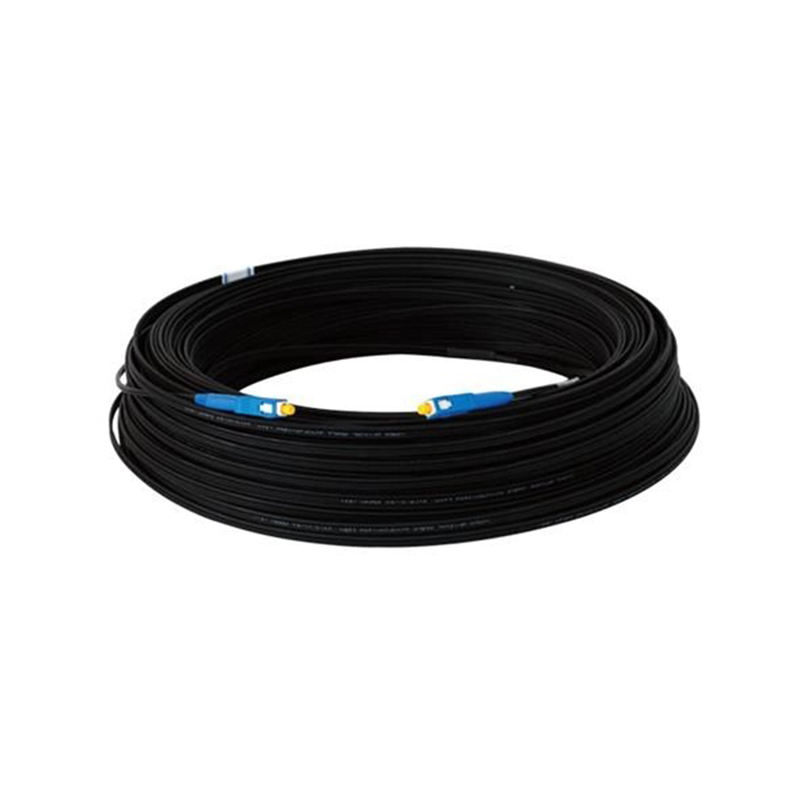
Application:It has the function of on-site termination in FTTH network, communication network termination and network cabling in FTTH network, making it the product for "tri-networks integration" (the...
See Details -
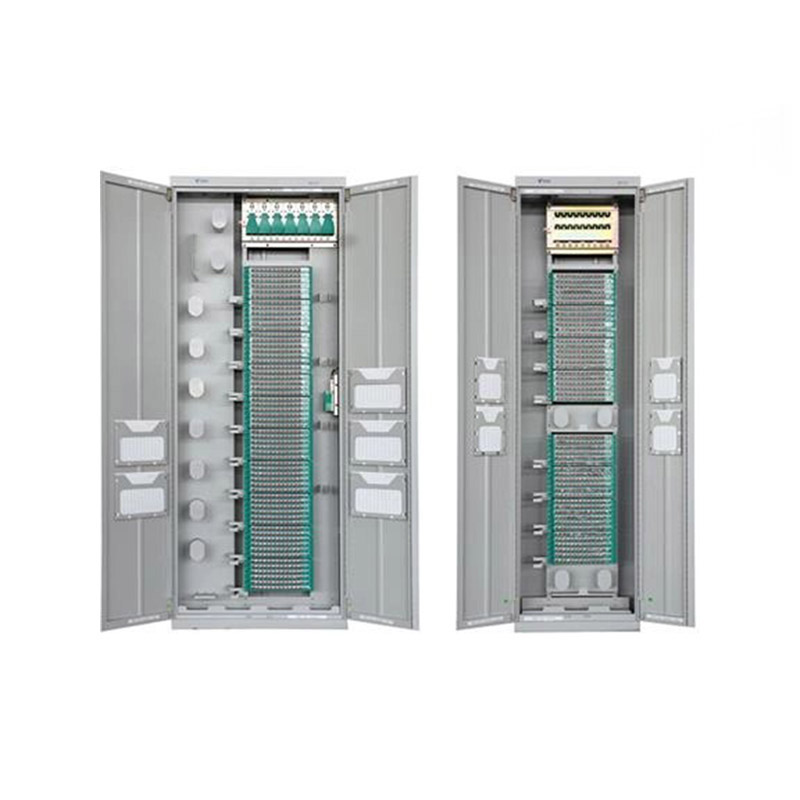
Application ScopeThe GPX129-09T fiber optic distribution frame is used to connect, distribute, and manage fiber optic cables and optical communication equipment. It is suitable for large-capacity fibe...
See Details -
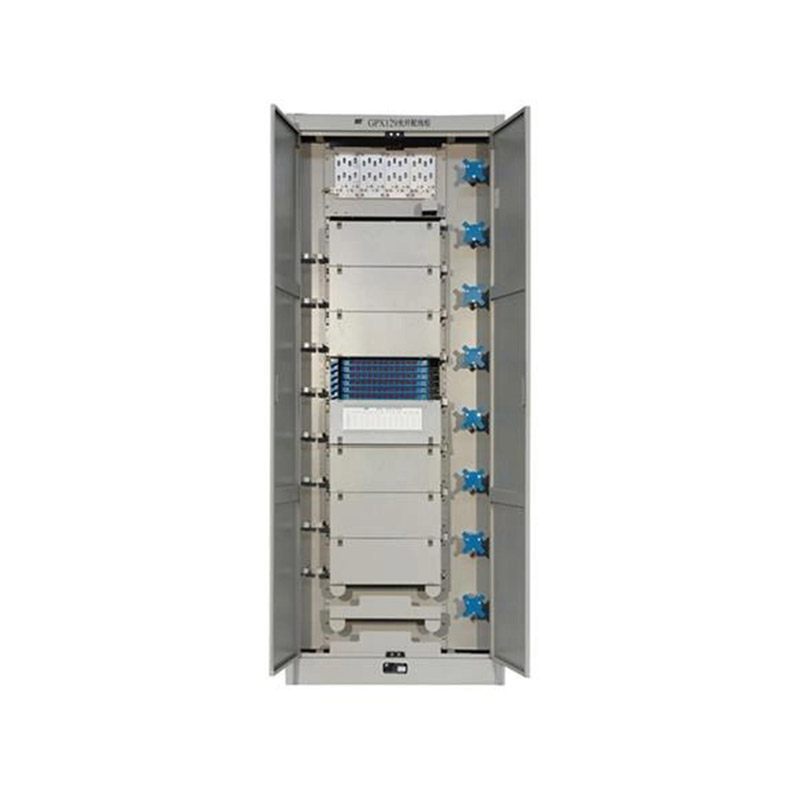
Application ScopeThe GPX129BKC fiber optic distribution frame is used to connect and distribute optical cables to optical communication equipment, and is suitable for large-capacity fiber optic commun...
See Details
Ready to Get started ? Contact Us Now !

Product.
Contact Details.
-
 +86 13958188250
-
 +86 13958188250
-
 [email protected]
-
 AUDIT Email:[email protected]
- Wanma Industrial Park Taihu Yuan Town Lin'an District Hangzhou City China.
QR Code

Copyright © Wanma Technology Co., Ltd. All Rights Reserved.
Privacy
Custom Ethernet Optical Network Railway Transit Equipments Suppliers
