

 English
 Français
 Español
 Português
 عربى
عربى





Product Definition The RFID Card Recycling Cabinet is an intelligent terminal designed for centralized recycling and management of RFID cards. It is suitable for scenarios requiring standardized card ...
See DetailsIntelligent RFID Card Recycling Cabinet for Secure Centralized Card Management
Content
- 1 Product Definition and Core Purpose
- 2 Why RFID Card Recycling Requires Intelligent Management
- 3 Key Functions and Features
- 4 Application Scenarios
- 5 Competitive Advantages Over Conventional Recycling Methods
- 6 Comparison With Common Alternatives
- 7 Design Philosophy: Standardization, Security, and Operational Simplicity
- 8 Manufacturing Strength and Quality Foundation
- 9 Advanced Process Capabilities Behind the Product
- 10 Why Company Experience Matters to Customers
- 11 Advantages in Medical Consumables Management Context
- 12 Security and Accountability Benefits
- 13 Operational Efficiency and Cost Control
- 14 User Experience and Adoption
- 15 Customization and Integrated Solution Potential
- 16 Deployment Considerations
- 17 How the Cabinet Supports Digital Transformation
- 18 Environmental and Resource Efficiency Value
- 19 Product Value Summary
- 20 Q&A Section
- 20.1 Q1: What is the main purpose of the RFID Card Recycling Cabinet?
- 20.2 Q2: Which industries can use this cabinet?
- 20.3 Q3: How does the cabinet improve security?
- 20.4 Q4: What is fixed-number card package recycling?
- 20.5 Q5: Why is this product useful in hospitals?
- 20.6 Q6: Can the cabinet be installed in different environments?
- 20.7 Q7: How is it better than a simple card collection box?
- 20.8 Q8: Does the product help reduce manual errors?
- 20.9 Q9: Why does manufacturing experience matter for this product?
- 20.10 Q10: Can the product support customized requirements?
- 21 Conclusion
- 22 References
- 23 Product: RFID Card Recycling Cabinet
In modern hospitals, enterprises, campuses, public service facilities, and access-controlled environments, RFID cards are no longer simple identification tools. They are part of a wider operational system that connects people, assets, data, permissions, workflows, and security policies. As RFID cards move through their service life, organizations must recover, count, verify, and manage them with the same discipline used during issuance. The RFID Card Recycling Cabinet is designed to meet this need through a centralized, intelligent, and standardized recycling process that improves traceability, reduces manual error, and strengthens operational control.
The product is an intelligent terminal developed for the centralized recycling and management of RFID cards. It supports secure authentication, fixed-number card package recycling, convenient quantity verification, simple operation, and flexible installation. It can be placed on a desktop or installed on a wall, making it suitable for locations with different space conditions and different process requirements. For institutions that handle large numbers of cards, including medical facilities, corporate offices, university campuses, laboratories, logistics areas, visitor centers, and managed dormitory environments, the cabinet provides a more reliable alternative to manual collection boxes, spreadsheet-based counting, and decentralized return procedures.
Although the product belongs to the broader field of intelligent management solutions for medical consumables, its value extends beyond a single industry. In hospitals, RFID cards may be associated with staff identity, patient access, temporary visitor control, medical consumable management, equipment authorization, or department-level workflow. In enterprises, RFID cards are often connected to access control, attendance, meeting room authorization, parking, equipment borrowing, cafeteria payment, or internal logistics. In campuses, cards may carry student identification, library access, laboratory permissions, dormitory access, and transportation functions. In each of these environments, recovering cards in an orderly manner is essential for security, cost control, compliance, and process integrity.
The RFID Card Recycling Cabinet offers a structured answer to a common problem: how to make card recycling secure, accurate, and easy to operate without adding unnecessary staff workload. Instead of relying on employees to manually receive, count, store, and report returned RFID cards, the cabinet standardizes the recycling process at the point of return. With authentication, fixed-number package recycling, and a controlled cabinet structure, it helps organizations ensure that recovered cards are returned by authorized users or operators, collected in defined quantities, and managed under consistent procedures.
Product Definition and Core Purpose
The RFID Card Recycling Cabinet is an intelligent terminal used for centralized recovery and management of RFID cards. Its primary purpose is to transform card recycling from a loose manual activity into a managed operational process. This is especially important in organizations where RFID cards represent access privileges, internal identity, transaction permissions, or workflow authorization. When a card is not recovered correctly, it may create security risks, inventory uncertainty, administrative inefficiency, and unnecessary replacement costs.
Traditional recycling methods often depend on manual handover. A staff member receives the card, writes down the quantity, stores it in a drawer or box, and later reports the total. This approach appears simple, but it can create multiple problems. Cards may be counted incorrectly. Unauthorized persons may return or remove cards without record. Recovered cards may be mixed with damaged or invalid cards. Staff may forget to register returns. In busy environments, such as hospital departments or campus service centers, such mistakes are common because card recycling is usually not the main task of the personnel involved.
The RFID Card Recycling Cabinet addresses these weaknesses by providing a purpose-built recycling terminal. It gives organizations a dedicated location for card recovery, a more controlled operating process, and a practical method for quantity verification. The cabinet is not merely a storage container; it is a process-enabling device. It supports authentication so that recycling activities are controlled. It supports fixed-number card package recycling, which helps simplify counting and confirmation. It offers efficient operation to minimize training requirements. It also supports flexible installation, allowing organizations to deploy it where the recycling process naturally occurs.
Why RFID Card Recycling Requires Intelligent Management
RFID cards are valuable because they connect physical identity with digital systems. Even when an individual card has a modest material cost, the permission attached to the card may be significant. A card may open a restricted area, identify a medical employee, authorize access to controlled equipment, or represent a visitor’s temporary rights. When such a card is not returned, the organization may need to disable the card, issue a replacement, investigate the missing item, and update related records. In large institutions, the cumulative cost of these small events can become substantial.
Centralized recycling also supports better inventory management. Many organizations issue RFID cards repeatedly. Visitor cards, temporary staff cards, contractor cards, training cards, access cards, and departmental cards may be returned, cleaned, revalidated, and reused. If returned cards are not counted reliably, the organization may over-order new cards, lose reusable assets, or suffer from inconsistent stock records. A cabinet designed specifically for recycling helps create a dependable return channel and makes the process visible and repeatable.
In medical environments, controlled recycling is especially important because staff members work under high time pressure and strict procedural expectations. Medical facilities must manage many forms of identification and consumable tracking. While the cabinet focuses on RFID card recycling, its design philosophy aligns with the broader need for intelligent management in healthcare: standardized procedures, minimized manual error, secure access, and clear accountability. The same principles apply to medical consumables, medicine cabinets, sample logistics, sterilization areas, and equipment management.
In campus and enterprise environments, card recycling affects security culture. If cards are frequently returned through informal channels, users may not treat them as controlled assets. A visible recycling terminal reinforces the idea that access media must be returned through an approved process. This improves operational discipline and reduces casual handling of cards that may still contain active permissions or sensitive associations.
Key Functions and Features
Multiple Authentication Methods
The cabinet supports multiple authentication methods to ensure secure and controlled card recycling. Authentication is essential because recycling should not be an anonymous or uncontrolled action in environments where cards are associated with access permissions or inventory records. By requiring proper authentication, the system can help organizations define who is allowed to recycle cards, when recycling can occur, and how the recycling action is managed.
Compared with ordinary collection boxes, this feature creates a clear advantage. A simple box can accept cards, but it cannot distinguish between an authorized operator and an unauthorized user. It cannot control the recycling process. It cannot support disciplined management. The RFID Card Recycling Cabinet is therefore better suited for organizations that require procedural control rather than passive collection.
Fixed-Number Card Package Recycling
The cabinet supports fixed-number card package recycling, which is valuable for quantity verification and management. Instead of receiving cards in uncertain batches, the organization can standardize recycling according to fixed quantities. This improves counting efficiency and reduces disputes about returned quantities. For example, a department may be required to return cards in a defined package size, making verification faster and easier for administrators.
This feature is particularly useful where large numbers of cards circulate regularly. Hospitals may issue and recover department cards or temporary access cards. Enterprises may manage visitor cards in batches. Campuses may recycle cards at the end of a semester or event. Fixed-number recycling makes the return process easier to audit and less dependent on individual counting accuracy.
Simple and Efficient Operation
A product used in busy service environments must be easy to operate. If a recycling terminal is complicated, staff members may avoid using it or may use it incorrectly. The RFID Card Recycling Cabinet emphasizes simple and efficient operation to reduce manual errors. The user experience is designed around practical workflow needs: authenticate, recycle the defined card package, and complete the process in a controlled manner.
This simplicity is one of the product’s strongest advantages over more complex systems that require extensive training, frequent intervention, or multiple manual confirmation steps. In many organizations, the best management tool is the one that staff can use correctly every day. By reducing unnecessary operational complexity, the cabinet supports consistent adoption and long-term process stability.
Desktop and Wall-Mounted Installation
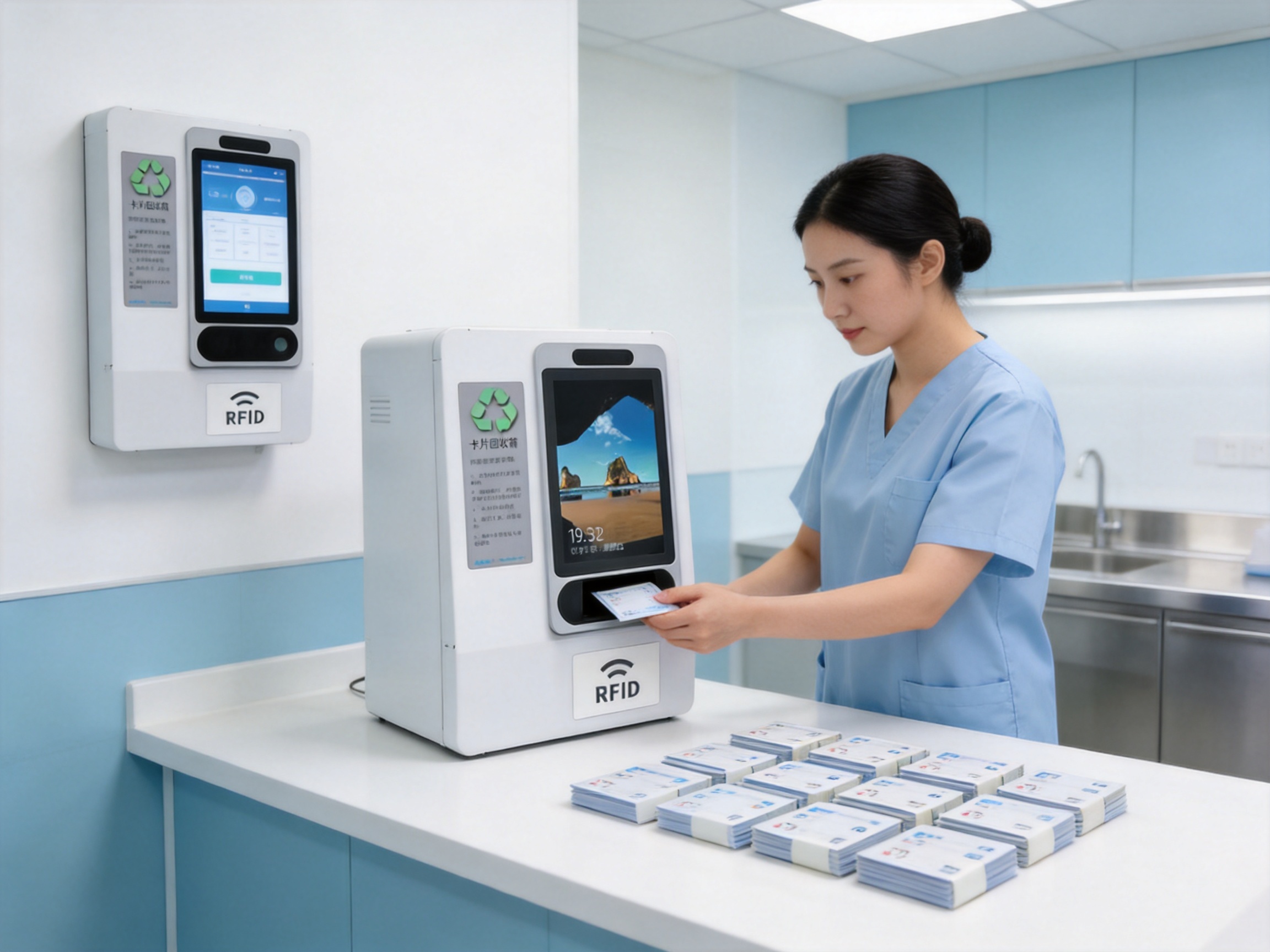
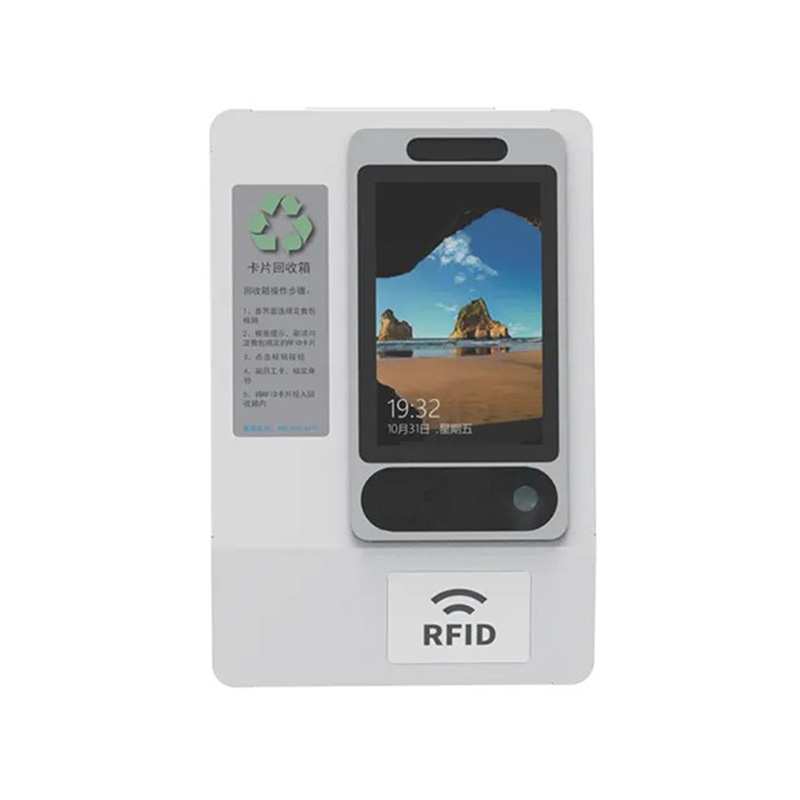
The cabinet supports both desktop placement and wall-mounted installation. This flexibility makes deployment easier in different environments. Some service counters have available desk space and require a terminal that can be placed near staff. Other sites have limited counter space but available wall space near an entrance, exit, security desk, or department return point. Wall-mounted installation can help save space and improve visibility, while desktop installation supports quick deployment and easier relocation.
Competitor products or improvised recycling methods may lack this installation flexibility. A fixed collection cabinet may require floor space. A simple box may not be secure or ergonomic. A system designed only for desktop use may not fit narrow corridors or compact service areas. The dual deployment mode gives the RFID Card Recycling Cabinet more practical adaptability, which is especially important for hospitals and campuses where space planning can be difficult.
Application Scenarios
Hospitals and Medical Facilities
Hospitals are complex environments where identity, access, workflow, and accountability are tightly connected. RFID cards may be used by doctors, nurses, technicians, administrators, cleaners, maintenance teams, temporary staff, and visitors. Cards may also be linked to departmental permissions, restricted medicine rooms, equipment rooms, operating areas, laboratories, or internal logistics systems. When a card is no longer required, recycling it through a secure and standardized process helps protect the facility.
The RFID Card Recycling Cabinet fits naturally into hospital service desks, staff entrances, department administration areas, logistics centers, and centralized card management offices. It can help reduce the burden on staff members who would otherwise count and record returned cards manually. It also supports the broader movement toward intelligent management in medical environments, where standardized terminals are increasingly used to improve process discipline and reduce human error.
Enterprises and Office Parks
Large enterprises often manage thousands of access cards for employees, contractors, visitors, and temporary personnel. Cards may be issued for limited periods and must be returned when employment ends, projects are completed, meetings conclude, or access permissions expire. Without a reliable recycling system, enterprise security teams may spend excessive time tracking missing cards and reconciling inventory records.
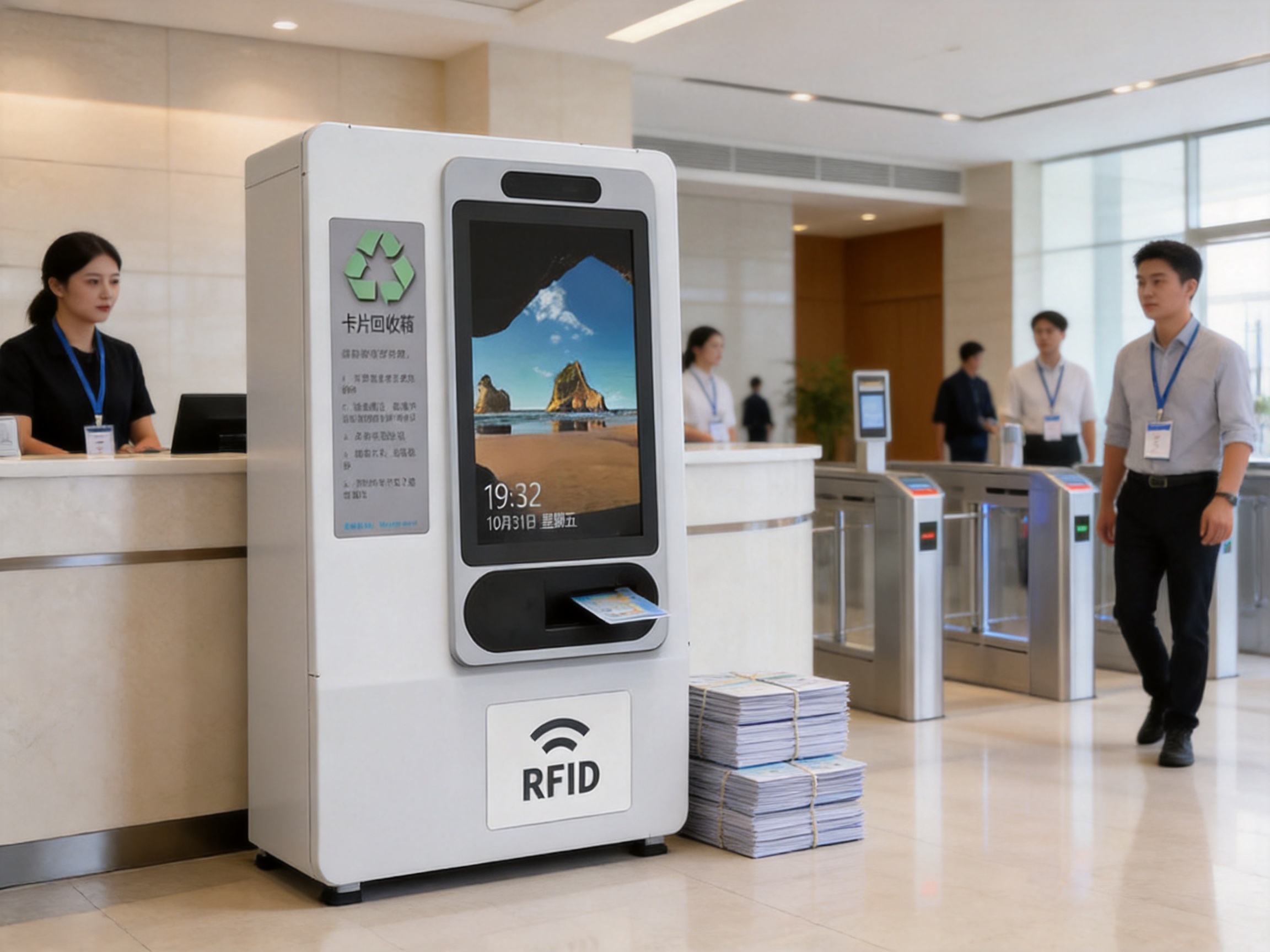
By installing the RFID Card Recycling Cabinet at reception areas, security offices, HR service points, or building exits, enterprises can create a consistent return point. This improves the recovery rate of cards and reduces the risk that active or reusable cards remain outside the organization. The cabinet also supports a professional image, showing that the organization treats access media as controlled assets.
Campuses and Educational Institutions
Universities, colleges, boarding schools, and training centers often operate large card systems. Student cards, temporary visitor cards, library cards, laboratory access cards, dormitory cards, and event cards may all require lifecycle management. During graduation, semester changes, student exchange periods, examinations, or large campus events, the number of cards needing recovery can increase sharply.
The cabinet helps educational institutions manage these peaks more efficiently. Fixed-number package recycling can simplify batch returns, while authentication helps control who can operate the recycling process. Wall-mounted installation can be useful in crowded campus service areas, and desktop placement can support temporary deployment during registration or event periods.
Public Facilities and Controlled Access Sites
Public service buildings, transportation-related facilities, libraries, laboratories, exhibition centers, and industrial parks may also benefit from centralized RFID card recycling. Any site that issues reusable cards can improve its process by replacing informal collection with an intelligent terminal. The product is particularly valuable where card loss creates security concerns, administrative costs, or service interruptions.
Competitive Advantages Over Conventional Recycling Methods
The RFID Card Recycling Cabinet offers several advantages over conventional methods such as manual reception, open collection boxes, locked drawers, envelopes, and general-purpose storage cabinets. The most obvious difference is process control. Traditional methods focus on physical collection, while the RFID Card Recycling Cabinet focuses on managed recycling. This distinction is important because organizations do not only need to store returned cards; they need to control how returns happen.
First, the cabinet improves security through authentication. An open collection box accepts any card from anyone, and a locked drawer depends entirely on the staff member who controls the key. Authentication-based operation provides a more structured method for limiting and validating recycling activities. In environments where security matters, this is a major improvement.
Second, the cabinet improves quantity control. Manual counting is vulnerable to distraction, fatigue, and inconsistent procedures. Fixed-number package recycling helps standardize card quantities and reduces the chance of counting mistakes. This is especially useful when cards are returned in batches or when multiple departments participate in recycling.
Third, the cabinet reduces manual workload. Staff members no longer need to design informal return procedures, repeatedly count random card batches, or handle every recycling action through ad hoc communication. A dedicated cabinet provides a clear process and reduces operational friction.
Fourth, the cabinet improves deployment flexibility. Desktop and wall-mounted options make it easier to place the terminal where users naturally return cards. This matters because the convenience of the return point directly affects compliance. If users must walk to a distant office or wait for a staff member, card recovery rates may decline. A conveniently placed recycling cabinet encourages timely returns.
Fifth, the cabinet projects a professional management image. In hospitals, campuses, and corporate facilities, visible intelligent terminals communicate that the organization has standardized procedures. This can improve user behavior and strengthen confidence in the institution’s operational discipline.
Comparison With Common Alternatives
| Management Method | Strengths | Weaknesses | Advantage of RFID Card Recycling Cabinet |
|---|---|---|---|
| Manual staff reception | Simple and familiar | Labor-intensive, vulnerable to counting errors, dependent on staff availability | Standardizes the process and reduces manual workload |
| Open collection box | Low cost and easy to place | No authentication, limited security, no structured quantity control | Supports controlled recycling through authentication and defined procedures |
| Locked drawer or cabinet | Provides basic physical storage | Still depends on manual records and key control | Combines physical collection with intelligent process management |
| Spreadsheet-based tracking | Can record quantities after manual entry | Delayed, error-prone, not integrated with the return action | Improves accuracy by supporting standardized recycling at the point of return |
| General-purpose kiosk | May provide digital interaction | Often not optimized for fixed-number card package recycling | Purpose-built for RFID card recycling and quantity management |
Design Philosophy: Standardization, Security, and Operational Simplicity
The design philosophy behind the RFID Card Recycling Cabinet can be summarized in three words: standardization, security, and simplicity. These qualities are essential for any intelligent management terminal intended for daily use in demanding environments.
Standardization means that every card return can follow the same basic process. This reduces uncertainty and makes training easier. When procedures are standardized, managers can compare data, identify abnormal patterns, and improve policies. Standardization also helps new employees or temporary staff understand the process quickly.
Security means that recycling is not treated as an uncontrolled activity. Since RFID cards may be connected to permissions, identities, or internal systems, the return process should be protected. Authentication supports this requirement by ensuring that recycling operations occur under controlled conditions.
Simplicity means that the cabinet is practical. In the real world, a technically powerful product may fail if it is difficult to operate. The RFID Card Recycling Cabinet is built for straightforward use, allowing organizations to improve management without introducing unnecessary complexity. This balance of intelligence and usability is one of the reasons the product is well suited to hospitals, campuses, and enterprises.
Manufacturing Strength and Quality Foundation
A reliable intelligent terminal depends not only on product design but also on manufacturing capability. Wanma Technology Co., Ltd. was established in 1997 and has long specialized in communication cabinets, communication electronic equipment, and passive optical components. Its products are widely used in Ethernet networks, optical communication networks, central equipment rooms, national high-speed railways, and urban rail transit systems. This background gives the company a strong foundation in precision enclosure production, electronic equipment integration, structural reliability, and large-scale industrial quality control.
The RFID Card Recycling Cabinet benefits from this manufacturing background. A cabinet used in public or semi-public environments must be physically durable, stable during repeated operation, and consistent in appearance and structure. Experience in communication cabinets and railway transit equipment is highly relevant because such products must withstand demanding installation conditions, long service cycles, and strict reliability expectations. The ability to manufacture equipment for communication networks and rail transit systems indicates familiarity with disciplined engineering, controlled production, and dependable delivery.
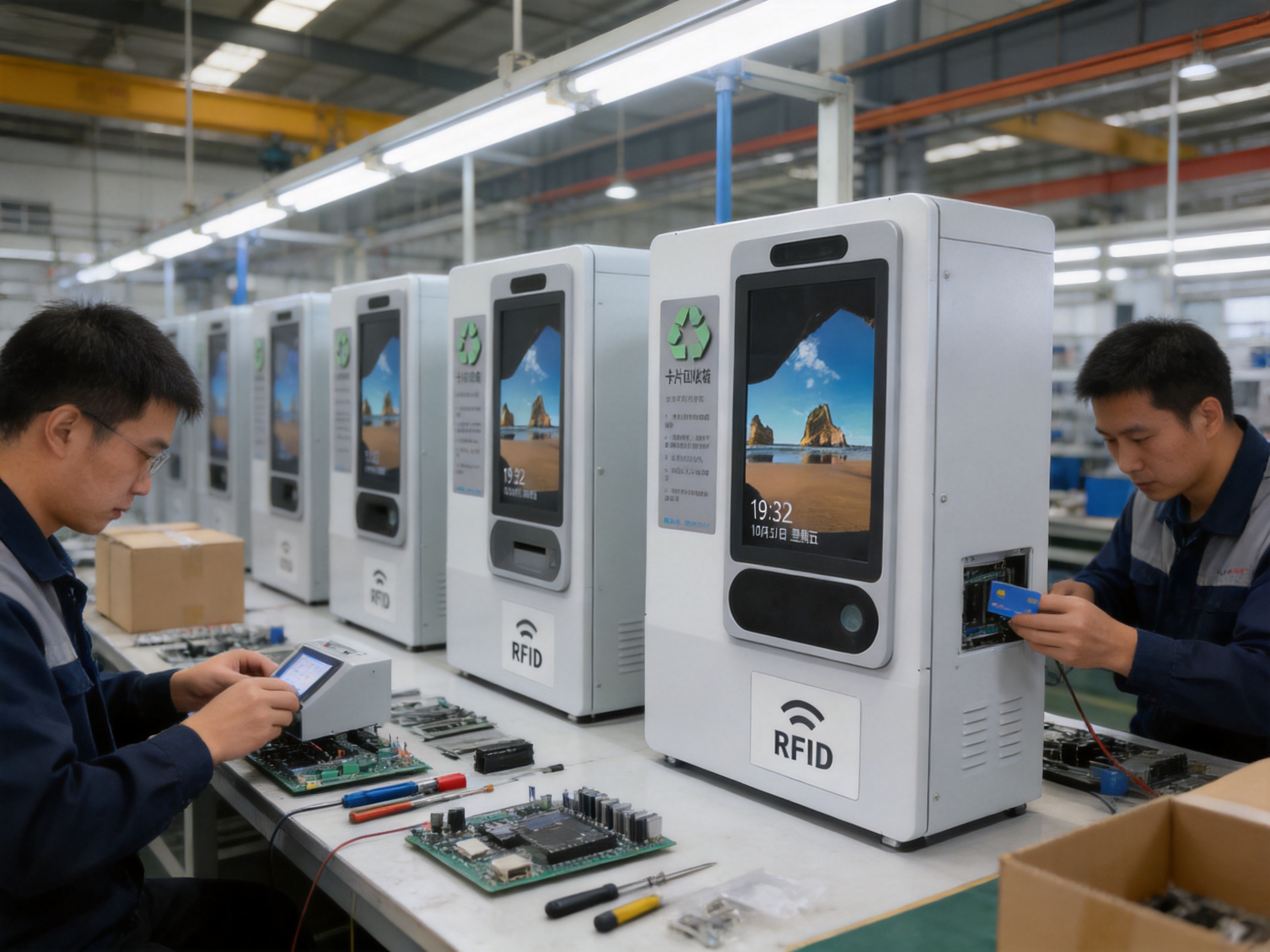
Advanced manufacturing processes are especially important for products that combine structure, electronics, authentication interaction, and user-facing operation. The enclosure must be accurately produced to ensure proper alignment, clean assembly, and stable installation. The internal layout must support secure card handling and convenient maintenance. Surface treatment must provide a professional appearance and help protect the product during long-term use. Assembly processes must ensure that each unit performs consistently before shipment.
The company’s manufacturing strengths also include the ability to develop, manufacture, and market self-branded products while providing integrated solutions for customized products. This is important because intelligent management terminals often need to adapt to different site requirements. A hospital may need a different deployment arrangement from a campus. An enterprise may have its own authentication policy or space limitations. A manufacturer with both standard production capability and customization experience can support these varied needs more effectively than a supplier limited to off-the-shelf hardware.
Advanced Process Capabilities Behind the Product
The quality of an RFID Card Recycling Cabinet is shaped by multiple manufacturing disciplines. Although users may mainly notice the exterior form and operating convenience, the final product reflects a chain of technical processes: design review, material selection, sheet metal processing, surface finishing, electronic integration, functional testing, packaging, and delivery control.
Structural Engineering and Enclosure Manufacturing
The cabinet must be compact enough for desktop or wall-mounted placement while strong enough for daily use. Structural engineering therefore requires careful attention to dimensions, load distribution, installation points, and operator interaction. Precision manufacturing helps ensure that doors, panels, card receiving areas, and mounting structures align properly. Good enclosure design also supports maintenance, cleaning, and long-term stability.
A company experienced in communication cabinets has a practical advantage in this area. Communication cabinets require accurate sheet metal fabrication, reliable assembly, and stable installation performance. These same capabilities support the production of a card recycling cabinet that must remain dependable in service counters, corridors, card centers, and other active locations.
Surface Treatment and Appearance Consistency
Public-facing terminals must look professional. Surface treatment affects not only appearance but also durability and cleaning convenience. In hospitals and corporate environments, equipment should present a clean, orderly, and modern image. Consistent surface finishing helps the cabinet blend into professional interiors and supports long-term use.
Competitors that rely on basic fabricated boxes may neglect this aspect. However, the visual and tactile quality of a recycling cabinet matters because it influences user trust. A well-finished cabinet suggests that the recycling process is formal and controlled. A poorly finished collection box may encourage casual or improper use.
Electronic Integration and Authentication Reliability
Because the cabinet supports multiple authentication methods, electronic integration is central to the product’s function. Authentication components must be installed securely and operate reliably during repeated daily use. Wiring, module placement, interface protection, and assembly consistency all affect reliability. A manufacturer with experience in communication electronic equipment is well positioned to manage these requirements.
Reliable authentication helps ensure that the cabinet performs its role as a controlled terminal rather than merely a storage unit. If authentication is unstable, users may lose confidence and return to manual methods. Therefore, manufacturing quality directly affects process adoption.
Assembly Standardization and Functional Testing
Assembly standardization is essential for consistent product performance. Each cabinet should follow defined assembly procedures, inspection standards, and functional testing requirements. This reduces variation between units and helps ensure that customers receive dependable products. Functional testing may include checking authentication operation, card package handling, installation components, mechanical fit, and general usability.
For customers, this manufacturing discipline translates into lower implementation risk. A product that is tested before delivery is easier to deploy and less likely to cause service disruption. This is especially important in hospitals and large enterprises, where downtime or faulty installation can affect many users.
Why Company Experience Matters to Customers
When selecting an intelligent recycling terminal, customers should consider more than the listed functions. Supplier background matters because it influences product reliability, delivery capability, customization support, and long-term partnership quality. Wanma Technology Co., Ltd. has operated since 1997, giving it decades of industrial experience. Its product portfolio covers communication cabinets, communication electronic equipment, and passive optical components, and its solutions are used in demanding sectors such as optical communication networks, central equipment rooms, high-speed railway systems, and urban rail transit systems.
This experience is relevant for several reasons. First, infrastructure-related industries require stable product quality. Equipment installed in communication networks or railway systems cannot be treated as disposable or casual hardware. The same reliability mindset supports the production of intelligent terminals for card management.
Second, the company has international market experience, with a sales network covering more than 20 countries and regions, including the United States, Australia, the United Kingdom, Italy, South Africa, and Ghana. Serving international customers requires attention to product consistency, documentation, packaging, delivery schedules, and communication. Customers purchasing the RFID Card Recycling Cabinet can benefit from a supplier accustomed to global cooperation.
Third, the company emphasizes reliable product quality, timely delivery, and long-term strategic partnerships. For organizations planning to standardize card recycling across multiple locations, supplier stability is important. A one-time hardware purchase is not enough; customers often need continuing support, additional units, and possible customization as their systems evolve.
Advantages in Medical Consumables Management Context
Although the product is specifically an RFID card recycling cabinet, it belongs to an intelligent management solution category related to medical consumables. This context is significant because healthcare organizations increasingly require digitalized, traceable, and standardized management for many physical items. Medical consumables, staff cards, access cards, authorization cards, and identification media all need disciplined lifecycle control.
In a hospital, an RFID card may function as an access credential, an operational identity token, or a link to digital systems that manage consumables and departments. Recovering such cards through a secure cabinet supports the broader hospital goal of preventing uncontrolled circulation of physical identifiers. It also supports efficient administration because staff members can return cards through a defined process rather than relying on informal handover.
The cabinet’s fixed-number package recycling function can be valuable in medical departments where cards are issued and recovered in groups. For example, temporary staff, visiting medical teams, training groups, or department-based users may receive cards in batches. Fixed-number recycling supports fast verification and reduces the burden on administrative staff. In a setting where time is precious and mistakes can have consequences, this is a meaningful operational improvement.
Security and Accountability Benefits
Security is one of the primary reasons to adopt an intelligent RFID card recycling system. RFID cards often represent access rights. Even if digital permissions can be disabled, the physical card still matters because users and administrators must know whether it has been recovered, lost, damaged, or retained. A standardized recycling cabinet supports this accountability.
Authentication helps link recycling activities to controlled operation. This discourages improper handling and supports internal governance. Fixed-number package recycling improves quantity accountability by making the return count easier to confirm. Centralized placement makes it clear where cards should be returned, reducing confusion and preventing cards from being left in unsecured locations.
Compared with competitors that offer only passive collection containers, the RFID Card Recycling Cabinet provides a more complete security framework. It does not simply wait for cards to be dropped inside; it supports a controlled process. This distinction is important in organizations with compliance requirements, internal audit procedures, security policies, or high asset turnover.
Operational Efficiency and Cost Control
Efficiency is another major benefit. Manual card recycling consumes time in small increments: receiving cards, asking questions, counting quantities, writing records, checking inventory, storing batches, and resolving discrepancies. These small tasks accumulate quickly in large organizations. By standardizing the return process, the RFID Card Recycling Cabinet helps reduce repetitive manual work and improves staff productivity.
Cost control also improves when more cards are recovered accurately. Reusable cards can be returned to inventory instead of being replaced unnecessarily. Missing cards can be identified more quickly. Administrative labor can be reduced. The organization can maintain a more accurate understanding of card circulation, which supports better purchasing decisions. Over time, the cabinet can contribute to lower operational waste and improved asset utilization.
The product’s flexible installation also supports cost-effective deployment. Organizations do not need to remodel spaces extensively. Desktop placement allows quick implementation, while wall-mounted installation saves space in compact areas. This flexibility can reduce installation costs and make pilot projects easier.
User Experience and Adoption
The success of any management tool depends on whether people use it correctly. The RFID Card Recycling Cabinet is designed to be simple and efficient, which supports user adoption. If the process is clear, staff and users are more likely to follow it. If the cabinet is placed conveniently, returned cards are less likely to be forgotten or left elsewhere.
Good user experience also reduces training requirements. In hospitals, campuses, and enterprises, staff turnover and role changes are common. A simple recycling process helps new personnel understand what to do without lengthy instruction. This supports continuity and reduces the risk that management procedures deteriorate over time.
The cabinet’s professional appearance can further encourage proper use. People tend to respect equipment that appears official and purpose-built. A labeled, installed recycling cabinet creates a stronger behavioral cue than a temporary box or envelope. This is a subtle but important advantage in process management.
Customization and Integrated Solution Potential
Different organizations have different card management requirements. Some may prioritize authentication. Others may emphasize batch recycling. Some may need wall-mounted units in multiple departments, while others may prefer desktop units at a central service desk. Because Wanma Technology Co., Ltd. develops and manufactures its own branded products and also provides integrated solutions for customized products, customers can benefit from a supplier capable of adapting to practical needs.
Customization potential may include installation configuration, operational workflow adjustment, interface adaptation, enclosure details, or deployment planning. A manufacturer with broad experience in communication equipment and intelligent terminal production can better understand how physical hardware, electronic modules, and operational processes must work together. This integrated perspective is valuable when customers want more than a single device and instead seek a complete management improvement.
For multi-site organizations, customization and solution support are especially important. A hospital group may need consistent card recycling standards across branches. A university may need multiple return points across campus. An enterprise park may need cabinets in different buildings. Standardized hardware combined with flexible deployment planning can support these larger projects.
Deployment Considerations
To maximize the value of the RFID Card Recycling Cabinet, organizations should plan deployment carefully. The first consideration is location. The cabinet should be installed where card returns naturally occur, such as reception areas, exit points, department offices, security posts, or card service centers. A convenient location increases return compliance.
The second consideration is workflow. Organizations should define who is authorized to operate the cabinet, what authentication method will be used, what fixed-number package rules apply, and how returned cards are transferred to inventory or further processing. Clear procedures help ensure that the cabinet becomes part of a complete management system rather than an isolated device.
The third consideration is user communication. Staff, visitors, students, or employees should be informed about where and how to return cards. Signage, internal notices, onboarding materials, or exit procedures can reinforce the process. The cabinet should be presented as the official card recycling point.
The fourth consideration is maintenance. Like any intelligent terminal, the cabinet should be inspected periodically to ensure proper operation. Physical condition, mounting stability, authentication function, and collection capacity should be checked according to the organization’s operating needs. Good maintenance helps preserve reliability and extends service life.
How the Cabinet Supports Digital Transformation
Digital transformation is not only about software platforms. It also requires intelligent physical terminals that connect real-world actions with managed procedures. The RFID Card Recycling Cabinet is an example of this principle. It improves a physical process, card return, by making it more controlled, standardized, and compatible with modern management thinking.
Many organizations invest heavily in access control systems, hospital information systems, campus management platforms, and enterprise identity systems. However, the lifecycle of the physical card is sometimes overlooked. Issuance may be digital, but recycling remains manual. This gap creates inefficiency and risk. An intelligent recycling cabinet helps close the loop by giving the organization a better way to manage the end stage of card use.
In this sense, the cabinet supports a more complete asset lifecycle. Cards are issued, used, returned, verified, and prepared for reuse or disposal. Each stage becomes more intentional. This is particularly important as organizations seek higher levels of governance, traceability, and resource efficiency.
Environmental and Resource Efficiency Value
Card recycling also has an environmental dimension. RFID cards contain materials and embedded components that should not be wasted unnecessarily. By improving recovery rates and making reusable cards easier to manage, organizations can reduce avoidable consumption. A structured recycling process supports more responsible resource use.
Fixed-number package recycling can make it easier to collect cards in organized batches for inspection, reactivation, cleaning, reuse, or proper disposal. This reduces the chance that cards are discarded casually. For institutions with sustainability goals, better card lifecycle management can contribute to broader waste reduction and responsible asset management initiatives.
Product Value Summary
The RFID Card Recycling Cabinet delivers value through a combination of security, efficiency, standardization, and deployment flexibility. It supports multiple authentication methods to control recycling activity. It enables fixed-number card package recycling for easier quantity verification. It simplifies operation to reduce manual errors. It offers both desktop and wall-mounted installation to fit diverse spaces. These features make it suitable for hospitals, enterprises, campuses, and other facilities that require centralized RFID card recycling and standardized management.
Its advantages over competitors and conventional methods are clear. It is more secure than an open collection box, more efficient than manual reception, more specialized than a general storage cabinet, and more process-oriented than spreadsheet-based tracking. It helps organizations improve card recovery, reduce workload, protect access media, and strengthen accountability.
The product is also supported by the manufacturing strength of Wanma Technology Co., Ltd., a company established in 1997 with deep experience in communication cabinets, communication electronic equipment, passive optical components, Ethernet networks, optical communication networks, central equipment rooms, high-speed railways, and urban rail transit systems. This industrial background supports strong enclosure manufacturing, reliable electronic integration, quality control, customization capability, and international delivery experience.
Q&A Section
Q1: What is the main purpose of the RFID Card Recycling Cabinet?
The main purpose is to provide a centralized, intelligent, and controlled terminal for recycling RFID cards. It helps organizations standardize the return process, improve quantity verification, reduce manual errors, and manage card recovery more securely.
Q2: Which industries can use this cabinet?
The cabinet is suitable for hospitals, enterprises, campuses, public facilities, office parks, laboratories, visitor centers, and any organization that needs centralized RFID card recycling and standardized card management.
Q3: How does the cabinet improve security?
It supports multiple authentication methods, which helps ensure that recycling activities are controlled. This is more secure than an open collection box or informal manual return process because it limits recycling operations to authorized procedures.
Q4: What is fixed-number card package recycling?
Fixed-number card package recycling means that cards can be returned according to defined quantities or package standards. This makes counting easier, improves verification accuracy, and reduces disputes or errors in batch returns.
Q5: Why is this product useful in hospitals?
Hospitals often use RFID cards for staff identity, access control, department authorization, visitor management, and workflow-related applications. The cabinet helps recover these cards in a standardized way, reducing administrative workload and supporting better security.
Q6: Can the cabinet be installed in different environments?
Yes. It supports both desktop placement and wall-mounted installation. This allows deployment at service counters, security desks, department offices, corridors, entrances, exits, and other practical return points.
Q7: How is it better than a simple card collection box?
A simple box only collects cards physically. It does not provide authentication, process control, or standardized quantity management. The RFID Card Recycling Cabinet offers a more secure and professional recycling process.
Q8: Does the product help reduce manual errors?
Yes. Its simple operation and fixed-number recycling support help reduce counting mistakes, missed records, and inconsistent manual procedures. This makes card recycling more reliable in busy environments.
Q9: Why does manufacturing experience matter for this product?
The cabinet combines structural hardware, electronic integration, authentication operation, and installation reliability. A manufacturer with long experience in communication cabinets and electronic equipment can provide better consistency, durability, and quality control.
Q10: Can the product support customized requirements?
Wanma Technology Co., Ltd. develops and manufactures its own products and provides integrated customized solutions. This capability can support different deployment needs, operating environments, and project requirements.
Conclusion
The RFID Card Recycling Cabinet is a practical and intelligent solution for organizations that need secure, efficient, and standardized RFID card recovery. By combining authentication, fixed-number package recycling, simple operation, and flexible installation, it turns a common administrative task into a controlled management process. It is especially valuable in hospitals, enterprises, campuses, and public facilities where RFID cards are connected to access, identity, workflow, and asset control.
Compared with manual collection, open boxes, locked drawers, or general-purpose storage methods, the cabinet provides stronger security, better quantity verification, lower staff workload, and a more professional user experience. Its value is not limited to collecting cards; it helps organizations improve accountability, reduce waste, support digital transformation, and strengthen lifecycle management of access media.
Backed by the advanced manufacturing capabilities and industrial experience of Wanma Technology Co., Ltd., the product benefits from a strong foundation in communication equipment, precision cabinet production, electronic integration, quality control, and international service. For customers seeking a dependable RFID card recycling solution, this cabinet offers a balanced combination of intelligent function, operational simplicity, durable manufacturing, and scalable deployment potential.
References
Finkenzeller, K. RFID Handbook: Fundamentals and Applications in Contactless Smart Cards, Radio Frequency Identification and Near-Field Communication.
Want, R. RFID Explained: A Primer on Radio Frequency Identification Technologies.
International Organization for Standardization. ISO/IEC 14443 Identification Cards: Contactless Integrated Circuit Cards.
International Organization for Standardization. ISO/IEC 15693 Identification Cards: Contactless Integrated Circuit Cards, Vicinity Cards.
International Electrotechnical Commission. General Principles for Electronic Equipment Reliability and Environmental Testing.
Healthcare Information and Management Systems Society. Guidance on Healthcare Asset Tracking and Digital Workflow Management.
Security Industry Association. Access Control System Design and Credential Lifecycle Management Practices.
Product: RFID Card Recycling Cabinet
PREV:RFID Handheld Inventory Device for Intelligent Medical Fabric Management
NEXT:20-Foot Containerized Data Center for Rapid, Resilient Digital Infrastructure
NEXT:20-Foot Containerized Data Center for Rapid, Resilient Digital Infrastructure
Interested in cooperation or have questions?
Related products
-
-
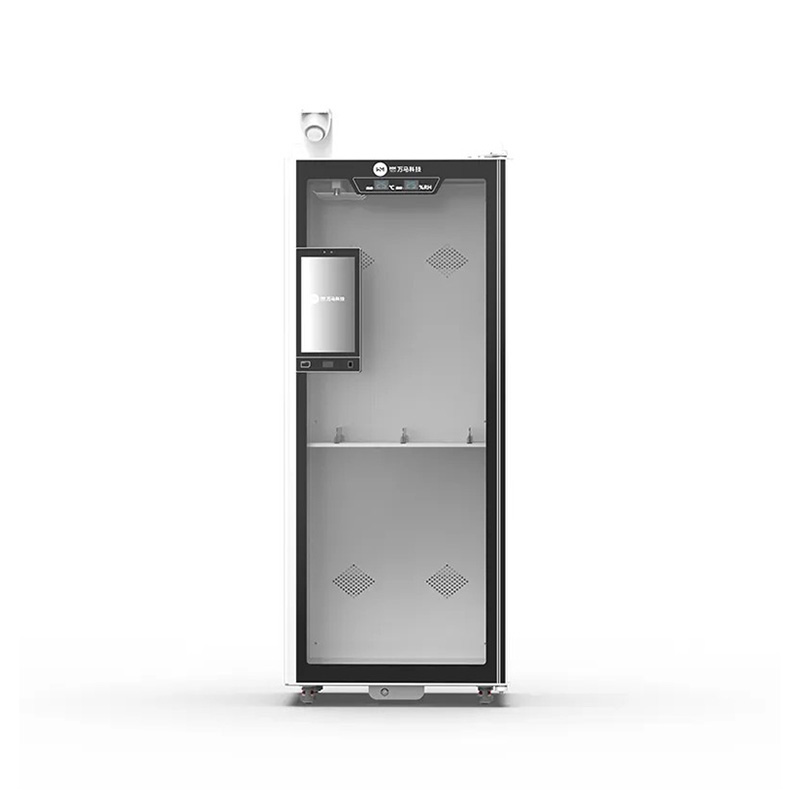
Product Definition This product is a high-capacity intelligent consumables management cabinet designed for hospitals, laboratories, and medical institutions, integrating RFID technology, smart access ...
See Details -
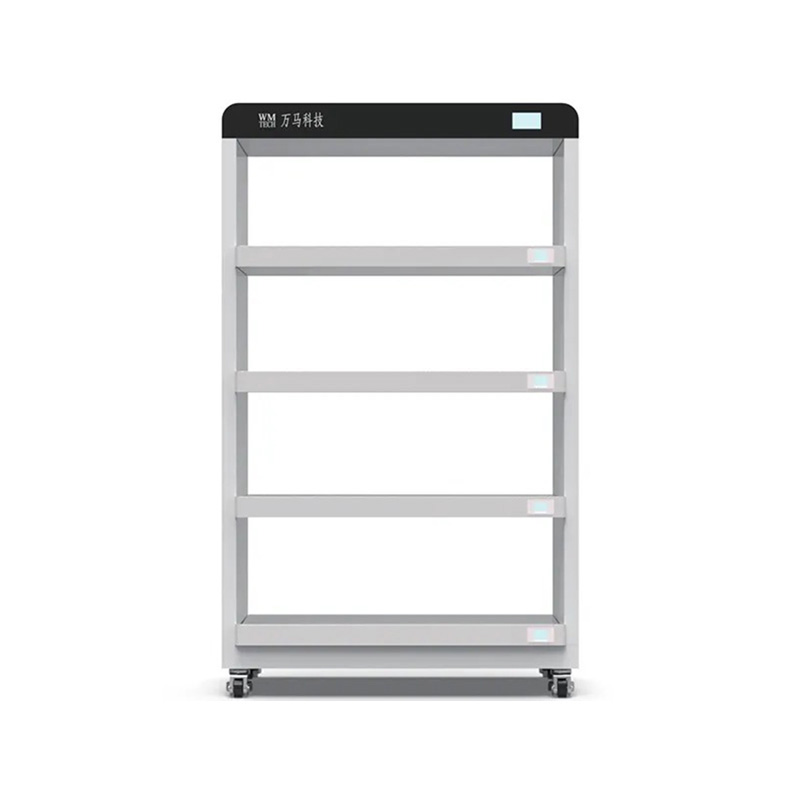
Product Definition:Intelligent Shelves are a smart warehouse management unit that integrates dynamic sensing, real-time display, and precise positioning. By leveraging advanced sensor technology, they...
See Details -
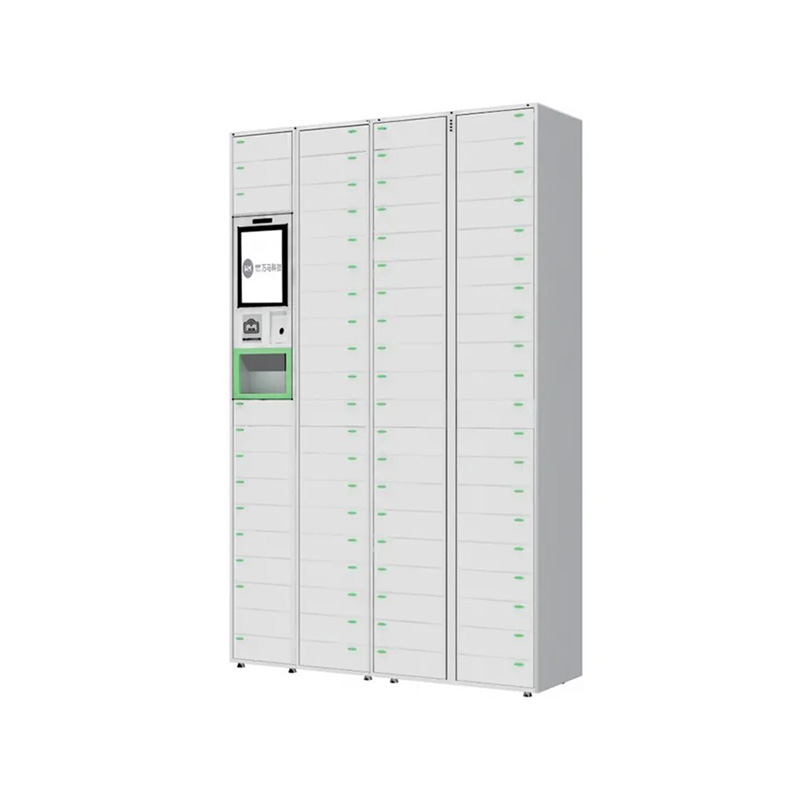
Product Definition:The Uniform Distribution Cabinet is an intelligent management solution for hospitals and medical institutions, designed for automated distribution, inventory management, and trackin...
See Details
Ready to Get started ? Contact Us Now !

Product.
Contact Details.
-
 +86 13958188250
-
 +86 13958188250
-
 [email protected]
- Wanma Industrial Park Taihu Yuan Town Lin'an District Hangzhou City China.
QR Code

Copyright © Wanma Technology Co., Ltd. All Rights Reserved.
Custom Ethernet Optical Network Railway Transit Equipments Suppliers
