

 English
 Français
 Español
 Português
 عربى






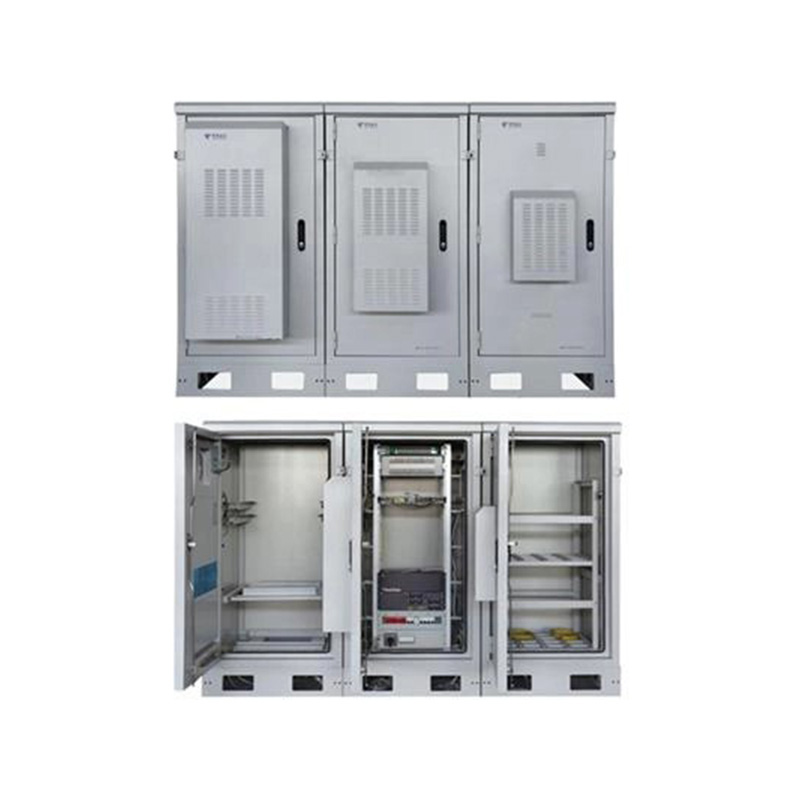
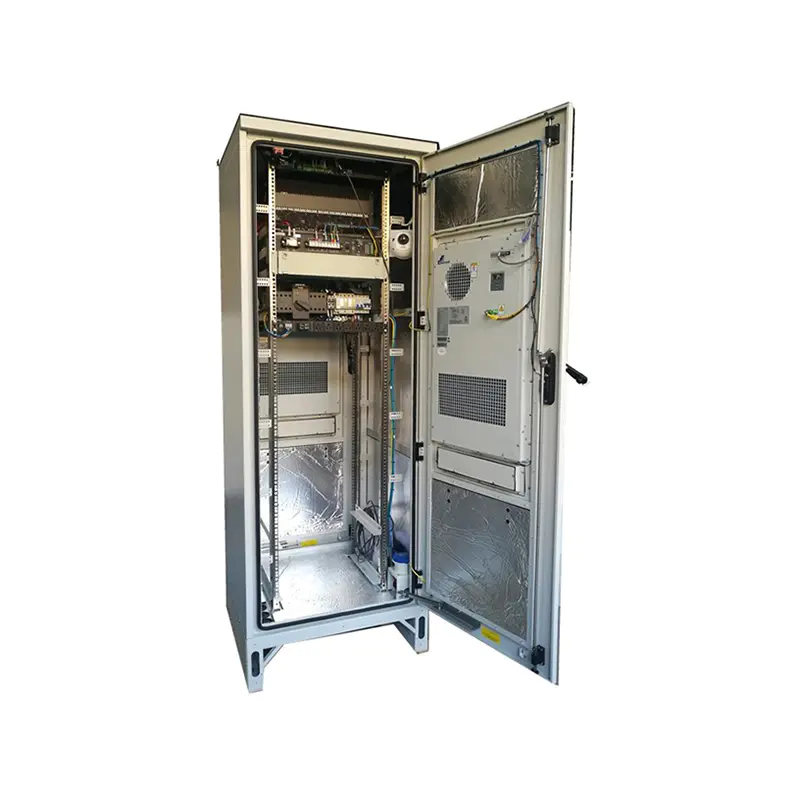
Application:It is used for the fixed network and broadband access, providing physical working environment and security system for the workstation in wired network. Features:•The cabinet is composed of...
See DetailsOutdoor Telecom Cabinets for Copper-to-Fibre Network Modernisation
Content
- 1 The Strategic Importance of the Outdoor Distribution Cabinet
- 2 Product Structure and Protection Features
- 3 Fibre Management for Reliable Optical Networks
- 4 Supporting the Copper-to-Fibre Coexistence Period
- 5 The Rotatable Main Distribution Frame
- 6 Optical Splitter Capacity and Network Flexibility
- 7 Advantages Compared with Conventional Copper Cabinets
- 8 Manufacturing Strengths and Quality-Control Approach
- 9 Installation and Commissioning Considerations
- 10 Maintenance Strategy for Long-Term Performance
- 11 Applications Across Different Network Environments
- 12 Why Partner with Wanma Technology
- 13 Selection Guidelines for Project Engineers
- 14 Q&A
- 14.1 What is the primary application of this outdoor telecom cabinet?
- 14.2 What protection grade does the cabinet provide?
- 14.3 Can the cabinet support copper and fibre equipment at the same time?
- 14.4 Why is a double-layer structure important?
- 14.5 What is the purpose of the rotatable MDF?
- 14.6 How does the cabinet support fibre splice management?
- 14.7 Why are concealed hinges useful in an outdoor cabinet?
- 14.8 How does the multi-point lock improve security?
- 14.9 What is the benefit of the drawer-type filter cover?
- 14.10 Can the cabinet be used for optical splitter installations?
- 14.11 What should be considered when installing fibre inside the cabinet?
- 14.12 Does Wanma Technology provide customised solutions?
- 14.13 Which industries can use this cabinet?
- 15 Conclusion
- 16 References
- 17 Product: Outdoor Telecom Cabinet--- for Replacement of Copper Cables with Optical Fiber Cables
The replacement of copper cables with optical fibre is transforming fixed-access networks, broadband infrastructure, railway communication systems, and urban telecommunications. However, the success of a fibre migration depends on more than installing new cables. It also requires a reliable outdoor cabinet capable of protecting sensitive optical equipment, organising fibre connections, supporting legacy copper services, and maintaining stable operation under changing environmental conditions.
The outdoor telecom cabinet for copper-to-optical-fibre replacement is designed for this exact transition. It provides a protected physical working environment for fixed networks and broadband access while helping operators manage the technical and operational challenges of mixed copper-and-fibre deployments. The cabinet combines a double-layer heat-insulation structure, IP55 protection, concealed hinges, a secure multi-point door lock, a serviceable filter cover, a rain-resistant herringbone roof, and a rotatable main distribution frame.
These features are important because the street cabinet is often the point where feeder infrastructure, distribution cables, optical termination equipment, splice trays, splitters, and legacy copper connections meet. A cabinet that is poorly designed for this environment can increase maintenance time, expose equipment to moisture and dust, and make future network expansion unnecessarily expensive. A purpose-designed enclosure provides a more orderly and dependable foundation for long-term access-network modernisation.
The Strategic Importance of the Outdoor Distribution Cabinet
Network migration from copper to fibre rarely occurs in one operation. In most access networks, operators must continue serving existing customers through copper-based services while gradually connecting new and migrating customers to fibre. This means that the outdoor cabinet must remain functional throughout a prolonged transition period.
At the beginning of a migration programme, the cabinet may contain copper cross-connection equipment, DSL-related components, line protection devices, power distribution hardware, and a limited number of optical components. As the programme advances, the optical side becomes more important. Fibre termination panels, splice trays, optical distribution modules, splitter cassettes, and fibre management accessories may eventually occupy most of the available working space.
A cabinet designed only for copper networks is not always suitable for this evolution. Copper cables can tolerate different routing methods and generally require different connection hardware from optical fibre. Fibre cables need controlled bend radii, protected splice points, organised slack storage, and careful separation between feeder and distribution routes. Optical connectors and splice trays must also be accessible without disturbing unrelated circuits.
The outdoor telecom cabinet for copper-to-fibre replacement addresses these requirements by providing a structured enclosure for the changing network. It can support the coexistence of legacy and modern equipment while giving operators a path toward a predominantly optical access network.
This approach offers several practical benefits:
- It allows migration to proceed cabinet by cabinet instead of requiring a disruptive network-wide cutover.
- It gives technicians a safer and more organised environment for fibre splicing and termination.
- It protects network equipment from rain, dust, accidental contact, and unauthorised access.
- It supports more efficient fault isolation and routine maintenance.
- It provides a foundation for future broadband capacity expansion.
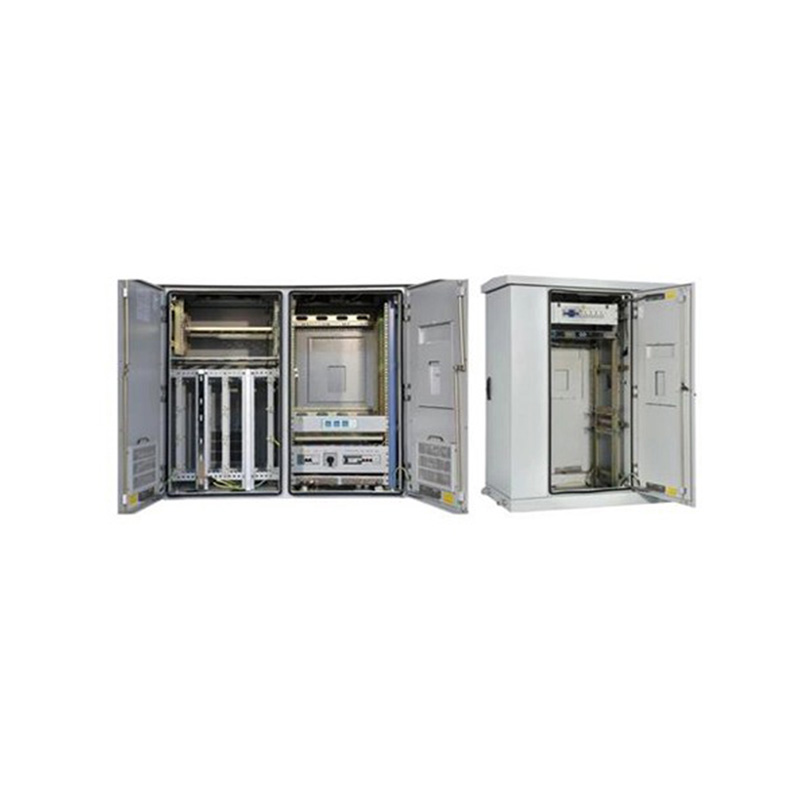
Outdoor Telecom Cabinet--- for Replacement of Copper Cables with Optical Fiber Cables
Product Structure and Protection Features
Double-Layer Heat-Insulation Construction
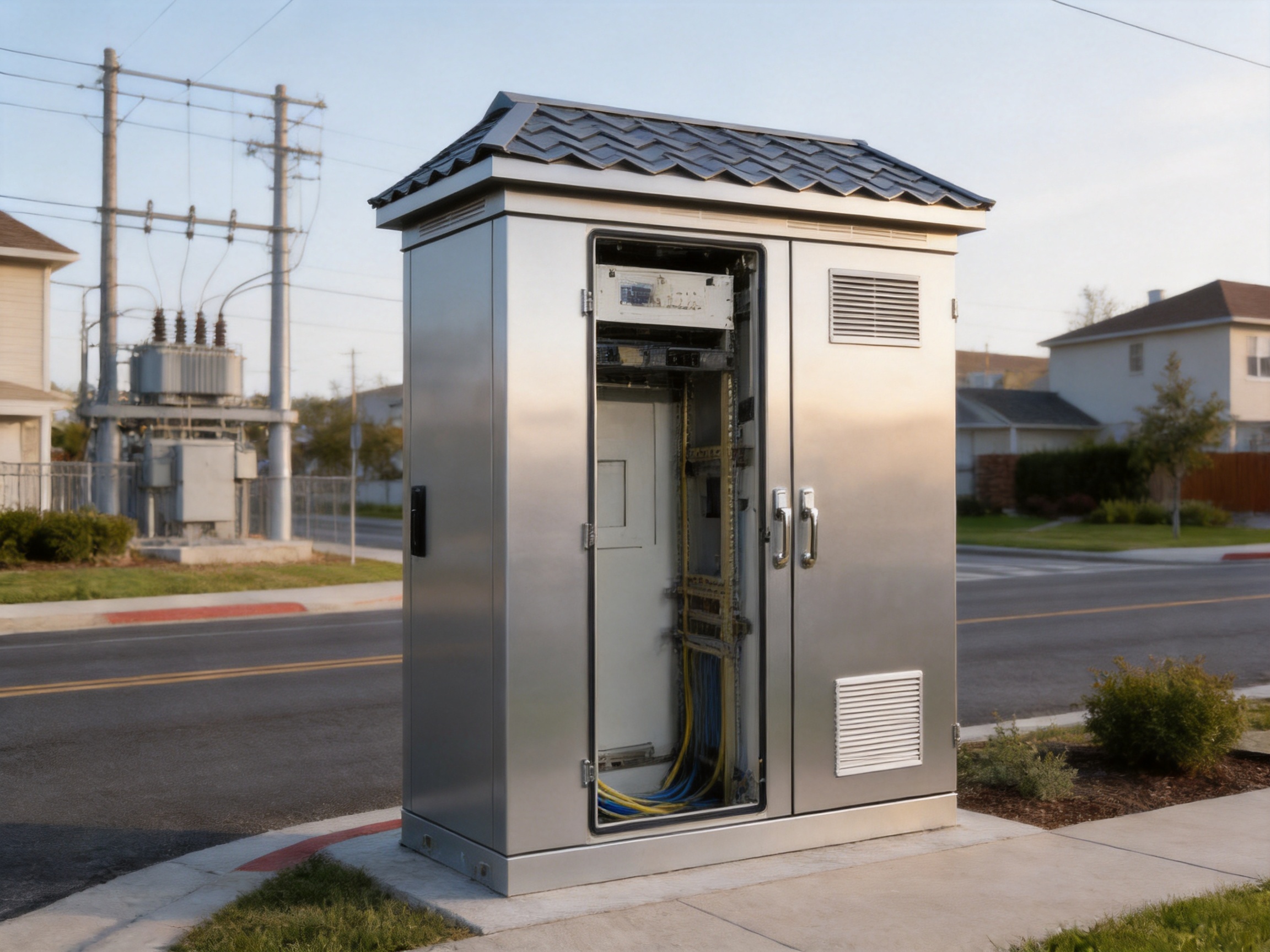
The cabinet is composed of a cover plate, cabinet body, and door. Its double-layer heat-insulation structure is one of the most important features for outdoor deployment. Cabinets installed at street level are exposed to solar radiation, seasonal temperature changes, wind, rain, and potentially snow or ice. Without an appropriate thermal design, the temperature inside the enclosure can rise significantly above the ambient temperature.
Excessive heat can shorten the operating life of power supplies, active network electronics, batteries, and optical transmission equipment. Temperature changes can also contribute to condensation, especially when warm and humid air enters a cabinet that has cooled rapidly at night. The double-layer construction helps reduce the direct transfer of external heat into the internal working area and creates a more stable environment for installed equipment.
Thermal stability is particularly valuable during the copper-to-fibre transition. Hybrid installations may contain equipment from different technology generations, each with its own temperature and ventilation requirements. A cabinet that reduces thermal stress can help the operator preserve equipment reliability while avoiding unnecessary premature replacement.
IP55 Protection
The cabinet complies with the GB4208 protection standard and provides an IP55 protection grade. The first digit indicates protection against the ingress of dust in quantities that could interfere with normal operation. The second digit indicates protection against water jets from any direction.
IP55 protection is appropriate for many outdoor telecommunications applications because it provides a balance between environmental protection and practical field serviceability. It helps shield fibre management components, connectors, copper termination equipment, and other internal assemblies from common outdoor hazards.
Protection performance depends not only on the cabinet shell but also on door seals, cable entry arrangements, filter maintenance, hinge design, and correct installation. For this reason, the cabinet’s structural features must work together as a complete environmental protection system. A strong enclosure with poorly managed cable entries would not provide the same practical result as a fully integrated design.
Concealed Hinge Structure
The hidden hinge structure improves both appearance and security. External hinges can become vulnerable to impact, corrosion, tampering, or deliberate removal. Concealed hinges reduce the number of exposed components that can be attacked from outside the cabinet.
This feature is particularly relevant in roadside, railway, industrial, and urban environments where equipment may be installed in locations accessible to the public. By protecting the hinge mechanism within the cabinet structure, the enclosure makes unauthorised access more difficult and helps preserve door alignment over the service life of the product.
Multi-Point Door Lock
The multi-point door lock is designed to prevent the cabinet from being forced open with a crowbar or similar tool. Instead of relying on a single locking point, the system secures the door at multiple locations. This improves resistance to prying and helps maintain even compression on the door seal.
Security is not merely a concern for preventing theft. Unauthorised access can lead to accidental cable disconnection, fibre contamination, equipment damage, service interruption, or unsafe exposure to electrical components. A secure door therefore supports both network availability and personnel safety.
Herringbone Double-Layer Cover Plate
The herringbone double-layer cover plate is designed to prevent the accumulation of rainwater on the top of the cabinet. A flat or poorly shaped roof can allow water to remain on the surface, increasing the possibility of leakage, corrosion, staining, and accelerated deterioration of external finishes.
The herringbone form encourages water to drain away from the cabinet rather than collect around seams or access points. Combined with the double-layer construction, it contributes to better environmental protection and helps the cabinet remain suitable for exposed outdoor locations.
Drawer-Type Filter Cover
The drawer-type filter cover is designed for convenient cleaning, maintenance, and replacement. Outdoor cabinets can accumulate dust, pollen, airborne particles, and other contaminants around ventilation or filtration areas. If a filter becomes blocked, airflow can be restricted and internal temperatures may increase.
A removable drawer-type design allows technicians to access the filter without dismantling a large section of the cabinet. This can shorten maintenance time and reduce the risk of disturbing active cables or installed modules. It also encourages more regular cleaning because the task is simpler and more predictable.
Easy maintenance is an important advantage over cabinets in which filters are permanently fixed behind complicated panels. In a large network, small reductions in service time can produce substantial operational savings when multiplied across hundreds or thousands of cabinets.
Fibre Management for Reliable Optical Networks
Optical fibre requires disciplined management. Although fibre cables are lightweight and occupy less space than many copper cables, they are more sensitive to bending, tension, contamination, and careless handling. The cabinet must therefore provide clear routing paths and sufficient room for storage and future service work.
Bend Radius Control
Single-mode fibre must be routed according to the minimum bend radius specified by the cable or component manufacturer. Standard G.652D fibre is commonly associated with a bend radius of approximately 30 millimetres during installation and approximately 15 millimetres for long-term static routing, although the exact requirement depends on the cable construction and application.
If a fibre is bent too sharply, microbending and macrobending losses can increase. The resulting attenuation may not be immediately visible during installation, but it can gradually affect link performance and reduce the available optical power margin. Poor routing can also make troubleshooting difficult because the fault may not be apparent through a basic visual inspection.
The cabinet should therefore provide smooth routing paths, protective guides, adequate slack storage, and sufficient clearance around splice trays and connector panels. A well-organised interior helps technicians comply with bend-radius requirements even during repeated maintenance activities.
Splice Tray Organisation
Fusion splicing is central to many fibre deployments. Each splice must be protected by an appropriate sleeve and positioned securely within a splice tray. Depending on the tray design, a tray may accommodate 12 or 24 fusion splices or another number specified for the application.
Splice trays should be arranged so that a technician can access one group of fibres without unnecessarily disturbing adjacent groups. Swing-out or slide-out mechanisms are particularly useful because they allow inspection and repair while maintaining visibility of the cable routing.
Clear labelling is equally important. Labels should identify the feeder cable, tube or buffer colour, fibre number, destination, and service assignment where applicable. Accurate labelling reduces the time required to identify a fault and lowers the likelihood of disconnecting the wrong circuit during expansion work.
Slack Storage and Cable Entry
Fibre slack must be stored carefully. Insufficient slack can place tension on the cable sheath or splice points when a tray is opened. Excessive or poorly controlled slack can create tangles, obstruct access, and increase the chance of accidental bending.
The cabinet should provide dedicated storage routes at cable entry points and around termination modules. Slack loops must be large enough to allow trays or panels to move without pulling on the incoming cable. The storage arrangement should also keep fibres away from sharp edges, door movements, locks, and other mechanical components.
Feeder and distribution fibres should preferably be routed in clearly separated areas. This physical separation improves work discipline and allows technicians to perform maintenance on one side of the network without unnecessarily disturbing the other.
Supporting the Copper-to-Fibre Coexistence Period
The migration period can last for several years, particularly in large metropolitan networks. During this time, the cabinet may need to support active copper subscribers, fibre subscribers, network power systems, and future expansion modules at the same time.
A practical hybrid cabinet must therefore provide a logical division between copper and optical functions. Copper cross-connection units, DSL splitter assemblies, and related power equipment should not be mixed randomly with splice trays and optical splitter cassettes. Physical separation helps reduce the chance that a copper maintenance task will disturb an active fibre connection.
Partitioning also improves technician orientation. A technician who opens the cabinet should be able to identify the copper zone, fibre zone, power zone, and cable-routing areas quickly. Clear organisation reduces the mental and physical complexity of field work, especially during bad weather, poor lighting, or urgent service restoration.
Where cabinet dimensions allow, independent access doors for different functional zones can provide an additional advantage. A technician working on copper connections may not need to open the fibre section at all. This limits exposure of optical components to dust and accidental contact while improving security during maintenance.
The outdoor telecom cabinet for copper-to-fibre replacement is therefore more than a weatherproof box. It is a migration platform that allows operators to manage two network generations in a controlled manner until the legacy system can be retired.
| Requirement | Operational Challenge | Cabinet Design Response | Practical Benefit |
|---|---|---|---|
| Protection from outdoor conditions | Rain, dust, temperature changes, and solar heating | IP55 enclosure, double-layer structure, and herringbone cover | Improved environmental protection and equipment stability |
| Optical fibre routing | Bend-radius limits and sensitivity to tension | Organised routing paths and dedicated slack storage | Lower risk of attenuation and fibre damage |
| Splicing and termination | Limited access and complex cable identification | Rotatable frame, serviceable trays, and labelling provisions | Faster installation, testing, and fault isolation |
| Hybrid network operation | Simultaneous support for copper and fibre services | Structured internal arrangement and physical separation | Reduced interference between maintenance activities |
| Unauthorised access | Vandalism, tampering, and accidental operation | Concealed hinges and multi-point locking | Higher physical security and service continuity |
| Routine maintenance | Blocked filters and difficult component access | Drawer-type filter cover and accessible internal modules | Reduced maintenance time and improved serviceability |
The Rotatable Main Distribution Frame
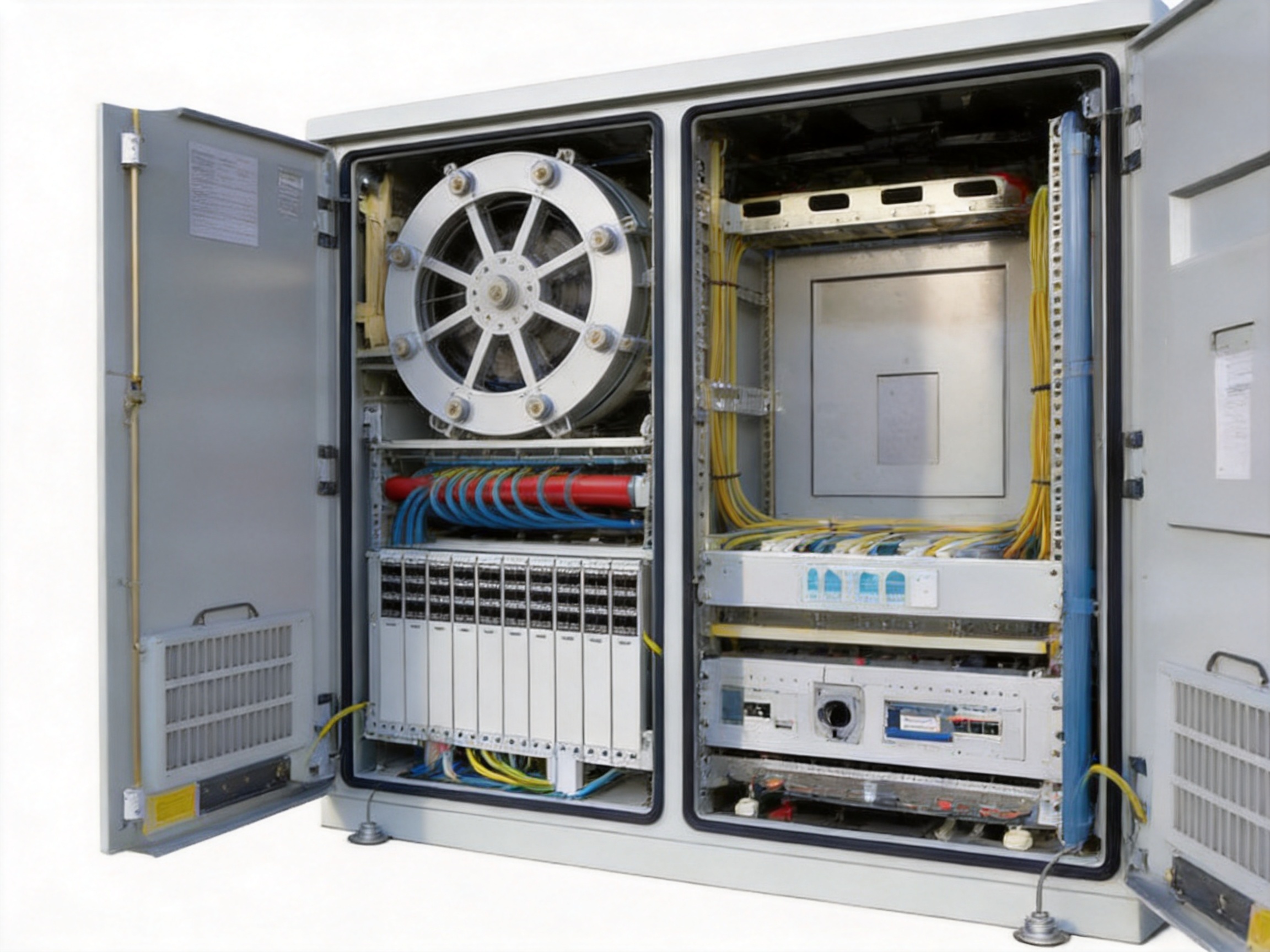
The MDF adopts a rotatable frame that allows a batch of cables to be terminated at one time. This feature can improve installation efficiency and simplify inspection. Instead of forcing technicians to work around a fixed panel from a restricted angle, the frame can be positioned to create a more accessible working surface.
Termination work is often repetitive and time-sensitive. Technicians may need to connect many fibre pigtails, copper pairs, feeder cables, or distribution cables during a single installation visit. A rotatable frame can reduce awkward movements, improve visibility, and make it easier to follow a consistent termination sequence.
The same feature is valuable during troubleshooting. When the frame can be moved into a suitable inspection position, technicians can examine connection points, labels, splice trays, and cable routes more efficiently. This can reduce the time required to identify loose connections, incorrect assignments, damaged components, or routing problems.
Compared with a fixed and crowded termination arrangement, a rotatable MDF offers a more flexible platform for both initial deployment and future modifications. It can be particularly useful when network requirements change over time and additional cables or optical modules must be installed within the existing enclosure.
Optical Splitter Capacity and Network Flexibility
In a passive optical network, optical splitters divide the signal from one feeder fibre among several distribution fibres. The selected splitter ratio and installation location influence the network’s capacity, reach, power budget, and expansion options.
A centralised splitting strategy places most splitting functions at a primary distribution cabinet. This arrangement can simplify network planning and reduce the number of locations requiring splitter maintenance. However, it may provide less flexibility in areas where subscriber density varies significantly.
A distributed splitting strategy may use a first-level splitter at the primary cabinet and additional splitters closer to buildings or subscriber groups. This can help operators serve areas with irregular demand and add capacity in stages. The trade-off is increased management complexity and a greater number of passive components distributed throughout the network.
The cabinet should be selected according to the planned network architecture rather than only the initial number of subscribers. It should provide adequate room for splitter cassettes, connector panels, fibre routing, splice trays, and future additions. Installing a cabinet with no expansion margin can create avoidable costs when the network reaches capacity.
Oversizing the internal optical capacity at the initial deployment stage is often more economical than rebuilding or replacing a fully loaded cabinet later. A well-planned enclosure allows the operator to add components progressively while keeping existing services organised and protected.
The product’s suitability for fibre migration comes from this combination of protection, access, internal organisation, and expansion potential. It can support different splitter strategies when the appropriate internal modules and accessories are specified for the project.
Advantages Compared with Conventional Copper Cabinets
Designed for Optical Requirements
Traditional copper cabinets are normally organised around punch-down blocks, copper pair management, and jumper access. They may not provide adequate space or routing control for fibre splice trays, optical splitters, connector panels, and bend-sensitive cables.
A cabinet specifically intended for copper-to-fibre replacement is better aligned with the physical requirements of optical networks. It gives fibre components a defined working environment instead of treating them as an afterthought inside a legacy enclosure.
Better Migration Efficiency
Using a purpose-designed enclosure can help operators migrate services progressively. Copper and fibre equipment can be arranged in separate zones, allowing the network to evolve without repeated cabinet reconstruction.
This reduces the need for temporary installations and lowers the risk of service interruption during the transition. It also gives field teams a repeatable installation method that can be applied across multiple sites.
Improved Security
Concealed hinges and a multi-point door lock provide stronger physical protection than basic single-point cabinet doors or exposed hinge arrangements. This is valuable for cabinets located in publicly accessible areas, transport corridors, industrial facilities, and roadside installations.
More Convenient Maintenance
The drawer-type filter cover, rotatable MDF, accessible internal arrangement, and structured fibre routing all contribute to easier service work. Maintenance efficiency affects the total cost of ownership because field labour, travel, outage duration, and troubleshooting time can exceed the initial enclosure purchase price over the life of a network.
Improved Environmental Protection
The IP55 construction, double-layer heat-insulation structure, and rain-resistant cover design help protect the equipment from common outdoor conditions. This is a more complete approach than simply placing indoor-grade equipment inside a basic metal box.
Manufacturing Strengths and Quality-Control Approach
Wanma Technology Co., Ltd. was established in 1997 and specialises in communication cabinets, communication electronic equipment, and passive optical components. Its product range serves Ethernet networks, optical communication networks, central equipment rooms, national high-speed railways, and urban rail transit systems.
The company’s experience across these applications supports the development of enclosures intended for demanding field environments. Railway and urban transit installations often require careful attention to mechanical strength, cable organisation, serviceability, environmental protection, and long-term operational continuity. These requirements are closely related to the needs of fixed-access and broadband networks.
Manufacturing a dependable telecom cabinet involves more than cutting and bending sheet metal. The complete process must control dimensional accuracy, door alignment, sealing interfaces, surface protection, assembly quality, and the compatibility of internal mounting structures.
Engineering and Product Configuration
The manufacturing process begins with engineering definition. Product dimensions, equipment capacity, door arrangement, cable-entry configuration, lock structure, filter position, internal frame design, and accessory compatibility must be considered together.
For project-based deployments, the cabinet may need to accommodate specific optical distribution modules, splitter configurations, power systems, or legacy copper equipment. A structured engineering process helps ensure that the selected cabinet can support the intended configuration without creating conflicts between cables, doors, trays, and service areas.
Sheet-Metal Fabrication
Cabinet panels and structural components require controlled fabrication so that the finished body remains stable and square. Accurate forming is important for door fit, seal compression, hinge alignment, lock engagement, and the installation of internal frames.
Consistent fabrication also allows multiple cabinets in the same project to share accessories and installation methods. This is valuable for operators that maintain large fleets of outdoor enclosures and want predictable spare-parts and service procedures.
Surface Treatment and Corrosion Resistance
Outdoor metal components require suitable surface preparation and protective finishing. The objective is to reduce the effect of moisture, pollutants, handling, and weather exposure on the cabinet body and accessories.
A controlled surface-treatment process can improve coating adhesion and help maintain a consistent appearance. It also supports long-term protection at edges, seams, mounting areas, and other locations that may be vulnerable if preparation is inadequate.
Assembly and Functional Inspection
During assembly, the cabinet body, cover plate, doors, locks, hinges, filter assembly, frames, and cable-management components must be fitted in the correct sequence. Functional inspection should verify that doors open and close correctly, locking points engage properly, removable filter components can be serviced, and the rotatable frame operates as intended.
Quality inspection should also consider dimensional consistency, visible finish quality, fastening security, seal contact, and the absence of sharp edges that could damage cables or injure technicians.
Application-Oriented Quality Thinking
Because the company supplies products for communication networks, high-speed railways, and urban rail transit systems, its manufacturing approach is informed by practical field requirements. The goal is not only to produce a cabinet that meets a drawing but to provide an enclosure that technicians can install, operate, inspect, and maintain over an extended service period.
This application-oriented approach is an important distinction from low-cost enclosures that focus primarily on initial purchase price. A cabinet that saves a small amount at procurement but creates repeated maintenance difficulties may produce higher costs throughout its operating life.
Installation and Commissioning Considerations
Site preparation is essential for reliable cabinet performance. The foundation or mounting structure should support the cabinet weight, installed equipment, cable loads, and local environmental conditions. The cabinet should be positioned to allow door opening, filter maintenance, cable access, and safe technician movement.
Cable routes should be planned before installation. Feeder, distribution, power, grounding, and service cables should enter through suitable paths without creating sharp bends or excessive mechanical stress. Cable glands and entry seals should be correctly installed to preserve the intended environmental protection.
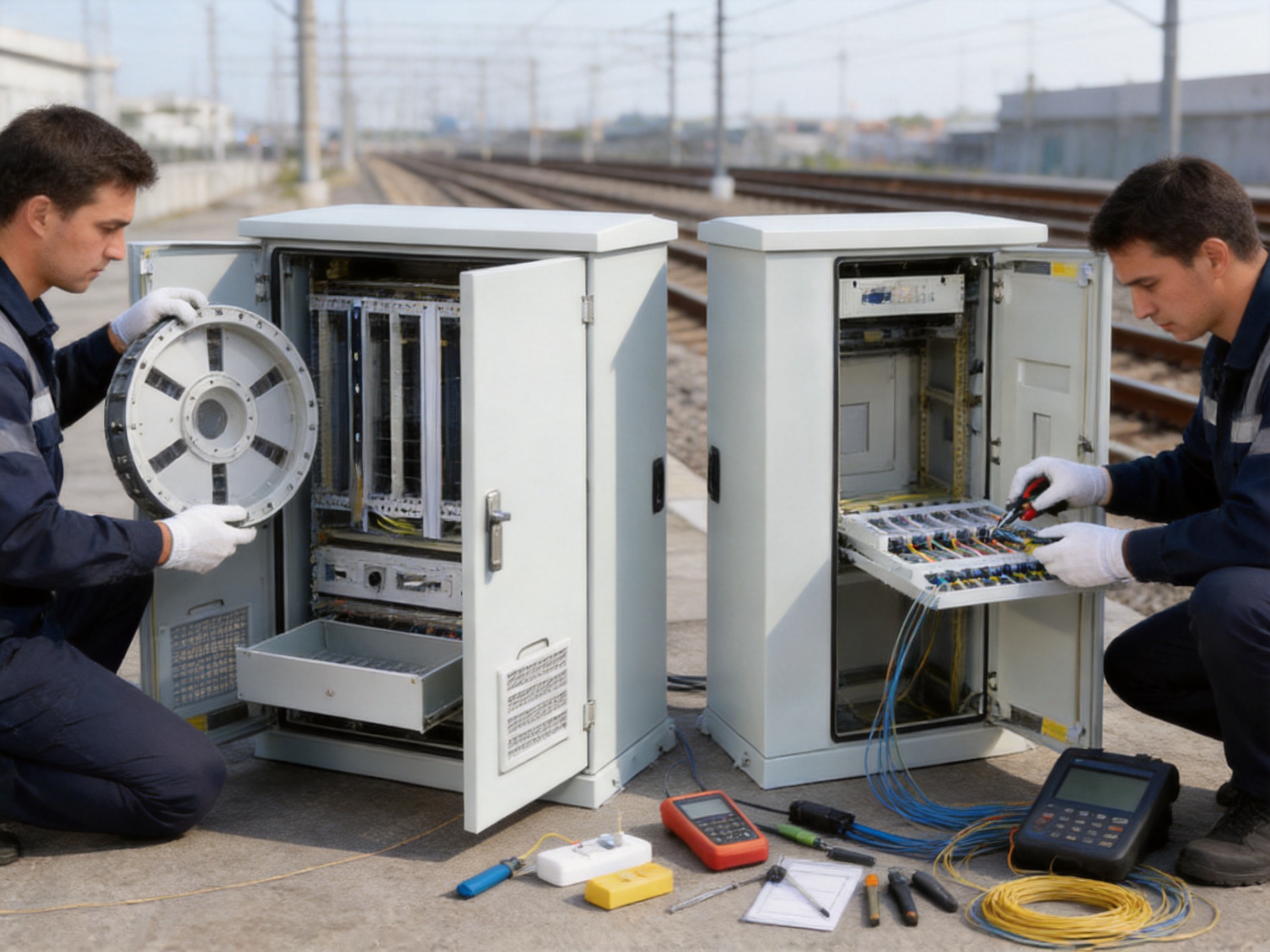
During fibre installation, technicians should keep protective caps on connectors until the connection is ready. Splice trays should be labelled according to the network documentation, and each fibre should be tested after splicing and termination. Optical power measurements and, where necessary, optical time-domain reflectometer testing can help verify the quality of the completed link.
The rotatable MDF should be used carefully. It should not be overloaded, forced beyond its intended movement, or operated while cables are under tension. After termination work, technicians should confirm that all fibres have adequate slack, the frame is securely returned to its operating position, and no cable is trapped by the door or frame.
Before closing the cabinet, the installer should verify:
- All splice trays and optical modules are securely mounted.
- Fibre bend radii comply with the applicable cable and component requirements.
- Labels match the as-built documentation.
- Cable entries are sealed and protected.
- The filter is correctly installed.
- The door seal is clean and evenly compressed.
- The lock and all locking points operate correctly.
- The cabinet is properly grounded where required by the project design.
- There is sufficient space for future expansion and routine maintenance.
Maintenance Strategy for Long-Term Performance
Preventive maintenance helps preserve the environmental and mechanical performance of the enclosure. Inspection intervals should be determined by location, climate, pollution level, network criticality, and the equipment installed inside the cabinet.
The filter cover should be checked and cleaned when necessary. A blocked filter can restrict airflow and contribute to thermal stress. The cabinet roof, door seal, cable entries, and drainage areas should also be inspected for signs of damage or contamination.
Technicians should examine hinges, locking points, and frame mechanisms for wear or obstruction. Although the hinges are concealed, the door should still be checked for alignment and smooth operation. The multi-point lock should engage evenly at all locking locations.
Fibre management areas should be inspected for excessive tension, displaced loops, broken labels, contaminated connectors, and accidental changes to routing. Any modification should be recorded in the network documentation so that future technicians can understand the current configuration.
During maintenance, the cabinet should remain open for the shortest practical time. This limits exposure to dust and moisture and reduces the chance of accidental contact with active circuits. If work is performed in wet or dusty conditions, additional precautions may be necessary according to the operator’s safety procedures.
Applications Across Different Network Environments
Fixed-Line Broadband Access
The cabinet is suitable for fixed networks and broadband access applications where feeder and distribution infrastructure must be managed outside a central equipment room. It can support progressive migration from copper-based access services to fibre-based services.
Urban Telecommunications
In cities, cabinets may be installed in streets, residential areas, commercial districts, or utility corridors. Security, visual consistency, maintenance access, and environmental protection are especially important in these locations.
Railway and Urban Rail Transit
Communication cabinets used in railway and urban rail transit systems must support dependable data and communication networks in demanding environments. The company’s experience with national high-speed railways and urban rail transit systems provides relevant application knowledge for projects that require organised cable infrastructure and robust outdoor protection.
Industrial and Infrastructure Networks
Industrial parks, transport facilities, campuses, utilities, and other infrastructure operators may require outdoor fibre distribution between buildings or operational zones. The cabinet can provide a controlled termination and distribution point where indoor equipment rooms are unavailable or too distant.
5G and Future Access Networks
Fibre infrastructure is also fundamental to 5G backhaul and access-network modernisation. As mobile and fixed networks require increased bandwidth and lower latency, outdoor fibre distribution points must support growing port counts, efficient splicing, and future upgrades.
Why Partner with Wanma Technology
Wanma Technology develops, manufactures, and markets its own branded products while also providing integrated solutions for customised projects. This combination allows customers to select standard cabinet configurations while retaining the option to adapt internal arrangements, dimensions, accessories, or optical components to project requirements.
The company’s product experience covers communication cabinets, communication electronic equipment, passive optical components, Ethernet networks, optical communication networks, central equipment rooms, railway systems, and urban rail transit. This broad portfolio supports a more complete understanding of how cabinets operate as part of a network rather than as isolated metal enclosures.
For international customers, a broad application background can simplify technical communication. A supplier familiar with fibre distribution, cabinet security, optical components, and network deployment can help identify practical issues before production begins.
The company maintains a sales network covering more than 20 countries and regions, including the United States, Australia, the United Kingdom, Italy, South Africa, and Ghana. Its stated priorities include reliable product quality, timely delivery, and long-term strategic partnerships with industry leaders.
These strengths are valuable for operators and system integrators that need repeatable products across multiple sites. Consistent manufacturing, responsive engineering support, and coordinated delivery can reduce project risk when a deployment includes many cabinets with similar but not identical configurations.
Selection Guidelines for Project Engineers
Before ordering an outdoor telecom cabinet, project engineers should define the expected network architecture and service life. Important questions include the number of feeder fibres, distribution fibres, splice trays, optical splitters, connector ports, copper pairs, power modules, and future expansion positions.
The environmental location should also be evaluated. Engineers should consider temperature range, solar exposure, rainfall, dust, pollution, wind, snow, flooding risk, vandalism exposure, and available maintenance space. The stated IP55 protection must be considered together with correct installation and regular maintenance.
The cabinet should be checked for compatibility with the preferred cable-entry system and internal modules. If the project includes both copper and fibre services, the planned segregation of these functions should be documented before production.
Operators should also review the expected maintenance model. If field technicians need to service filters, splice trays, and termination panels frequently, access features such as the drawer-type filter cover and rotatable MDF can have a meaningful effect on operating efficiency.
Finally, the cabinet should be evaluated as part of the total network cost. Purchase price is only one factor. Installation time, fault-repair duration, expansion capability, equipment protection, spare-parts requirements, and expected service life all contribute to the actual cost of ownership.
Q&A
What is the primary application of this outdoor telecom cabinet?
It is designed for fixed networks and broadband access applications, particularly where operators are replacing or supplementing copper cables with optical fibre cables. It provides a protected outdoor working environment for cable termination, fibre splicing, distribution, and related network equipment.
What protection grade does the cabinet provide?
The cabinet complies with GB4208 requirements and provides IP55 protection. This helps protect the internal equipment from dust ingress and water jets when the cabinet is correctly installed, closed, and maintained.
Can the cabinet support copper and fibre equipment at the same time?
Yes. It is intended to support the coexistence period in which legacy copper services remain active while fibre services are introduced. The internal arrangement can be organised to separate copper functions from fibre termination and distribution functions.
Why is a double-layer structure important?
The double-layer structure helps reduce the transfer of external heat into the cabinet and supports a more stable internal environment. This is beneficial for optical equipment, power systems, and other components installed in locations exposed to sunlight and changing outdoor temperatures.
What is the purpose of the rotatable MDF?
The rotatable main distribution frame allows technicians to position the termination area for easier installation, inspection, and maintenance. It can help technicians terminate a batch of cables more efficiently and examine connection points with improved access.
How does the cabinet support fibre splice management?
The cabinet provides a structured environment for fibre routing, splice trays, slack storage, and optical distribution equipment. Project-specific trays and modules should be selected according to the required fibre count, splice capacity, splitter arrangement, and connector configuration.
Why are concealed hinges useful in an outdoor cabinet?
Concealed hinges reduce the number of exposed mechanical components and make the door more difficult to attack or remove. They also contribute to a cleaner external design and help protect the hinge mechanism from direct environmental exposure.
How does the multi-point lock improve security?
The door is secured at multiple locations rather than relying on a single locking point. This improves resistance to prying and helps maintain consistent pressure on the door seal.
What is the benefit of the drawer-type filter cover?
The drawer-type cover allows the filter to be removed for cleaning, maintenance, or replacement without requiring extensive cabinet disassembly. This can reduce field service time and help maintain appropriate airflow.
Can the cabinet be used for optical splitter installations?
Yes. The cabinet can support optical splitter cassettes and related fibre-management components when the internal configuration is selected for the required split ratio, port count, routing capacity, and expansion plan.
What should be considered when installing fibre inside the cabinet?
Technicians should follow the specified bend radius, avoid tension on cables and splice points, provide sufficient slack for tray access, protect connectors from contamination, and label every fibre and splice group accurately.
Does Wanma Technology provide customised solutions?
Yes. In addition to its own branded products, the company provides integrated solutions for customised products. Customers can discuss cabinet dimensions, internal components, optical modules, mounting requirements, and project-specific configurations with the engineering team.
Which industries can use this cabinet?
Typical applications include fixed broadband access, Ethernet networks, optical communication networks, railway communication systems, urban rail transit, industrial parks, utilities, campuses, and other infrastructure environments requiring protected outdoor fibre distribution.
Conclusion
The migration from copper to optical fibre is a long-term infrastructure programme rather than a single equipment replacement. Outdoor cabinets play a central role because they connect feeder networks with distribution networks and must support both legacy and modern services during the transition.
The outdoor telecom cabinet for copper-to-fibre replacement provides a practical platform for this process. Its IP55 protection, double-layer heat-insulation structure, concealed hinge design, multi-point locking system, drawer-type filter cover, herringbone double-layer roof, and rotatable MDF address the environmental, security, installation, and maintenance requirements of modern access networks.
Compared with conventional copper cabinets or basic outdoor enclosures, the product is better suited to optical fibre routing, splice management, hybrid network operation, and future capacity expansion. Its value is not limited to initial deployment. A well-organised cabinet can reduce maintenance time, improve fault isolation, protect active services, and help operators expand the network without repeatedly rebuilding the physical infrastructure.
Supported by experience in communication cabinets, passive optical components, Ethernet networks, high-speed railways, urban rail transit, and customised integrated solutions, Wanma Technology offers a manufacturing and engineering foundation for customers modernising telecommunications infrastructure. For operators seeking a dependable transition from copper to fibre, the cabinet provides a secure and serviceable foundation for the next generation of outdoor access networks.
References
GB4208, Degrees of Protection Provided by Enclosures, applicable protection classifications for electrical and communication equipment.
International Electrotechnical Commission, IEC 60529, Degrees of Protection Provided by Enclosures.
International Telecommunication Union, Recommendations for Optical Fibre Cables, Fibre Characteristics, and Access Network Engineering.
ITU-T G.652, Characteristics of a Single-Mode Optical Fibre and Cable.
ITU-T G.984, Gigabit-Capable Passive Optical Networks.
Telecommunications Industry Association, Fibre Optic Infrastructure Installation and Administration Practices.
Optical Fibre Communications: Principles and Practice, guidance on fibre attenuation, bending loss, splicing, and optical power budgets.
Passive Optical Network Design and Deployment Guidelines, technical principles for splitter placement, feeder distribution, and subscriber access architecture.
Product: Outdoor Telecom Cabinet--- for Replacement of Copper Cables with Optical Fiber Cables
PREV:No previous
article
NEXT:High-Density 19-Inch Optical Distribution Frame for Reliable Fiber Network Management
NEXT:High-Density 19-Inch Optical Distribution Frame for Reliable Fiber Network Management
Interested in cooperation or have questions?
Related products
-
-
Application ScopeThis product is used in wireless network coverage systems, providing a safe and stable physical working environment and comprehensive security protection for workstations at wireless ...
See Details -
Application:Fiber adapter packs are installed on fiber optic panel, and served as standard 1U 19'' rack, ODF and cabinets, to create a complete system for connectivity. It can be applied in LAN's hous...
See Details -
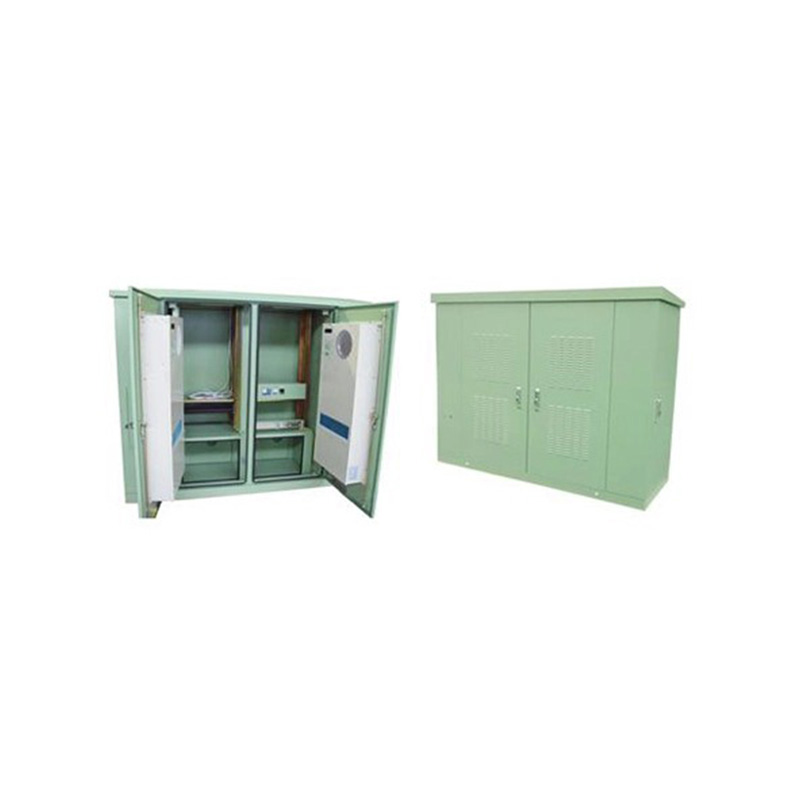
Application:The enclosure for outdoor wiring is designed for locating of telecommunication equipment, distributing frame, power supply system with accumulator battery, equipment for maintaining temper...
See Details
Ready to Get started ? Contact Us Now !

Product.
Contact Details.
-
 +86 13958188250
-
 +86 13958188250
-
 [email protected]
-
 AUDIT Email:[email protected]
- Wanma Industrial Park Taihu Yuan Town Lin'an District Hangzhou City China.
QR Code

Copyright © Wanma Technology Co., Ltd. All Rights Reserved.
Privacy
Custom Ethernet Optical Network Railway Transit Equipments Suppliers
