

 English
 Français
 Español
 Português
 عربى



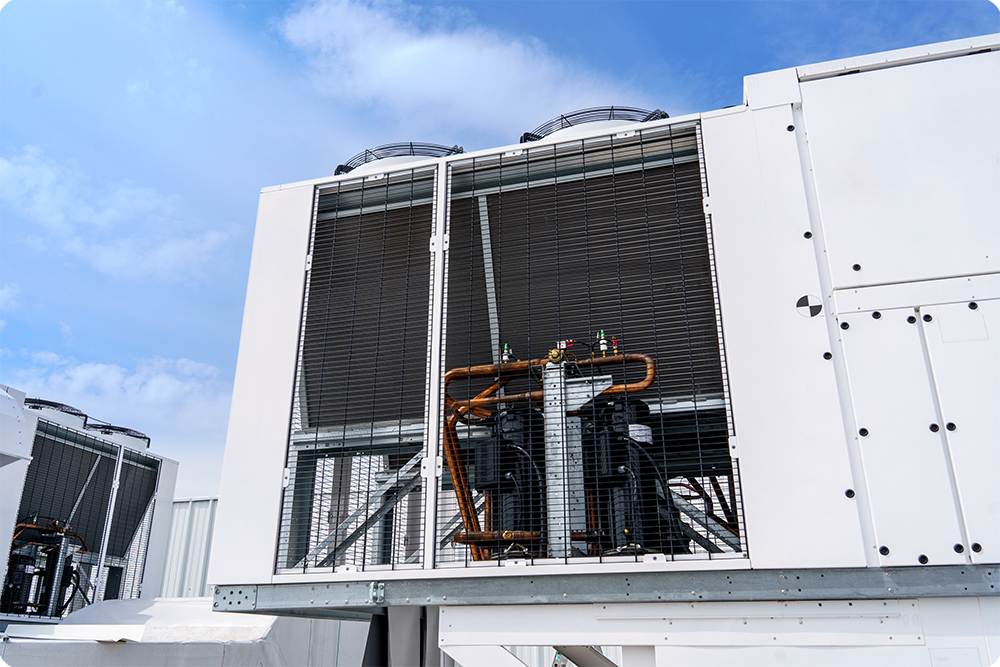

20-inch Containerized Data Center (CDC-20) is a compact and highly integrated modular data center solution built within a standard 20-foot ISO shipping container. It pre-integrates IT racks, power sup...
See Details20-Foot Containerized Data Center: Design, Deployment, and Operational Advantages
Content
- 1 What Is a Containerized Data Center?
- 2 Core Configuration of the CDC-20
- 3 Advantages Over Conventional On-Site Data Center Construction
- 4 Why the Standard 20-Foot Container Format Matters
- 5 Internal Layout and Space Utilization
- 6 Electrical Architecture and Power Continuity
- 7 Precision Cooling for a Compact IT Environment
- 8 Environmental Monitoring and Remote Supervision
- 9 Fire Protection and Physical Security
- 10 Manufacturing Process and Quality Control
- 11 Application Scenarios
- 12 Competitive Advantages of the CDC-20 Platform
- 13 Customization and OEM/ODM Capability
- 14 Installation, Commissioning, and Maintenance
- 15 Operational Efficiency and Lifecycle Management
- 16 Company Manufacturing Strengths
- 17 Selection Checklist for Buyers
- 18 Questions and Answers
- 18.1 What is the main purpose of the CDC-20?
- 18.2 How many IT cabinets does the standard configuration include?
- 18.3 What UPS capacity is available?
- 18.4 How long can the battery support the load?
- 18.5 Does the system include redundant cooling?
- 18.6 Can the CDC-20 be used in remote areas?
- 18.7 Does the container require a permanent building foundation?
- 18.8 Can the product be customized?
- 18.9 Is video surveillance included?
- 18.10 What type of fire protection is supported?
- 18.11 Why is factory integration important?
- 18.12 Can the container be relocated?
- 18.13 What information should a buyer provide for a quotation?
- 19 Conclusion
- 20 References
- 21 Product: 20-inch Containerized Data Center (CDC-20)
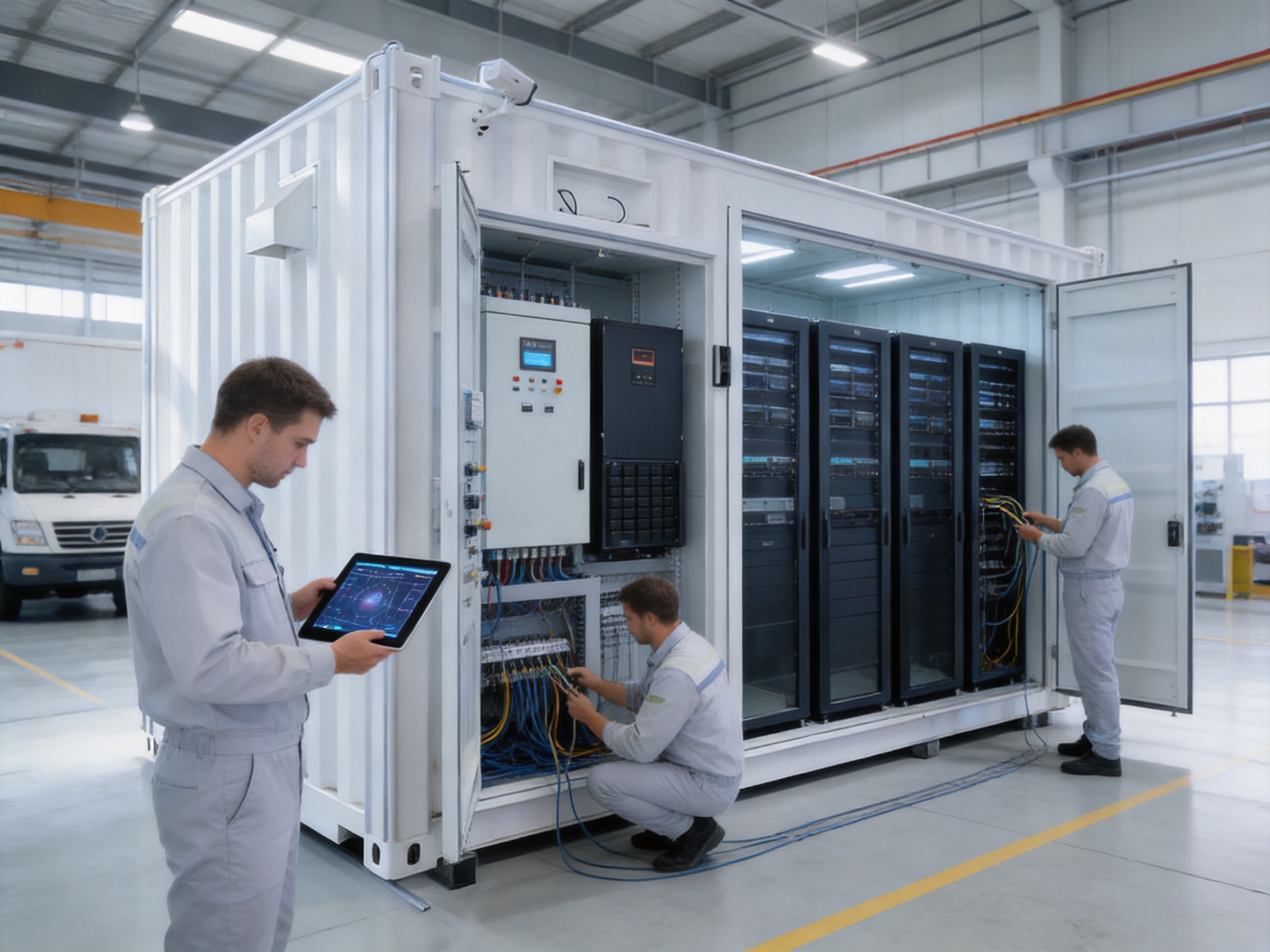
The 20-inch Containerized Data Center, identified as the CDC-20, is a compact, factory-integrated data center solution built inside a standard 20-foot high-cube ISO shipping container. It combines information technology cabinets, power distribution, uninterruptible power supply equipment, battery backup, precision cooling, environmental monitoring, and automatic fire protection in one transportable enclosure.
Unlike a conventional equipment room that must be constructed, fitted out, tested, and commissioned on site, the CDC-20 is designed as a complete infrastructure unit. Most of the engineering, assembly, cabling, system integration, and functional testing can be completed in a controlled manufacturing environment before delivery. Once the container reaches its destination, the deployment process is primarily concerned with positioning, utility connection, network configuration, and final commissioning.
This model is particularly valuable where a permanent building is unavailable, construction resources are limited, project schedules are compressed, or the data center must eventually be relocated. It is suitable for edge computing, remote industrial operations, emergency response, temporary projects, small-scale disaster recovery, railway and transport infrastructure, and other applications requiring dependable computing capacity in a compact footprint.
Wanma Technology Co., Ltd. brings experience in communication cabinets, communication electronic equipment, passive optical components, Ethernet networks, optical communication networks, railway systems, and urban rail transit applications to the development of this containerized platform. That background supports a practical approach to enclosure engineering, structured cabling, equipment protection, manufacturing consistency, and deployment in demanding field environments.
What Is a Containerized Data Center?
A containerized data center is a data center built within a standardized transport container rather than inside a conventional permanent building. The container functions as the structural enclosure and provides a defined space for all major infrastructure systems. In the CDC-20 design, the enclosure is based on a standard 20-foot high-cube container with external dimensions of approximately 6,058 millimeters in length, 2,438 millimeters in width, and 2,896 millimeters in height.
The concept goes beyond placing a few server racks inside a shipping container. A complete containerized data center must address electrical distribution, power quality, backup power, heat removal, fire protection, physical access, environmental monitoring, cable routing, equipment maintenance, transportation, and on-site installation. These systems must operate together within a restricted internal volume while maintaining safe working clearances and reliable airflow.
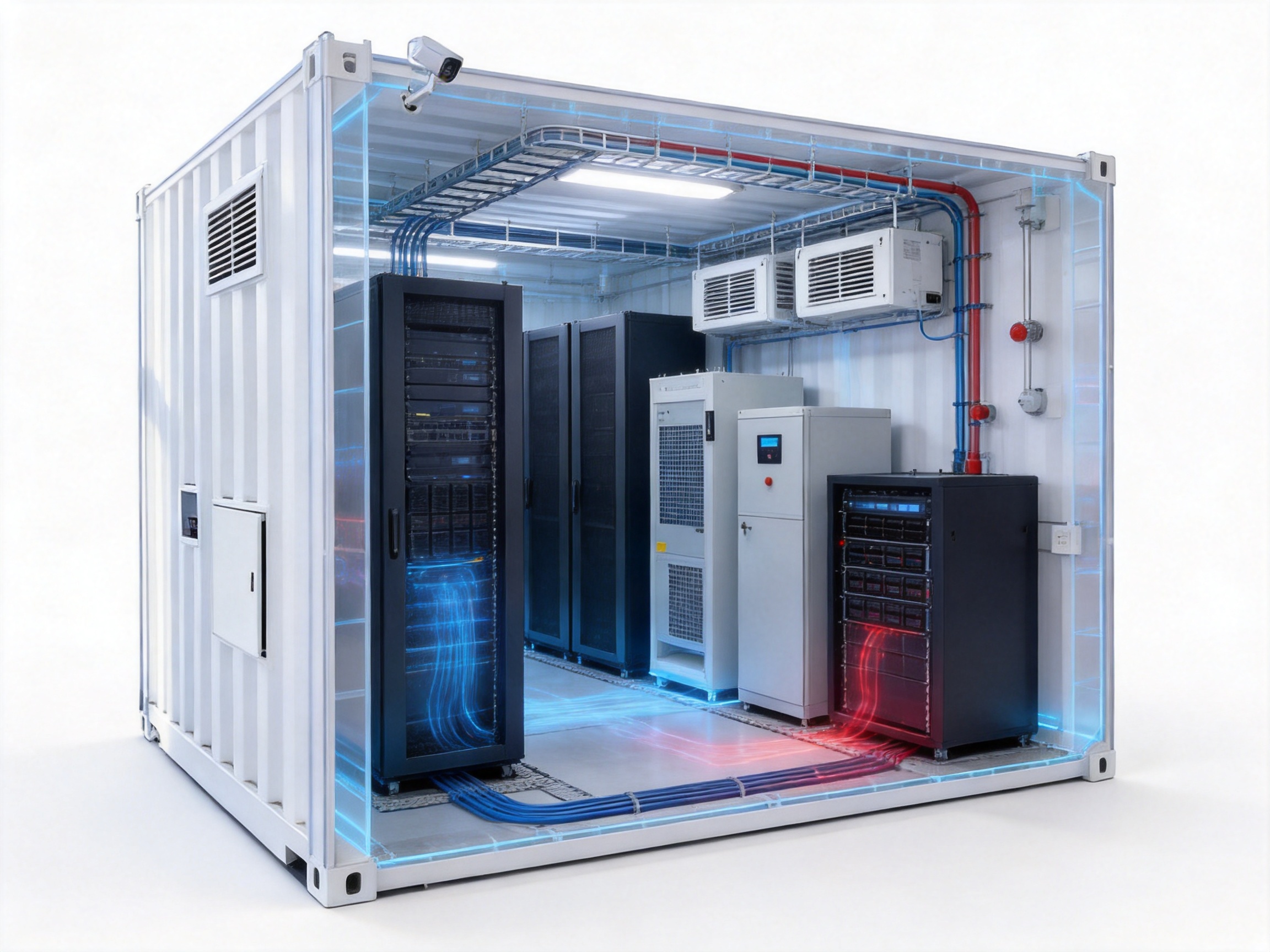
The CDC-20 addresses this challenge by pre-integrating nine functional equipment positions. The standard layout includes one power distribution cabinet, one UPS cabinet, one battery cabinet, two in-row precision air conditioners, and four IT cabinets. The arrangement creates a compact infrastructure platform with a total IT power design of up to 30 kilowatts, based on a maximum load of approximately 7.5 kilowatts per IT cabinet.
Because the product is engineered as a system, its value is not limited to the individual components. The greater benefit comes from the relationships among the components. The cooling system is selected and positioned according to the IT load. The electrical distribution system is coordinated with the UPS capacity and dual power inputs. Cable paths are planned during factory assembly. Fire protection is designed for the enclosed internal volume. Monitoring points can be specified to provide visibility into the condition of the complete unit.
Core Configuration of the CDC-20
The CDC-20 provides a balanced configuration for organizations that need a small but fully functional data center rather than an isolated rack or an unfinished enclosure. Four IT cabinets provide the primary equipment space, while dedicated power, battery, and cooling positions support the operational requirements of the IT load.
| System Area | Standard Configuration | Operational Purpose |
|---|---|---|
| Container enclosure | 20-foot high-cube ISO container | Provides a transportable, weather-resistant structural envelope |
| IT cabinets | Four cabinets, approximately 2,000 × 600 × 1,100 millimeters or 1,200 millimeters | Accommodates servers, network equipment, storage, and edge computing hardware |
| Power distribution | One power distribution cabinet | Receives and distributes electrical power to the critical systems |
| UPS system | Up to 40 kVA with 1+1 power module redundancy | Maintains power continuity and protects sensitive loads |
| Battery system | Lead-acid battery configuration | Supports approximately 15 minutes of backup time under the specified design conditions |
| Cooling | Two in-row precision air conditioners with 1+1 redundancy | Removes heat generated by IT equipment and maintains the internal thermal environment |
| Input power | 380 volts, 50 or 60 hertz, three-phase, five-wire | Supports common industrial and commercial electrical arrangements |
| Power feeds | Dual power supply | Provides an additional level of supply resilience |
| Fire protection | Automatic gas fire system | Provides fire suppression capability suitable for an enclosed equipment environment |
| Video surveillance | Optional | Supports remote security observation and access control objectives |
The specified input voltage range is 380 volts plus or minus 10 percent, with a dual-circuit input current of 200 amperes. These parameters should be confirmed against the local electrical infrastructure and project conditions before ordering. The system can also be adapted through engineering consultation when a project requires different power characteristics, battery autonomy, monitoring functions, or security provisions.
The use of a 1+1 arrangement for the UPS power modules and precision cooling units is an important design feature. Redundancy does not mean that every failure is automatically eliminated, but it can allow one module or cooling unit to be unavailable while the remaining unit continues supporting the required load, subject to the final operating conditions and maintenance procedures.
Advantages Over Conventional On-Site Data Center Construction
Shorter Deployment Cycle
The most visible advantage of a containerized data center is the reduction in on-site construction activity. A traditional small data center may require architectural preparation, foundations, electrical rooms, mechanical services, raised floors, fire systems, security systems, cable containment, equipment delivery, installation, and multiple rounds of testing. Each activity introduces scheduling dependencies.
The CDC-20 moves much of this work into the factory. Equipment can be mounted, interconnected, labeled, inspected, and tested before shipment. The site therefore requires a level foundation or suitable support surface, utility connection points, external cabling, and final commissioning rather than a complete building project.
This approach is especially useful for remote locations where skilled technicians, construction materials, cranes, and specialized contractors may be difficult to obtain. It also helps project owners reduce uncertainty when a facility must become operational within a short period.
Reduced Site Complexity
Construction sites often contain multiple trades working in sequence. Electrical contractors may be waiting for structural work, cooling contractors may be waiting for equipment placement, and network installers may be unable to complete their work until cable routes are finished. A factory-integrated unit reduces the number of unresolved interfaces at the destination.
For the customer, this can simplify project management. Instead of coordinating a building and several independent infrastructure suppliers, the customer can procure a defined system with an established internal layout. External works remain important, but the scope is more clearly bounded.
Repeatable Manufacturing Quality
Factory assembly provides a more controlled environment than open-air or temporary on-site installation. Technicians can work with calibrated tools, controlled documentation, standardized inspection procedures, and repeatable wiring practices. The same layout can be reproduced for multiple sites, making it easier to train operators and maintain spare parts.
Factory integration also makes it easier to identify workmanship issues before shipment. Cable labels, terminal connections, cabinet alignment, cooling interfaces, sensor positions, and fire-system components can be inspected as part of a planned quality process. This is particularly valuable when the destination is far from the manufacturing facility.
Relocation and Redeployment
A permanent building is normally tied to its original site. A containerized data center can be designed for relocation when the operational requirement changes. It may support a temporary construction project, a disaster recovery exercise, a remote communications node, or an edge computing deployment that later moves to another service area.
Relocation requirements must be considered during engineering. Equipment must be securely installed, transport loads must be assessed, external connections must be safely disconnected, and the container must be lifted according to approved procedures. When these requirements are addressed from the beginning, the data center becomes a reusable infrastructure asset rather than a one-time building improvement.
Efficient Use of Capital
The compact form factor can be financially attractive for applications that do not justify a permanent data center building. Customers can deploy the required computing capacity without committing to a large facility with unused floor area. The system can also be expanded through additional containers or complementary infrastructure if demand increases.
In temporary or mobile applications, the container may retain value after the first project is completed. It can be redeployed, upgraded, or integrated into another site. This creates a different asset model from fixed construction, where much of the investment becomes inseparable from the original property.
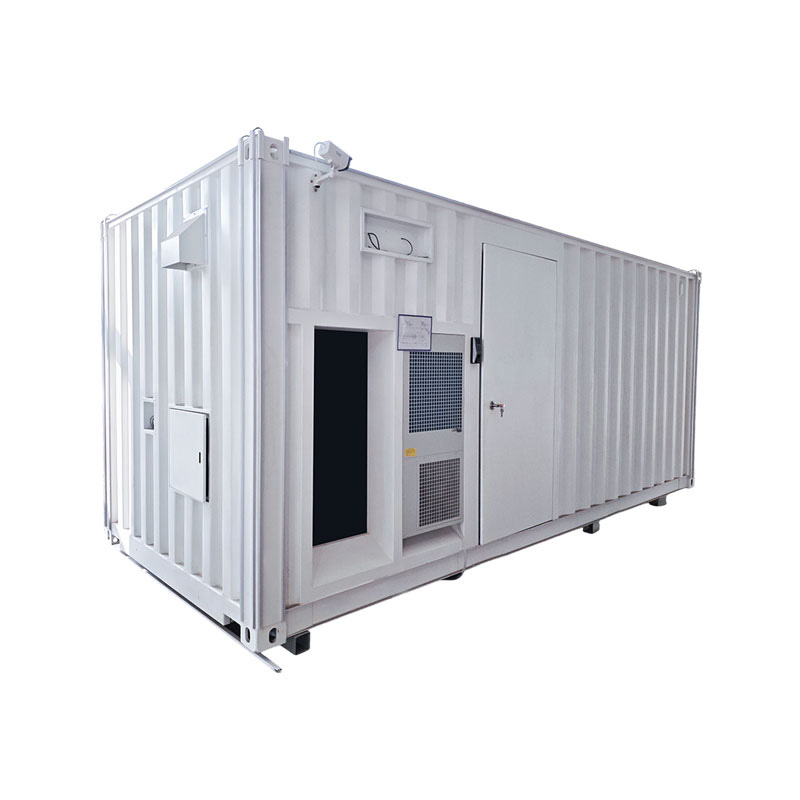
20-inch Containerized Data Center (CDC-20)
Why the Standard 20-Foot Container Format Matters
The ISO container format is more than a convenient box. It provides a globally familiar transport envelope with established dimensions, lifting points, handling practices, and multimodal logistics procedures. This can simplify shipment by road, rail, or sea, subject to applicable regulations and the final gross weight of the completed unit.
Standardized dimensions also simplify site planning. Customers can assess access roads, turning areas, crane positions, foundation dimensions, and maintenance clearances using known container geometry. Logistics teams are familiar with the requirements for transporting and positioning a 20-foot container, reducing the need to develop an entirely new handling method.
The high-cube configuration provides additional internal height compared with a standard-height container. That extra space is useful for cable management, cooling interfaces, fire suppression piping, lighting, and maintenance access. Although the internal volume remains limited, careful use of vertical space allows the design to accommodate a complete infrastructure stack.
The steel enclosure can also contribute to physical protection and environmental separation. However, the container should not be treated as a complete environmental solution without proper engineering. Insulation, sealing, corrosion protection, thermal management, ventilation strategy, drainage, door design, and external penetrations must all be considered according to the installation climate.
Container structural ratings, stacking capability, and transport suitability depend on the specific container, modifications, loaded weight, and handling method. Project engineers should verify these factors rather than assuming that every modified container retains the same characteristics as an unmodified shipping container.
Internal Layout and Space Utilization
A 20-foot container provides a relatively small usable floor area, commonly understood to be approximately 14.8 square meters inside the standard enclosure, with an internal height of roughly 2.39 meters depending on the construction details. Integrating four IT cabinets, two precision cooling units, power equipment, batteries, fire protection, and monitoring systems therefore requires careful spatial planning.
The CDC-20 uses dedicated positions for power, UPS, batteries, cooling, and IT cabinets. This arrangement avoids treating the interior as an unplanned storage space. Each system has a defined role and location, allowing the installation team to understand service paths, equipment clearances, and cable routes before the unit reaches the site.
IT Cabinet Arrangement
The four IT cabinets form the primary computing area. Each cabinet is designed for a nominal load of up to approximately 7.5 kilowatts under the stated total power configuration. The actual allowable load depends on equipment type, airflow characteristics, ambient conditions, redundancy settings, and the final cooling design.
Cabinet dimensions are approximately 2,000 millimeters in height and 600 millimeters in width, with a depth of either 1,100 or 1,200 millimeters according to the selected configuration. This size accommodates a wide range of servers, switches, storage equipment, security appliances, industrial computing systems, and communications equipment.
Equipment loading should be planned before installation. High-density servers, battery-backed systems, networking equipment, and storage arrays produce different airflow and electrical demands. A properly prepared rack elevation and power budget help prevent uneven heat concentration and simplify future maintenance.
Power Zone Separation
Power distribution, UPS equipment, and batteries are positioned as dedicated infrastructure rather than mixed randomly with IT equipment. This separation supports safer maintenance and makes it easier to identify the boundaries between high-voltage equipment and information technology systems.
The power zone should include clear labeling, appropriate protective devices, grounding and bonding provisions, and a documented isolation procedure. Access should be controlled according to the voltage level and the local safety requirements. The final installation must comply with applicable electrical codes and customer standards.
Cooling Integration
In-row precision cooling units are positioned close to the IT cabinets to shorten the airflow path. This arrangement can help direct conditioned air toward the equipment and reduce the inefficiency associated with long, uncontrolled air paths. The two cooling units also support a 1+1 redundancy design in the stated configuration.
Cooling capacity is listed as a maximum of 30 kilowatts per unit, but actual cooling performance depends on ambient temperature, refrigerant or chilled-water conditions where applicable, heat rejection arrangements, humidity control, equipment loading, and the method used to connect the external system. Capacity should therefore be evaluated as part of a complete thermal design rather than treated as an unlimited load rating.
Thermal validation before shipment can confirm whether the intended airflow path, temperature differential, and equipment loading are compatible. Factory testing does not eliminate the need for site testing, but it provides a valuable baseline against which the final operating results can be compared.
Cable Management
Overhead cable routing helps keep floor-level passages clear and allows power and data cabling to be organized according to function. Proper separation between power and communications cabling can reduce electromagnetic interference risks and make maintenance more efficient.
Factory-installed cable trays, labels, patching arrangements, and documented termination points provide a strong starting point for the customer’s IT installation. Additional cabling should follow the original pathways wherever possible. Cable fill, bend radius, fire stopping, and future expansion capacity should be considered during the design review.
Electrical Architecture and Power Continuity
Reliable power is central to every data center, including a compact edge facility. The CDC-20 is designed for a 380-volt, three-phase, five-wire supply at 50 or 60 hertz. The stated input voltage range is 380 volts plus or minus 10 percent. A dual-circuit 200-ampere input arrangement and dual power supply are included in the product information.
The dual-feed concept can improve resilience when the upstream electrical system is appropriately designed. The two feeds may be connected to independent sources, separate distribution paths, or a suitable dual-input arrangement depending on the project. The effectiveness of redundancy depends on the independence and quality of the upstream sources; two cables connected to the same failed source do not provide full source redundancy.
The power distribution cabinet provides the interface between the incoming supply and the internal equipment. It should include the protection, switching, metering, labeling, and isolation functions required by the project. The final protection coordination study should account for the utility supply, generator systems if present, UPS behavior, downstream breakers, and the characteristics of the connected IT equipment.
UPS and Battery Backup
The UPS system has a capacity of up to 40 kVA and uses power modules with 1+1 redundancy. Its role is to maintain power to critical equipment during short interruptions, voltage disturbances, or transfer events. The battery cabinet uses lead-acid batteries and provides a stated backup time of approximately 15 minutes under the specified design conditions.
Backup time is not a fixed result independent of load. It varies according to the connected power, battery age, temperature, discharge rate, maintenance condition, and end-of-life criteria. Customers should confirm the required autonomy using the actual critical load rather than the total installed cabinet capacity alone.
Lead-acid batteries remain widely used because of their established supply chain, familiar maintenance practices, and predictable electrical characteristics. They require suitable temperature control, inspection, ventilation considerations, terminal checks, and replacement planning. Where a project requires lithium-ion batteries or a longer autonomy period, the battery architecture may need to be redesigned and approved separately.
Power Quality and Monitoring
Power quality monitoring can provide information about voltage, current, frequency, phase balance, power factor, and abnormal events. Combining these measurements with UPS alarms and branch-level monitoring helps operators determine whether a problem originates from the external supply, the UPS, the distribution system, or a particular load.
For remote deployments, this information is particularly important because an operator may not be able to inspect the equipment immediately. Alarm thresholds should be configured with escalation priorities so that critical events receive rapid attention while developing trends can be reviewed during planned maintenance.
Precision Cooling for a Compact IT Environment
Cooling a containerized data center is more demanding than simply installing an air conditioner in a metal box. IT equipment continuously converts electrical energy into heat, and the heat must be removed while temperature and humidity remain within the operating limits of the installed equipment.
The enclosure has a limited air volume and may be exposed to strong solar radiation, low outdoor temperatures, dust, rain, salt, or rapid changes in ambient conditions. The cooling design must therefore address both the internal IT heat load and the external climate.
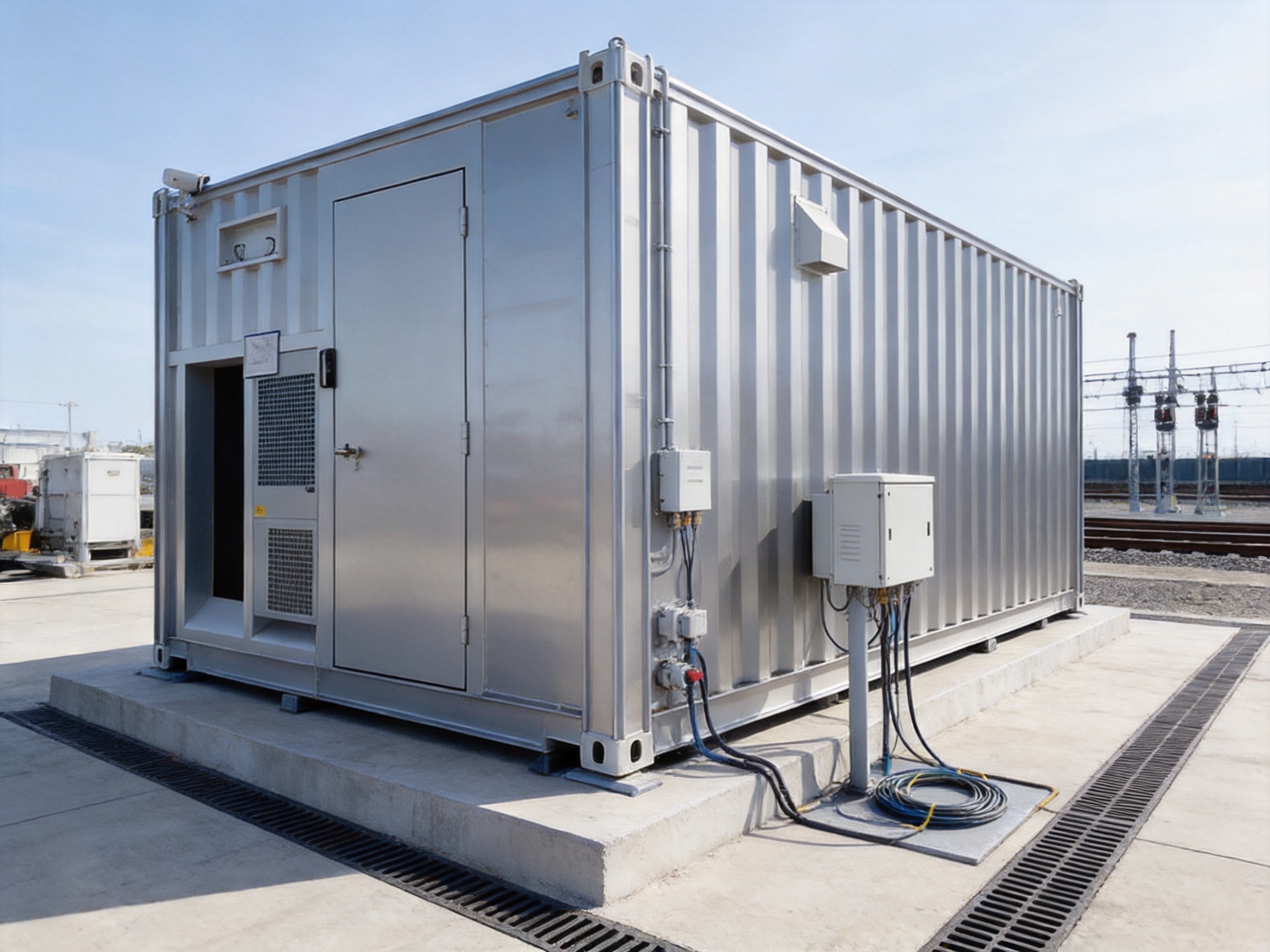
The CDC-20 uses two in-row precision air conditioners. Locating the cooling units near the IT cabinets supports a controlled airflow path and reduces the distance between the cooling source and the equipment intake. The 1+1 arrangement provides a degree of operational continuity during maintenance or a single cooling-unit fault, provided that the remaining unit has sufficient capacity for the active load and environmental conditions.
Thermal Design Process
A reliable thermal design begins with a load assessment. The assessment should identify the expected power draw of servers, storage systems, networking equipment, security devices, lighting, UPS losses, and other internal loads. It should also account for heat transferred through the container envelope and heat generated by power conversion equipment.
Airflow planning should then define the direction of supply and return air, the location of cabinet intakes and exhausts, the effect of blanking panels, and the risk of recirculation. Unused rack spaces should be managed so that hot exhaust air does not return directly to the equipment intakes.
Factory thermal testing can be used to check representative load conditions. Measurements may include supply temperature, return temperature, rack inlet temperature, cabinet outlet temperature, humidity, and cooling-unit operating status. These results establish a baseline for commissioning and future troubleshooting.
Operation in Difficult Climates
For hot climates, the external heat rejection equipment and control strategy must be sized for elevated ambient conditions. For cold climates, low-ambient operation, condensation prevention, battery performance, and startup conditions require attention. In dusty or humid environments, filtration, sealing, corrosion protection, and maintenance intervals become more significant.
The container may require external shelters, sunshades, raised supports, drainage improvements, or protective fencing according to the site. These additions do not change the value of the integrated data center; they help adapt the standard platform to local environmental conditions.
Environmental Monitoring and Remote Supervision
A remote containerized data center should be treated as a monitored technical facility rather than an unattended equipment box. Environmental monitoring can provide early warning of conditions that may affect availability, including rising temperature, excessive humidity, water leaks, smoke, unauthorized door opening, power abnormalities, and cooling-system faults.
Typical monitoring points include temperature and humidity sensors at multiple rack positions, differential pressure measurements near cooling units, water detection near condensate drains and external penetrations, smoke and gas detection, door contacts, UPS status, battery alarms, and electrical measurements at the main input and distribution branches.
The monitoring system should present these data through a unified management interface. Remote access is especially important for edge and industrial deployments where permanent staff may not be located at the site. Alarm forwarding can be connected to a network operations center, facility management platform, or customer-defined service desk.
Monitoring is useful not only for emergency alarms but also for trend analysis. A gradual rise in rack inlet temperature may indicate filter fouling, airflow obstruction, refrigerant loss, or a change in IT load. Increasing battery temperature or declining UPS performance may indicate battery aging. Higher cooling runtime combined with a stable IT load may suggest reduced efficiency or a developing mechanical issue.
Wanma Technology’s experience in communication and infrastructure applications supports an integrated view of monitoring. Communication equipment and optical network components often operate in remote or distributed locations, where alarm visibility and dependable cabinet design are essential. The same principles apply to containerized data centers.
Fire Protection and Physical Security
The CDC-20 supports an automatic gas fire system designed for the enclosed data center environment. Gas-based suppression is commonly considered for rooms containing energized electronic equipment because it can suppress a fire without applying large quantities of water directly to servers and networking equipment.
A complete fire protection design must include detection, alarm logic, agent storage, piping, discharge nozzles, control panels, abort or maintenance functions where required, and appropriate warning signage. The system must be engineered for the internal volume, enclosure integrity, agent type, local regulations, and personnel safety requirements.
Fire protection is most effective when combined with early detection, electrical protection, housekeeping, cable management, and clear operating procedures. Penetrations should be sealed appropriately, doors should close reliably, and unauthorized modifications should not compromise the enclosure’s integrity.
Video surveillance is available as an optional feature. Cameras can support site security, equipment inspection, access verification, and incident review. Door contacts and access control can be combined with surveillance to create a more complete physical security system. The final arrangement should consider privacy, network bandwidth, storage duration, lighting, and local security policies.
Manufacturing Process and Quality Control
The advantages of a factory-integrated data center depend heavily on the quality of the manufacturing process. A containerized system is not simply assembled by placing separate products inside a box. It requires coordinated mechanical, electrical, thermal, control, and documentation work.
Engineering Review
The process begins with a review of the customer’s operating requirements. Important inputs include the IT load, cabinet quantity, power source, required backup time, climate, transportation route, installation surface, network architecture, monitoring requirements, fire regulations, security expectations, and future expansion plans.
Engineering teams use these inputs to confirm the cabinet layout, power ratings, cooling capacity, battery selection, cable routes, access clearances, external interfaces, and control logic. This stage is also where optional features such as video surveillance, additional sensors, customized network cabinets, or alternative battery technologies can be evaluated.
Container Preparation
The container is prepared to accept the integrated systems. Preparation may include internal surface treatment, insulation, thermal protection, corrosion control, floor reinforcement, cable entry arrangements, lighting, drainage provisions, doors, locks, and equipment mounting structures.
Any modification to a shipping container should be assessed carefully because cutting openings, adding equipment, or changing the internal structure can affect strength, sealing, transport handling, and environmental performance. The objective is to preserve a robust enclosure while adapting it to data center requirements.
Cabinet and Equipment Installation
The power distribution cabinet, UPS cabinet, battery cabinet, cooling units, and IT cabinets are installed according to the approved layout. Equipment is aligned, secured, bonded, labeled, and connected. Mounting methods must account for transportation loads as well as normal operation.
Service access is checked during this stage. Technicians need enough room to open cabinet doors, remove filters, inspect batteries, operate isolation devices, and replace modules. A compact layout must be efficient without making routine maintenance impractical.
Electrical and Control Integration
Power cables, grounding conductors, control cables, sensor wiring, communications links, and alarm circuits are installed according to the system drawings. Cable routing is separated by function where necessary, and each termination is identified for future maintenance.
Control integration connects the UPS, cooling units, fire protection system, environmental sensors, door contacts, power meters, and optional security equipment. The control philosophy should define normal operation, warning levels, shutdown conditions, redundancy behavior, and communication-loss responses.
Factory Acceptance Testing
Factory acceptance testing can include visual inspection, dimensional verification, electrical continuity checks, insulation tests where appropriate, protective device checks, grounding verification, UPS operation, battery circuit inspection, cooling operation, alarm simulation, sensor verification, fire-system interface checks, and monitoring communication tests.
Load testing or thermal simulation may be used to evaluate the system under representative conditions. Test results should be recorded in a structured report so the customer has a baseline for site commissioning and future maintenance.
This manufacturing approach provides an important advantage over loosely coordinated site installation. The complete system can be reviewed as an integrated platform before transportation. Problems are generally easier to isolate in a factory environment, where tools, replacement components, engineering personnel, and documentation are immediately available.
Application Scenarios
Edge Computing
Edge computing places processing and storage closer to users, sensors, machines, or communication endpoints. A CDC-20 can serve as a local computing node where latency, bandwidth, or data sovereignty requirements make it impractical to send all information to a distant central facility.
Applications may include video analytics, industrial control support, content delivery, intelligent transportation, private wireless networks, and local data aggregation. The container format allows the computing capacity to be positioned near the operational demand without waiting for a complete new building.
Remote Industrial Facilities
Mining, energy, manufacturing, water treatment, and infrastructure projects may require reliable IT and communications equipment far from major urban centers. A containerized data center can provide a controlled equipment environment at a remote plant, field site, or temporary project area.
The factory-integrated configuration is helpful where local construction skills are limited or where the project schedule cannot accommodate a long building program. The unit can be delivered with its main systems already installed, reducing the amount of specialist work needed at the remote site.
Railway and Urban Transit Infrastructure
Railway and urban rail transit systems rely on communications, signaling support systems, surveillance, passenger information, network management, and operational technology. These systems may be distributed along routes, near stations, or at control points where conventional building space is limited.
Wanma Technology’s background in national high-speed railway and urban rail transit environments provides relevant experience in communication infrastructure, equipment cabinets, and field-oriented deployment requirements. A containerized platform can support distributed control or communications functions while providing a standardized enclosure for sensitive equipment.
Emergency Response
After a natural disaster, industrial incident, or major infrastructure failure, communications and data processing may need to be restored before permanent buildings are available. A pre-staged CDC-20 can be transported to a prepared location and activated after utility and network connections are established.
The unit may support emergency coordination, temporary communications, public safety systems, backup computing, or restoration of essential digital services. The actual response time depends on transportation, site access, lifting equipment, fuel or utility availability, and local approvals, but the pre-integrated design can reduce the technical work required after delivery.
Temporary Project Sites
Large construction projects, exhibitions, field research programs, temporary production facilities, and seasonal operations may need IT capacity for a defined period. A containerized data center provides a more capable solution than scattered server rooms or improvised equipment shelters.
When the project ends, the unit can potentially be disconnected, transported, and redeployed. This flexibility supports organizations whose digital infrastructure requirements move with their projects.
Small-Scale Disaster Recovery
Not every organization requires a large secondary data center. A compact, containerized facility can provide a dedicated recovery environment for essential applications, backup systems, network services, or replicated storage.
The four IT cabinets can be allocated according to recovery priorities. The UPS and dual-feed design can support continuity during short power events, while the monitoring and fire protection systems help maintain the unit when it is operating with limited on-site staffing.
Competitive Advantages of the CDC-20 Platform
The CDC-20 competes with several alternatives, including conventional server rooms, prefabricated modular buildings, equipment shelters, mobile trailers, and individually assembled container solutions. Its main advantage is the combination of a standardized transport envelope and a complete integrated infrastructure package.
| Solution Type | Primary Strength | Common Limitation | CDC-20 Differentiator |
|---|---|---|---|
| Conventional building | Large space and long-term permanence | Long construction period and high site complexity | Faster deployment in a compact, transportable unit |
| Unfinished equipment shelter | Basic enclosure protection | Requires separate power, cooling, monitoring, and fire integration | Major infrastructure systems are factory integrated |
| Modular data center room | Scalable prefabricated construction | Often requires prepared foundations and site assembly | Uses an ISO container for simplified transport and positioning |
| Mobile trailer system | Easy movement in some applications | May provide less equipment density or less standardized handling | Uses a widely recognized 20-foot container format |
| Individually assembled container | Potentially low initial customization cost | Greater integration, testing, and responsibility gaps | Coordinated engineering, assembly, and factory acceptance testing |
The platform’s competitive strength is therefore based on integration, repeatability, redundancy, logistics, and engineering coordination rather than on a single component. Customers should compare complete lifecycle value, including deployment labor, commissioning time, maintenance access, transportability, documentation, and future redeployment.
Customization and OEM/ODM Capability
Although the CDC-20 has a defined standard configuration, data center projects rarely have identical requirements. Wanma Technology provides custom product development and OEM/ODM support for customers that need changes to the cabinet arrangement, power architecture, cooling method, monitoring functions, communications equipment, fire protection, security, or external interfaces.
Customization may include different rack dimensions, alternative battery autonomy, revised UPS capacity, additional network cabinets, modified cable entry points, enhanced environmental sensors, video surveillance, access control, generator interfaces, or climate-specific enclosure treatment. Each change should be evaluated for its effect on weight, heat load, power demand, maintenance access, transport, and compliance.
OEM and ODM work is most effective when the customer provides a clear technical specification at the start of the project. A good specification identifies the IT equipment, expected load profile, environmental conditions, utility characteristics, operational staffing, remote monitoring requirements, and service life expectations.
The company’s product background in communication cabinets and passive optical components can also support projects where the data center must include optical distribution, Ethernet connectivity, structured cabling, or communications equipment. Integrating these functions into the initial design can reduce later modifications and improve the clarity of the final installation.
Installation, Commissioning, and Maintenance
Site preparation normally includes a level support surface, suitable drainage, access for delivery vehicles and lifting equipment, external power connection, communications pathways, grounding, and any required cooling heat rejection infrastructure. The customer should confirm site conditions before shipment because a containerized system still requires a properly prepared installation location.
After placement, technicians connect the incoming power and external communication cables, verify grounding and bonding, inspect the enclosure, check equipment restraints, confirm sensor operation, and start the systems according to the commissioning plan. The IT equipment is then installed or connected according to the agreed rack layout and power budget.
Commissioning should include operation of the normal and backup power paths, UPS transfer behavior, battery alarms, cooling redundancy, environmental alarms, door contacts, fire-system interfaces, monitoring communications, and optional video surveillance. Test results should be recorded together with as-built drawings, equipment manuals, spare parts lists, and maintenance instructions.
Maintenance intervals depend on the local environment and equipment type. Routine activities may include filter inspection, cooling-system checks, battery inspection, UPS diagnostics, sensor verification, alarm testing, cabinet cleaning, cable review, grounding inspection, door seal examination, and fire-system service.
Remote monitoring reduces the need for constant physical visits but does not eliminate preventive maintenance. A remote site should have a documented response plan identifying who receives alarms, who can access the container, what spare parts are available, and how emergency shutdown or recovery will be performed.
Operational Efficiency and Lifecycle Management
Operational efficiency begins with correctly sizing the infrastructure. Oversized cooling equipment may operate inefficiently at low loads, while undersized systems may struggle during peak conditions. The UPS and battery system should be selected according to the critical load and the desired autonomy rather than simply the maximum physical rack capacity.
Energy monitoring can help operators understand the relationship between IT consumption, cooling power, UPS losses, and auxiliary loads. This information supports capacity planning and can identify abnormal changes before they become service interruptions.
Lifecycle management should include planned replacement of batteries, cooling filters, fans, control modules, sensors, and other consumable or aging components. Since the unit is standardized, maintenance teams can develop repeatable service procedures for multiple deployments.
When a CDC-20 is relocated, operators should create a disconnection and transportation plan. The plan should cover data security, equipment shutdown, battery handling, external cable removal, lifting, route restrictions, shock protection, insurance, and recommissioning. A relocation checklist helps preserve the benefits of portability without introducing avoidable risk.
Company Manufacturing Strengths
Wanma Technology Co., Ltd. was established in 1997 and specializes in communication cabinets, communication electronic equipment, and passive optical components. Its products serve Ethernet networks, optical communication networks, central equipment rooms, high-speed railway systems, and urban rail transit applications.
This background is relevant to containerized data center production because a dependable container platform requires more than general metal fabrication. It requires an understanding of equipment cabinets, cable organization, network infrastructure, field installation, environmental protection, and the operational demands of communications systems.
The company develops, manufactures, and markets its own branded products while also providing integrated solutions for customized products. This combination allows it to support standard product delivery as well as project-specific engineering. Customers can work from a defined CDC-20 configuration or request changes based on their power, cooling, monitoring, security, and communications requirements.
A sales network covering more than 20 countries and regions supports international project coordination and customer service. Experience serving markets such as the United States, Australia, the United Kingdom, Italy, South Africa, and Ghana also provides exposure to different logistics conditions, operating environments, and customer expectations.
The company emphasizes reliable product quality, timely delivery, and long-term strategic partnerships. These priorities are particularly important for containerized data centers because the equipment may be deployed far from the factory and may serve critical communications or computing functions. Consistent documentation, clear delivery coordination, and responsive technical support can be as important as the equipment itself.
Selection Checklist for Buyers
Before purchasing a containerized data center, buyers should define the required IT load, cabinet quantity, power source, voltage and frequency, backup time, cooling environment, fire regulations, security requirements, monitoring architecture, site access, transport method, and expected service life.
The customer should also clarify whether the stated power rating refers to the total connected load, the expected operating load, or the maximum design capacity. The difference affects UPS sizing, battery autonomy, cooling performance, upstream electrical protection, and future expansion.
Site surveys should review foundation or support conditions, drainage, ambient temperature, solar exposure, wind, dust, humidity, salt, seismic considerations, access roads, lifting locations, and external cable routes. These factors can influence enclosure modifications and installation costs.
Documentation requirements should be agreed before production. Typical documents include general arrangement drawings, single-line diagrams, wiring diagrams, equipment schedules, cable lists, control descriptions, testing procedures, maintenance manuals, spare parts recommendations, and acceptance certificates.
Customers should also ask how the manufacturer handles factory testing, customization approval, shipment preparation, warranty support, remote troubleshooting, spare parts, software updates, and end-of-life component replacement. A complete procurement decision should consider the full operating lifecycle rather than the initial container price alone.
Questions and Answers
What is the main purpose of the CDC-20?
The CDC-20 provides a compact, transportable, and integrated environment for IT equipment. It combines racks, power distribution, UPS backup, batteries, precision cooling, monitoring, and fire protection within a 20-foot high-cube container.
How many IT cabinets does the standard configuration include?
The standard configuration includes four IT cabinets. Each cabinet is designed for an approximate maximum load of 7.5 kilowatts under the stated total power arrangement, giving a total IT power design of up to 30 kilowatts.
What UPS capacity is available?
The specified UPS capacity is up to 40 kVA, using power modules in a 1+1 redundancy arrangement. The final usable capacity depends on the selected configuration, operating power factor, redundancy policy, and connected load.
How long can the battery support the load?
The standard information specifies approximately 15 minutes of backup time. Actual autonomy depends on the critical load, battery condition, temperature, discharge characteristics, and the selected end-of-discharge limit.
Does the system include redundant cooling?
Yes. The standard layout includes two in-row precision air conditioners with a 1+1 redundancy concept. The actual performance during a single-unit outage depends on the IT load, ambient conditions, and the capacity of the remaining cooling unit.
Can the CDC-20 be used in remote areas?
Yes. Its factory-integrated design is particularly suitable for remote industrial sites, edge computing locations, transportation infrastructure, emergency response, and temporary projects where local construction resources may be limited.
Does the container require a permanent building foundation?
The unit requires a suitable level support surface and appropriate site preparation, but it is not dependent on a conventional data center building. The specific foundation or support method must be confirmed according to soil conditions, local regulations, container weight, drainage, wind, and seismic requirements.
Can the product be customized?
Yes. Customization may include rack dimensions, power capacity, battery autonomy, cooling configuration, monitoring points, optical and Ethernet equipment, fire protection, security systems, cable entries, and environmental adaptations. Engineering review is required for each modification.
Is video surveillance included?
Video surveillance is listed as an optional feature. It can be integrated with access control, door contacts, lighting, and remote monitoring according to the customer’s security requirements.
What type of fire protection is supported?
The CDC-20 supports an automatic gas fire system. The final fire protection design must be selected and installed according to the internal volume, agent type, local regulations, detection requirements, personnel safety provisions, and enclosure integrity.
Why is factory integration important?
Factory integration allows equipment installation, cabling, control programming, inspection, and system testing to be completed in a controlled environment. This can reduce on-site work, improve repeatability, simplify commissioning, and identify integration issues before shipment.
Can the container be relocated?
Yes, portability is one of the principal benefits of the format. Relocation requires a planned shutdown, safe disconnection, suitable lifting and transport procedures, data protection measures, and recommissioning at the new location.
What information should a buyer provide for a quotation?
A buyer should provide the expected IT load, rack quantity and dimensions, input voltage and frequency, backup-time requirement, site climate, installation location, monitoring needs, fire and security requirements, transport conditions, and any required communications or optical networking equipment.
Conclusion
The CDC-20 offers a practical alternative to conventional small data center construction by combining IT space, electrical infrastructure, backup power, cooling, monitoring, and fire protection in a standardized 20-foot high-cube container. Its main benefits include rapid deployment, reduced site complexity, repeatable factory quality, compact space utilization, dual power capability, cooling redundancy, and potential relocation.
The product is especially appropriate for edge computing, remote facilities, railway and transit infrastructure, temporary projects, emergency response, and small-scale disaster recovery. Its success depends on correct load sizing, suitable site preparation, proper utility connection, disciplined commissioning, and an effective maintenance and monitoring program.
Wanma Technology’s experience in communication cabinets, electronic equipment, passive optical components, Ethernet networks, optical communications, high-speed railway systems, and urban rail transit supports the engineering requirements of a field-deployable data center platform. Through standard products and customized OEM/ODM services, the company can adapt the CDC-20 concept to different power, cooling, monitoring, communications, and security requirements.
For organizations that need dependable computing capacity without the schedule and cost of a permanent building, a factory-integrated containerized data center can provide a balanced combination of mobility, resilience, and operational readiness.
References
ISO, Freight Containers: Dimensions and Ratings, International Standards Organization.
Telecommunications Industry Association, Telecommunications Infrastructure Standards for Data Centers.
ASHRAE Technical Committee, Thermal Guidelines for Data Processing Environments.
National Fire Protection Association, Standard for Clean Agent Fire Extinguishing Systems.
International Electrotechnical Commission, Uninterruptible Power Systems and Safety Requirements.
International Organization for Standardization, Environmental Management and Quality Management Principles.
Manufacturer product information for the CDC-20 20-foot containerized data center.
Manufacturer information concerning communication cabinets, optical communication equipment, railway infrastructure, and customized integrated solutions.
Product: 20-inch Containerized Data Center (CDC-20)
PREV:Smart RFID High-Value Consumable Cabinet: A Complete Guide to Secure, Traceable Medical Inventory Management
NEXT:Advanced Fiber Access Distribution for Outdoor FTTH Networks
NEXT:Advanced Fiber Access Distribution for Outdoor FTTH Networks
Interested in cooperation or have questions?
Related products
-
-
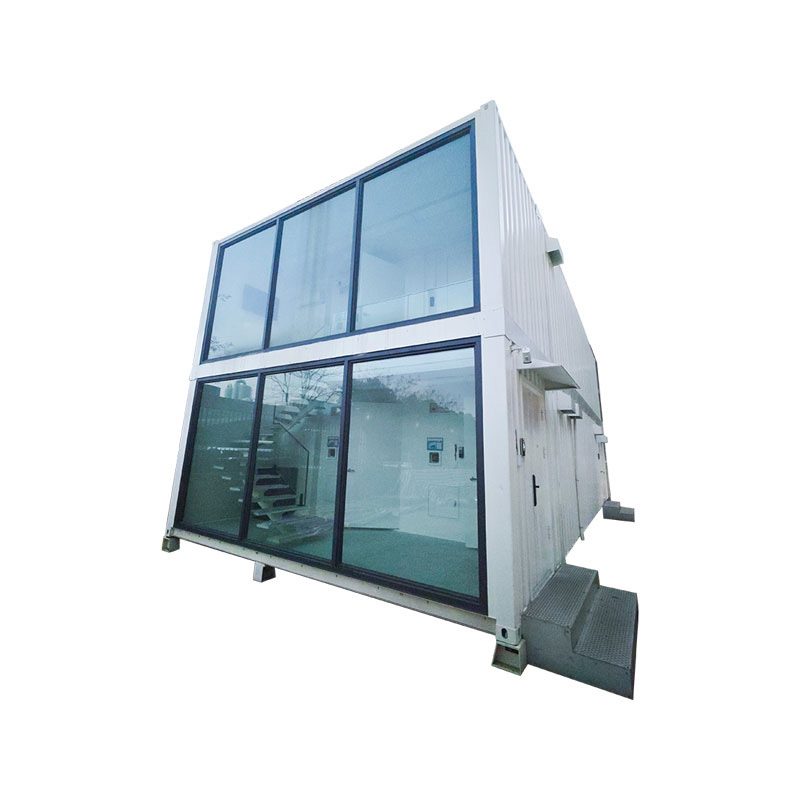
40-inch Containerized Data Center (CDC-40) is a high-capacity, high-density modular data center solution based on a standard 40-inch Containerized Data Center (CDC-40) ISO shipping container. It provi...
See Details -
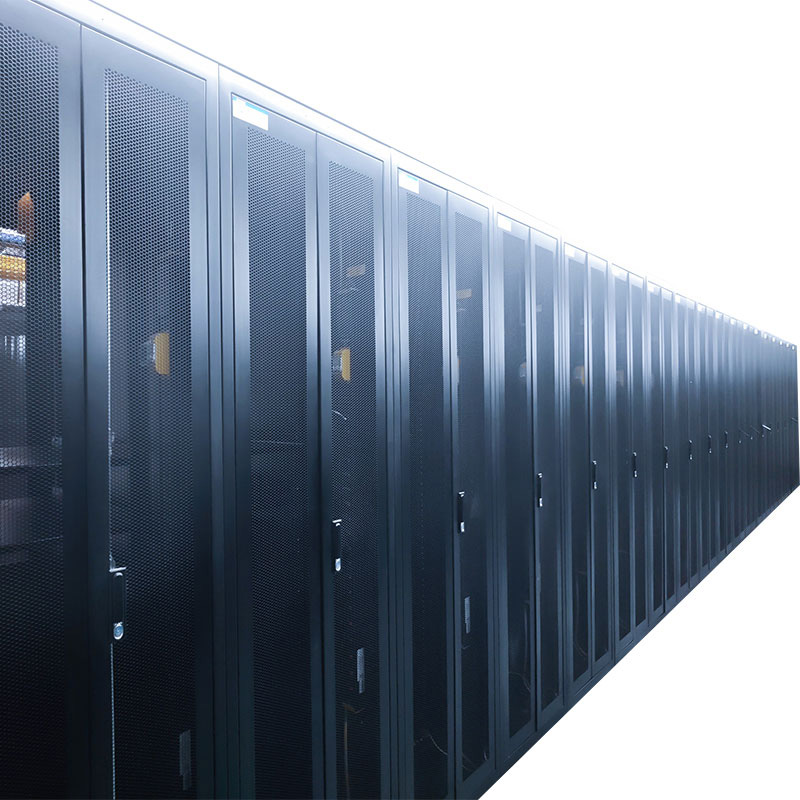
Application:It is used in internet data center equipment room to house server cabinets and provides them with required working environment. Features:•Modularization: Two cabinets combined sharing one ...
See Details -
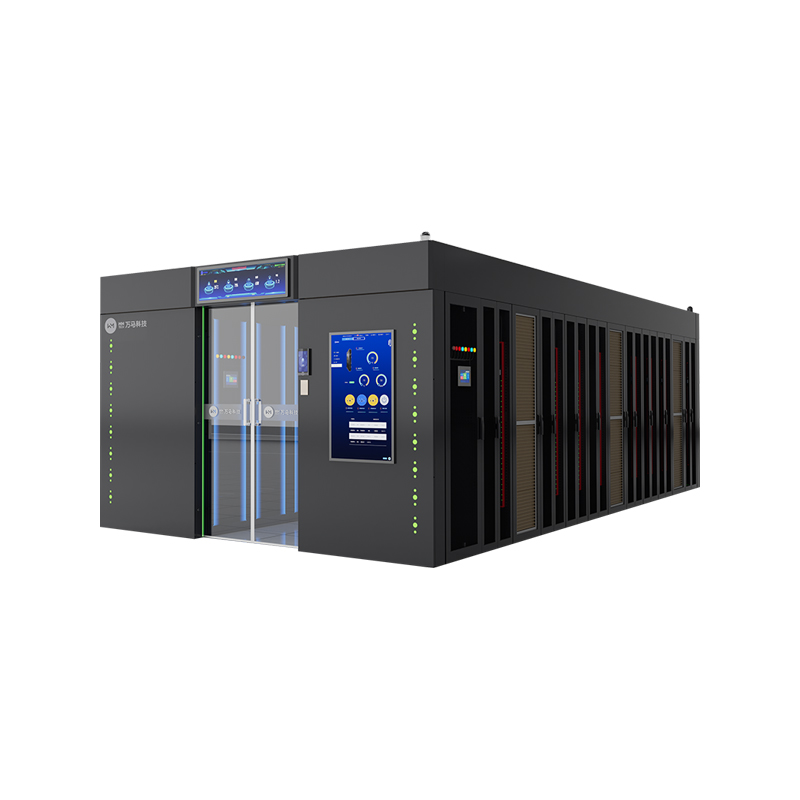
A micro-module data center (MMDC) is a new generation data center architecture that uses standardized modules as units, features prefabricated design, and allows for rapid deployment. It integrates t...
See Details
Ready to Get started ? Contact Us Now !

Product.
Contact Details.
-
 +86 13958188250
-
 +86 13958188250
-
 [email protected]
-
 AUDIT Email:[email protected]
- Wanma Industrial Park Taihu Yuan Town Lin'an District Hangzhou City China.
QR Code

Copyright © Wanma Technology Co., Ltd. All Rights Reserved.
Privacy
Custom Ethernet Optical Network Railway Transit Equipments Suppliers
